Liber XIII · High Magick · Chapter I: Angelic Magic & Invocation
Trithemius and the Steganographia: Angels, Spirits and Ciphers
Johannes Trithemius and the Steganographia: the abbot's angelic magic, the scandal of 1499, the ciphers hidden in its conjurations and its long influence.

Johannes Trithemius (1462–1516) was a German Benedictine abbot, scholar and reputed magician whose Steganographia, written around 1499–1500, appears to teach how to send secret messages over any distance by means of angels and spirits. For centuries it was condemned as a book of demonic magic; it is now known that much of it, and probably all of it, is an ingenious system of cryptography disguised as angelic conjuration, though scholars still debate whether Trithemius also believed in genuine angelic communication.
Johannes Trithemius: Abbot, Humanist and Magus§
Johannes Heidenberg was born in 1462 at Trittenheim on the Moselle, from which he took the name Trithemius. After study, partly at Heidelberg, he entered the Benedictine abbey of Sponheim near Kreuznach in 1482 and was elected its abbot the following year, at the age of about twenty-one. He turned a poor house into a famous centre of learning, building a library of some two thousand volumes, then one of the largest in Germany, and supported the monastic reform movement of Bursfelde.
Trithemius wrote prolifically: a catalogue of ecclesiastical writers (1494), histories, sermons and a treatise in praise of scribes. He also cultivated a reputation for occult learning. Humanists and princes, including the Emperor Maximilian I, consulted him; his Book of Eight Questions answers the emperor's questions on matters including witches and the powers of magic (Liber octo quaestionum), and his Antipalus maleficiorum (1508) catalogues magic books he considered evil while defending a pious, natural magic (Antipalus Maleficiorum). Later legend claimed that he raised the ghost of Maximilian's dead wife, Mary of Burgundy.
Conflict with his monks led him to leave Sponheim in 1505–1506, and he spent his last decade as abbot of the Schottenkloster of St James in Würzburg, where he died in December 1516.
The Steganographia and the Scandal of 1499§
In 1499 Trithemius wrote to the Carmelite Arnold Bostius of Ghent describing a work in progress that would enable a person to communicate his thoughts to another far away, without words, signs or messenger, and to teach an illiterate person Latin in a short time. Bostius died before the letter arrived, and it was read by others. The French philosopher Charles de Bovelles, who visited Sponheim in 1503 and saw part of the manuscript, denounced it in a letter published some years later as full of barbarous names of demons.

The reputation stuck. The Steganographia circulated in manuscript through the sixteenth century, eagerly copied and widely feared, and was printed only in 1606 at Frankfurt. In 1609 it was placed on the Catholic Index of forbidden books. Writers such as Jean Bodin cited it as evidence of Trithemius' commerce with demons, while defenders argued that it was a work of concealed writing. The catalogue entry for the Steganographia gives details of its manuscripts and editions.
Spirit Conjurations as Cipher Keys: Books One and Two§
The first two books are organised around spirits with names such as Pamersiel, Padiel and Camuel, ruling the points of the compass, each with dukes and subordinates. For each, Trithemius gives a "conjuration": a string of exotic, angelic-sounding words to be spoken over the letter, after which the spirit will carry its secret meaning to the recipient.
Already in the sixteenth century some readers suspected that the conjurations themselves were the message. In 1676 Wolfgang Ernst Heidel published a demonstration that the incantations in books one and two are cryptograms: by reading only certain letters of certain words according to rules indicated by the spirit's name and instructions, one recovers plaintext Latin or German. The "spirits" stand for cipher methods and the "conjurations" are worked examples. Trithemius had in effect written a cryptographic textbook in the language of angelic magic, which explains both its fascination and its alarm.
Book Three and the Planetary Angels Decoded§
The unfinished third book seemed different. It presents seven planetary angels with tables of numbers and instructions for working with images and astrological timing, and it was long regarded as genuinely magical. In the 1990s two scholars, Thomas Ernst in Germany and Jim Reeds in the United States, independently showed that the number tables are also ciphers, concealing short messages that can be recovered by systematic substitution. Their work, published in 1996 and 1998, was reported widely as the solution of a five-hundred-year-old mystery.
The decipherment did not settle every question. Noel Brann and D. P. Walker argued that Trithemius saw no contradiction between cryptography and what Brann calls "magical theology": he believed that angels mediate thought and that a purified mind could communicate through them, and his cryptographic devices may have been both a concealment and a demonstration of such a power. Walker read the work as an attempt at telepathic communication through planetary spirits. Others see the angelic framing as an elaborate humanist game. The evidence allows more than one reading, and Trithemius' own statements are ambiguous.
De septem secundeis: Angels Who Govern the Ages§
Trithemius' most influential work of angelology is the short De septem secundeis ("On the Seven Secondary Causes"), written in 1508 for Maximilian and printed in 1522. It teaches that under God the world is governed by seven planetary angels, or secondary intelligences, who rule in succession for periods of 354 years and four months each: Orifiel of Saturn, Anael of Venus, Zachariel of Jupiter, Raphael of Mercury, Samael of Mars, Gabriel of the Moon and Michael of the Sun. By counting from the Creation, Trithemius placed the events of sacred and secular history under their reigns and looked ahead to the ages still to come.
This scheme of angelic world ages was taken up by later occultists, including Éliphas Lévi, and remained a model for prophetic chronologies based on planetary angels. It also fed directly into the lists of planetary angels in Agrippa and the Heptameron.
Influence: Agrippa, Dee, the Lemegeton and Cryptography§
Trithemius' personal influence on Renaissance magic was considerable. Heinrich Cornelius Agrippa visited him at Würzburg in 1509 or 1510 and sent him the first draft of De occulta philosophia; Trithemius replied with warm encouragement and the advice to share common secrets with common friends but higher ones only with higher and secret friends. Paracelsus later claimed him as a teacher, though the extent of any contact is uncertain.
John Dee obtained a manuscript of the Steganographia in Antwerp in 1563 and wrote enthusiastically to William Cecil about it; it formed part of the background to his later angel conversations. The spirits of books one and two passed, stripped of their cryptographic meaning, into the Theurgia-Goetia, the second book of the Lemegeton (Theurgia-Goetia), where they became objects of real conjuration.
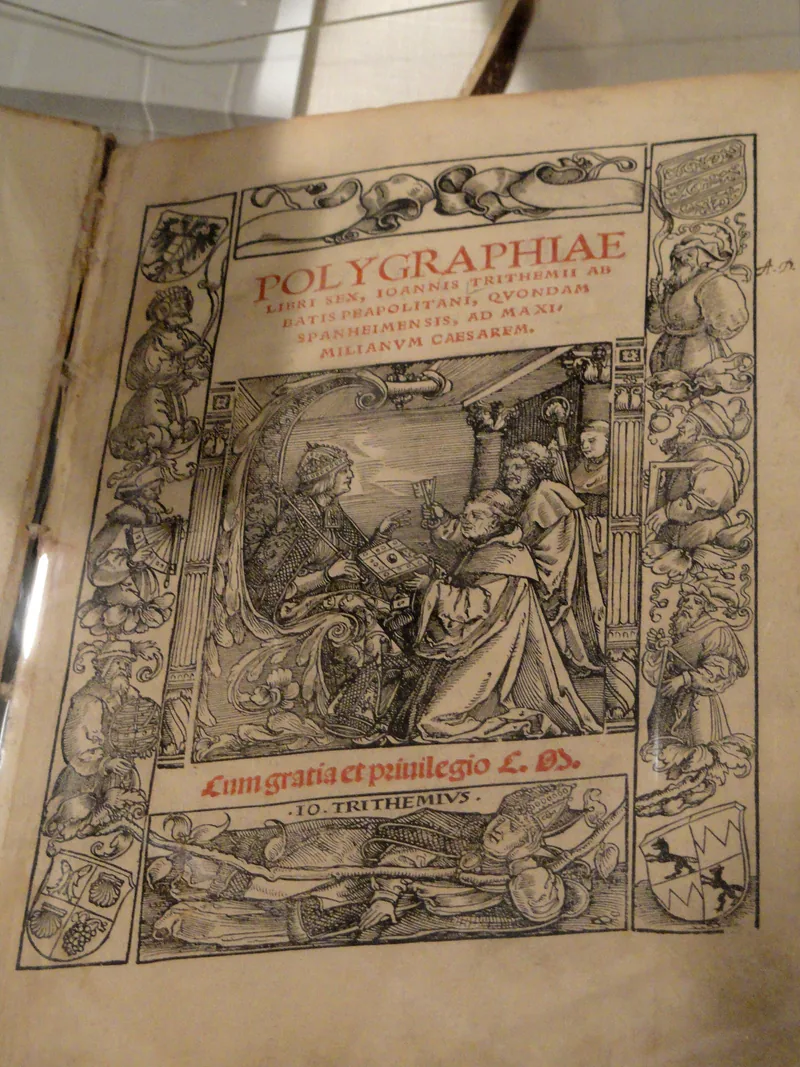
In the history of cryptography Trithemius is equally important. His Polygraphia, completed in 1508 and printed in 1518, is the first printed book on the subject and introduced the square table of shifted alphabets, the tabula recta, which underlies later polyalphabetic ciphers. Historians of codes such as David Kahn regard him as a founder of the field. For angel magic more broadly, see angel magic: a complete guide.
Frequently asked questions§
What is the Steganographia?§
It is a treatise by Johannes Trithemius, written about 1499–1500 and printed in 1606, that appears to teach how to send messages through angels and spirits. In fact its conjurations and tables conceal cipher systems, making it one of the earliest works of cryptography as well as a famous book of supposed magic.
Was Trithemius a magician?§
He was a Benedictine abbot and scholar who wrote on angels, spirits and magic, defended what he considered a pious magic and was reputed in legend to work wonders. Whether he practised angelic invocation himself, beyond his cryptographic work, is debated among historians.
Who decoded the Steganographia?§
Wolfgang Ernst Heidel explained the ciphers of books one and two in 1676. The number tables of book three were decoded independently by Thomas Ernst and Jim Reeds in the 1990s.
What is the difference between steganography and cryptography?§
Cryptography scrambles a message so that it cannot be read; steganography hides the existence of a message inside something innocent. The modern word steganography derives from the title of Trithemius' book.
Sources and further reading§
- Trithemius and Magical Theology: A Chapter in the Controversy over Occult Studies in Early Modern Europe — Noel L. Brann, 1999
- The Abbot Trithemius (1462–1516): The Renaissance of Monastic Humanism — Noel L. Brann, 1981
- The Steganographia of Johannes Trithemius, Book I — Adam McLean (ed.), 1982
- Spiritual and Demonic Magic from Ficino to Campanella — D. P. Walker, 1958
- The Codebreakers — David Kahn, 1967
- Antipalus Maleficiorum — Johannes Trithemius, 2024
- Three Books of Occult Philosophy — Henry Cornelius Agrippa, 1533