Liber XIII · High Magick · Chapter II: Angels & Spirits
Angelic Amulets in Jewish and Christian Folk Practice
Angelic amulets in Jewish and Christian folk practice: childbirth amulets, the four angels of the bedtime prayer, Coptic and Ethiopian scrolls, angelic seals.

Angelic amulets are protective objects, usually written on parchment, paper or metal, that call on named angels to guard the wearer or a household from illness, demons, the evil eye and the dangers of childbirth. They form one of the oldest and most widespread uses of angels in Jewish and Christian folk religion, from late antique metal lamellae and medieval textual amulets to the childbirth charms of eastern European Jews and the healing scrolls of Ethiopia.
Calling on Angels Outside the Liturgy§
In both Judaism and Christianity, angels are understood as servants of God who protect the faithful. Psalm 91 promises that God will give his angels charge over the righteous (Psalm 91), and that psalm became one of the most frequently written texts on amulets in both traditions. Popular religion went further than the official liturgy by naming individual angels, assigning them tasks and writing their names on objects worn or hung in the house.
Religious authorities drew lines around this practice. The Council of Laodicea, in the fourth century, forbade Christians to "name" angels in private assemblies, and a Roman synod under Pope Zachary in 745 condemned the itinerant preacher Aldebert for praying to eight angels, among them Uriel, Raguel and Tubuel, declaring that only Michael, Gabriel and Raphael were known to the Church. Rabbinic writers likewise warned against praying to angels rather than to God, while accepting amulets made by recognised experts. The history of these tensions is set out in angel magic: a complete guide.
Jewish Angel Amulets: From Late Antiquity to the Kimpetbriv§
The earliest Jewish amulets with angel names are thin sheets of silver, bronze or gold inscribed in Aramaic or Hebrew and rolled into cases, found in Palestine, Syria and beyond from late antiquity. Studied by Joseph Naveh, Shaul Shaked and Gideon Bohak, they call on angels and divine names to heal fever, protect a woman in pregnancy or drive away a named demon. Related texts appear on the Aramaic incantation bowls of Mesopotamia and in Cairo Genizah fragments.
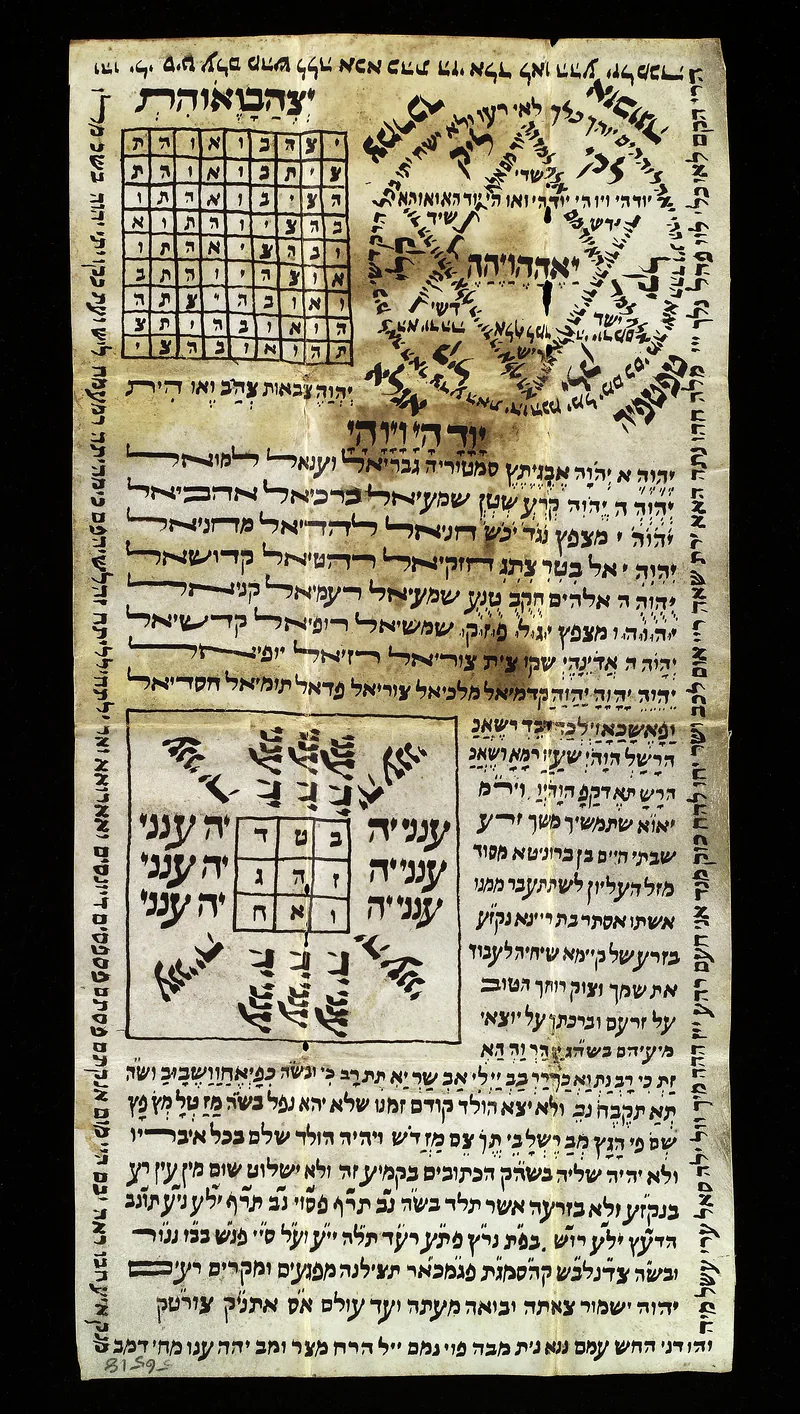
The most famous angelic names in Jewish folk practice are Sanoi, Sansanoi and Semangelof. In the Alphabet of Ben Sira, a medieval satirical work, these three angels are sent to bring back Lilith, Adam's first wife, who agrees to spare any newborn protected by their names or images. From the Middle Ages to the twentieth century, Jewish families hung amulets bearing the three names, often with Psalm 121, the formula "Adam and Eve, out Lilith" and drawings of the angels, around the bed of a woman in childbirth. In Yiddish such sheets were called kimpetbriv. The site's spellbook describes the Sanoi, Sansanoi and Semangelof childbirth amulet historically.
Later amulets, studied by Theodore Schrire and Joshua Trachtenberg, combine angel names with divine names, verses and permutations from practical Kabbalah. The printed Sefer Raziel ha-Malakh (Amsterdam, 1701), a compilation of angelology and magical lore, was itself kept in homes as a protection against fire and harm. Wider context is given in Jewish magic and folklore.
Michael at My Right: Angels in Bedtime and Protective Prayer§
A tradition preserved in midrash places four angels around the throne of God: Michael on the right, Gabriel on the left, Uriel in front and Raphael behind. This arrangement entered the Jewish prayer recited before sleep, in which the worshipper asks, in the name of the God of Israel, for Michael at the right, Gabriel at the left, Uriel before, Raphael behind and the divine Presence above the head. It remains part of many prayer books and is said by children and adults alike. The Golden Dawn's Lesser Banishing Ritual of the Pentagram adapted the same formula.
Christian tradition developed parallel night prayers. An English charm, recorded in the seventeenth century by the sceptical writer Thomas Ady among the prayers of ordinary people, begins with the four evangelists blessing the bed and speaks of angels at its corners and head; versions survived as nursery prayers into the twentieth century. The Latin prayer Angele Dei, "Angel of God, my guardian dear", is of medieval origin and is still taught to Catholic children.
The archangel Michael, as leader of the heavenly host and weigher of souls, was the protector par excellence. Churches and shrines on high places, such as Monte Gargano in Italy and Mont-Saint-Michel in Normandy, drew pilgrims, and medals, badges and printed images of Michael defeating the dragon served as protective objects. In 1886 Pope Leo XIII introduced a prayer to St Michael to be said after Low Mass, asking the archangel to defend the faithful in battle against Satan; see angels, demons and Christian exorcism.
Christian Angel Amulets in Byzantium, Egypt and Ethiopia§
In late antique and Byzantine Christianity, amulets frequently invoke angels. Coptic texts of ritual power, collected by Marvin Meyer and Richard Smith, call on Michael, Gabriel, Raphael, Suriel and other archangels, sometimes as a group of seven, for healing, protection and success. Byzantine amulets show a holy rider, identified as Solomon, St Sisinnios or the archangel Michael, spearing a female demon who threatens mothers and infants; in the related legend the demon, often called Gylou, reveals her secret names so that they can be written down for protection. The parallel with Sanoi, Sansanoi and Semangelof is close. Glenn Peers has shown how Byzantine art and devotion represented angels as both bodiless and visibly present.
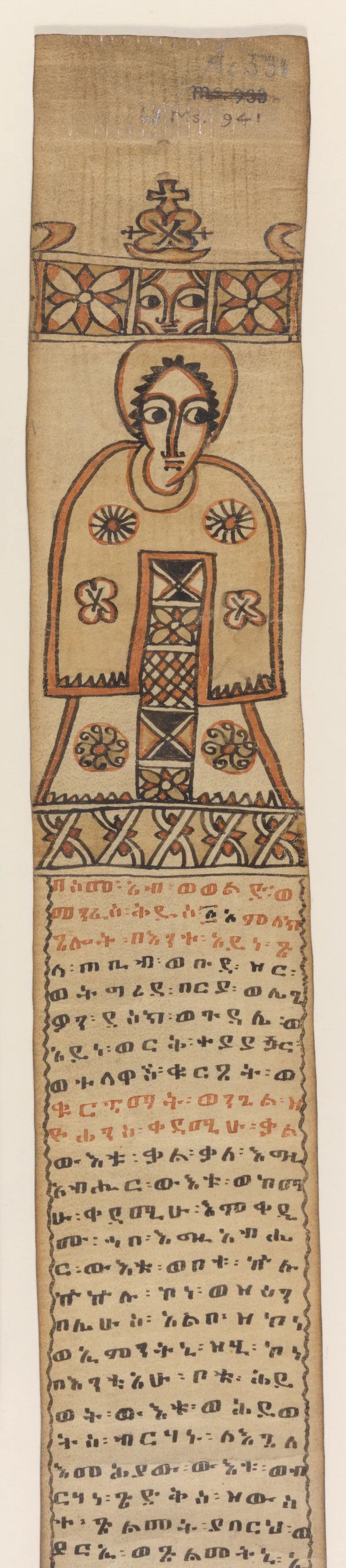
In Ethiopia, Orthodox Christian clerics known as dabtara have produced healing scrolls on strips of parchment, sometimes cut to the height of the client, combining prayers, the names of God, legends of the saints and painted images of archangels such as Michael and Phanuel with drawn swords, together with eyes and stylised faces. Jacques Mercier's studies describe these scrolls as part of a living therapeutic practice that the church hierarchy has regarded with ambivalence. Many surviving scrolls are now in museum collections.
Medieval and Early Modern Europe: Names, Charms and Their Critics§
Medieval Western Christians carried textual amulets with prayers, the names of God and lists of angelic and holy names, often folded small or sewn into cloth. Don Skemer's study of such amulets shows that birth girdles, prayer rolls and protective letters were common and frequently produced by clergy. Charms naming the archangels were used against fever, storms and theft.
Reformers attacked these practices. Protestant writers condemned amulets and angel invocations as superstition, and post-Tridentine Catholic authorities also discouraged unofficial angel names. Yet the cult of the guardian angel grew in the seventeenth century, as Peter Marshall and Alexandra Walsham have shown, and a feast in its honour was extended to the whole Catholic Church in 1670. A modern Vatican directory on popular piety (2001) still discourages the use of angel names other than Michael, Gabriel and Raphael. For the wider setting, see folk Christianity.
Angelic Seals, Letters and Scripts on Amulets§
Angelic amulets often carry special scripts. Medieval Jewish amulets use "eye-writing" or "ring letters", characters whose strokes end in small circles, said to be the script of angels. Agrippa's Three Books of Occult Philosophy printed several such alphabets, the Celestial, Malachim ("of angels") and "Passing of the River", which he attributed to the Kabbalists and which passed into later ceremonial magic.
Seals and geometric figures also appear: the hexagram and pentagram associated with the seal of Solomon, magic squares, and the elaborate seals of angels found in the grimoires. In learned magic these seals were fashioned at astrologically chosen times, as described in planetary angels in Agrippa and the Heptameron; in folk practice the same signs were often copied from books with little regard to timing. Historians read such amulets as evidence of everyday religion, of fears around birth, illness and the night, and not as proof of any power. For the long history of protective objects, see amulets and talismans.
Frequently asked questions§
Which angels appear most often on amulets?§
Michael, Gabriel, Raphael and Uriel are the most common in both Jewish and Christian amulets. Jewish childbirth amulets add Sanoi, Sansanoi and Semangelof, and Coptic and Ethiopian amulets invoke Suriel, Phanuel and other archangels.
What are Sanoi, Sansanoi and Semangelof?§
They are three angels named in the medieval Alphabet of Ben Sira, sent to capture Lilith. Their names were written on amulets placed around mothers and newborns to protect them, a practice that lasted into the twentieth century.
Did the Church allow angel amulets?§
Church authorities accepted devotion to angels, especially Michael, Gabriel, Raphael and the guardian angel, but repeatedly condemned the naming of other angels and the use of amulets as superstition. Practice on the ground was often more permissive than official teaching.
What is the Jewish bedtime prayer with four angels?§
Part of the prayer said before sleep asks for Michael at the right, Gabriel at the left, Uriel in front, Raphael behind and the divine Presence above. It derives from a midrashic tradition of four angels surrounding God's throne.
Sources and further reading§
- Jewish Magic and Superstition — Joshua Trachtenberg, 1939
- Hebrew Amulets: Their Decipherment and Interpretation — T. Schrire, 1966
- Amulets and Magic Bowls: Aramaic Incantations of Late Antiquity — Joseph Naveh & Shaul Shaked, 1985
- Ancient Jewish Magic: A History — Gideon Bohak, 2008
- Ancient Christian Magic: Coptic Texts of Ritual Power — Marvin Meyer & Richard Smith, 1994
- Ethiopian Magic Scrolls — Jacques Mercier, 1979
- Subtle Bodies: Representing Angels in Byzantium — Glenn Peers, 2001
- Binding Words: Textual Amulets in the Middle Ages — Don C. Skemer, 2006
- Angels in the Early Modern World — Peter Marshall & Alexandra Walsham (eds.), 2006