Liber V · Chaos Magick · Chapter IV: Sigils
Magic Squares and Planetary Seals: The Kameas of Agrippa
Magic squares (kameas) and planetary seals: their Chinese and Islamic origins, Agrippa's seven planetary tables of 1533, and how sigils were traced on them.

A magic square is a grid of numbers in which every row, column and main diagonal adds up to the same total, and in Western magic seven such squares, called kameas or planetary tables, were assigned to the seven traditional planets. Cornelius Agrippa's Three Books of Occult Philosophy (1533) printed the definitive set, together with a seal for each planet and characters for its "intelligence" and "spirit" traced across the numbers of the square, and these designs became one of the main sources of sigils in later magic.
What a Magic Square Is§
A magic square of order n contains the numbers 1 to n² arranged so that each line sums to the same "magic constant". The smallest non-trivial example is the 3×3 square, whose rows, columns and diagonals all total 15, using the numbers 1 to 9. Larger squares can be built by several methods, and mathematicians from medieval Baghdad to early modern France devised rules for constructing them.
For magicians the attraction lay in harmony and completeness. A square that "balances" in every direction seemed a natural image of cosmic order, and its numbers could be linked to letters through Hebrew, Greek or Arabic letter-numbering, the practice discussed in Gematria. A square could therefore be read as a hidden table of names, and the wider symbolism of numbers in esoteric thought is surveyed in Number Symbolism.
Chinese and Islamic Origins§
The earliest known magic square is the Chinese Luoshu, the "Writing of the Luo River", a 3×3 arrangement linked in legend with a turtle that emerged from the river in the time of the sage-king Yu. The legend is ancient, but the identification of the Luoshu with a numerical square is attested only from roughly the early centuries CE, and the square became important in cosmology, divination and later feng shui.
Magic squares were developed much further in the Islamic world, where they were called wafq (plural awfāq), meaning "harmonious arrangement". Tenth-century Arabic texts, including the encyclopaedia of the Ikhwān al-Ṣafāʾ, contain squares of several orders, and mathematicians studied their construction for its own sake. At the same time squares were inscribed on amulets, bowls and talismanic shirts, often combined with divine names. The corpus attributed to Aḥmad al-Būnī (d. 1225), the Shams al-maʿārif, became the most famous source for talismanic squares, though much of it was compiled or expanded after his death. This background is covered in Islamic Occult Sciences.
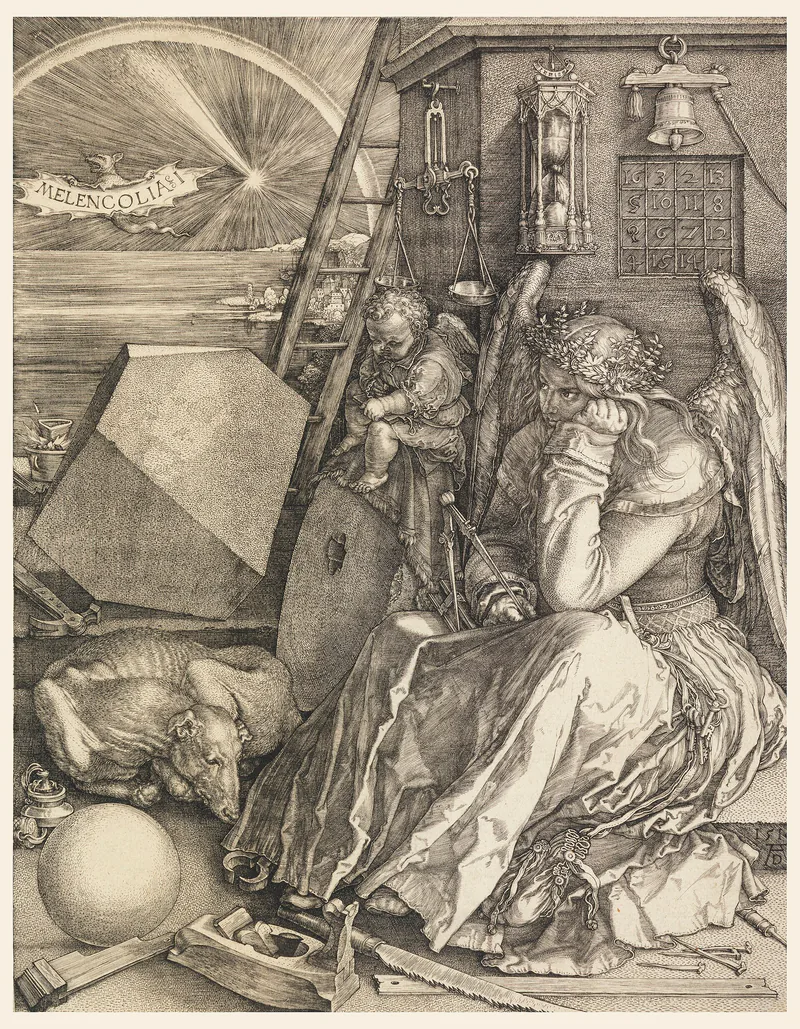
Arabic astral magic of the kind found in the Picatrix associated squares with planets, and Latin translations carried the idea into Europe. A Latin treatise on the seven planetary squares circulated in the later Middle Ages, and the squares appear in the work of Paracelsus. The most famous Renaissance example is the 4×4 square in Albrecht Dürer's engraving Melencolia I (1514), whose bottom row shows the year 1514; art historians often read it as a Jupiter square, set against the Saturnine melancholy of the figure.
Agrippa's Seven Planetary Tables§
In Book II, chapter 22, of the Three Books of Occult Philosophy, described in Agrippa's Three Books, Agrippa set out the "tables of the planets" in the order of their traditional spheres, with each planet receiving a square whose order matched its sacred number. The scheme, which became standard, is:
| Planet | Order | Line total | Sum of all numbers |
|---|---|---|---|
| Saturn | 3 × 3 | 15 | 45 |
| Jupiter | 4 × 4 | 34 | 136 |
| Mars | 5 × 5 | 65 | 325 |
| Sun | 6 × 6 | 111 | 666 |
| Venus | 7 × 7 | 175 | 1225 |
| Mercury | 8 × 8 | 260 | 2080 |
| Moon | 9 × 9 | 369 | 3321 |
Agrippa gave each square in Arabic numerals and in Hebrew letters, and explained its supposed virtues. Engraved on the planet's metal (lead for Saturn, tin for Jupiter, iron for Mars, gold for the Sun, copper for Venus, silver for the Moon) at a favourable astrological moment, a table was said to draw down the planet's influence; inscribed when the planet was afflicted, it could do harm. These recipes belong to the tradition of astral magic and planetary correspondences described in The Zodiac and the Planets. The Spellbook describes historical examples in its entries on a Jupiter talisman after Agrippa, a Sun talisman with the square of 111 and a Venus talisman.
Seals, Intelligences and Spirits§
Alongside each square Agrippa printed three kinds of sign. The seal (sigillum) of the planet is a geometric figure associated with the structure of its square; later commentators explained that it was designed to touch or connect the square's cells. Then come the character of the intelligence, a benevolent governing power, and the character of the spirit, a lower power through which the planet acts in the material world.
The names of these beings were chosen so that their Hebrew letters, read as numbers, added up to the square's key totals. For Saturn, both the intelligence Agiel and the spirit Zazel sum to 45; for Jupiter, Iophiel and Hismael give 136; for Mars, Graphiel and Barzabel give 325; for the Sun, the intelligence Nachiel gives 111, and the spirit Sorath gives 666. The squares of Venus, Mercury and Moon have further names, including composite "intelligences of intelligences" for the Moon. The planetary seals in the site's collection, from the seal of Saturn to the seal of the Moon, reproduce these designs.
How the characters were traced§
The characters were produced by converting each letter of a name into its number, reducing larger numbers where necessary so that they fall within the square, and then drawing a line from cell to cell in the order of the letters. Many characters in Agrippa's printed editions do not match the method exactly, and modern editors, notably Donald Tyson in his annotated edition of 1993, have discussed copying errors and alternative reductions. The result was a sign that encoded the being's name in the geometry of its planet.
From Agrippa to the Golden Dawn§
Agrippa's tables entered almost every later work of learned magic. Francis Barrett reproduced them in The Magus (1801), and they reappear in the Fourth Book of Occult Philosophy attributed to Agrippa, in nineteenth-century compilations and in the teaching of the Hermetic Order of the Golden Dawn. The Golden Dawn and later writers formalised the tracing technique: a sigil begins with a small circle on the first letter's cell and ends with a short bar, and the same method can be applied to any Hebrew name, not only those of the planetary beings. Aleister Crowley's 777 (1909) tabulated the planetary names and numbers among its correspondences.
The same period developed an alternative way of making sigils from Hebrew letters, using a rose of twenty-two petals instead of a square; it is described in Rose-Cross Sigils of the Golden Dawn.
Kameas in Modern Practice§
In twentieth-century magic the kameas became a common tool for talismans and sigils. Ceremonial magicians trace angelic and planetary names on them; some chaos magicians, who otherwise favour Austin Spare's word method, trace their own statements of intent across a planetary square chosen to suit the aim, mixing old correspondences with modern psychology. Reference works such as Stephen Skinner's Complete Magician's Tables (2006) compile the squares, names and totals.
Historians stress the distinction between the mathematics and the magic. The arithmetic of magic squares is genuine and has a long scholarly history, traced in detail by Jacques Sesiano; the planetary attributions, the names of the intelligences and spirits and the claimed virtues belong to a specific tradition of Renaissance astral magic built on Arabic and Hebrew foundations. Treating the squares as historical artefacts makes it possible to appreciate both.
Frequently asked questions§
What is a kamea?§
"Kamea" is a Hebrew-derived term used by modern occultists for a magic square, especially one of the seven planetary squares in Agrippa's Three Books of Occult Philosophy. Each square is assigned to a planet according to its order, from 3×3 for Saturn to 9×9 for the Moon.
Why does the Sun's square add up to 666?§
The 6×6 square of the Sun contains the numbers 1 to 36, which total 666. In Agrippa's scheme the spirit of the Sun, Sorath, was given a Hebrew spelling with the same value. The number's association with Revelation made the square notorious, but in Agrippa it is simply the solar total.
How are sigils made from magic squares?§
Each letter of a name is turned into a number, reduced where necessary to fit the square, and a line is drawn from cell to cell in the order of the letters. Agrippa's characters of planetary intelligences and spirits were made this way, and the Golden Dawn standardised the method.
Where do magic squares come from?§
The 3×3 Luoshu is known from Chinese tradition, and medieval Islamic scholars studied and used magic squares extensively. Europe received them through Arabic sources, and Agrippa's 1533 tables made the planetary set standard in Western magic.
Sources and further reading§
- Three Books of Occult Philosophy — Henry Cornelius Agrippa, 1533
- The Magus, or Celestial Intelligencer — Francis Barrett, 1801
- 777 and Other Qabalistic Writings — Aleister Crowley, 1909
- The Language of Demons and Angels: Cornelius Agrippa's Occult Philosophy — Christopher I. Lehrich, 2003
- Picatrix: A Medieval Treatise on Astral Magic — Dan Attrell & David Porreca (trans.), 2019
- Magic Squares: Their History and Construction from Ancient Times to AD 1600 — Jacques Sesiano, 2019
- Magic Squares and Cubes — W. S. Andrews, 1908
- The Complete Magician's Tables — Stephen Skinner, 2006