Liber V · Chaos Magick · Chapter IV: Sigils
Goetic Seals and Grimoire Sigils: A History of Spirit Signs
A history of the Goetic seals and other grimoire sigils: medieval spirit books, the 72 seals of the Lemegeton, the Grimorium Verum and their modern afterlife.
Goetic seals are the signs assigned to the seventy-two spirits of the Ars Goetia, the first book of the seventeenth-century Lesser Key of Solomon, and they are the best-known members of a larger family of grimoire sigils: characters that medieval and early modern magic books gave to demons, angels and planetary spirits. In the grimoires a seal identified a particular spirit and served as a token of the magician's authority over it; today the same designs circulate as art, tattoos and emblems of occult identity, often far removed from their original context.
What Spirit Seals Meant in the Grimoires§
In learned magic of the Middle Ages and the early modern period, a spirit was a real being with a name, a rank and a nature, and the seal was its mark. The idea drew on the everyday authority of seals in a world of charters and letters: a seal was the sign by which a lord's will was recognised. In the grimoires the relationship was double. A spirit's character identified that particular spirit among thousands, and the magician's possession of it, together with the divine names under which the work was done, was understood as a claim of power over it.
These books were written within a Christian framework. Their authors presented the control of demons as possible only through God's names and the example of Solomon, the subject of Solomon's Ring and Seal. The Church saw the matter very differently: theologians condemned any dealings with demons as idolatry, and owning such books could lead to prosecution. The history of this tension is told in Necromancy in the Middle Ages and Demonology.
Medieval Antecedents: Characters, Circles and Spirit Books§
The practice of drawing abstract signs for spirits is older than any surviving grimoire. Late antique magical papyri and gems used charaktēres, and medieval Latin magic inherited both these signs and the Arabic tradition of astral talismans. By the thirteenth and fourteenth centuries, works such as the Sworn Book of Honorius combined angelic names with elaborate seals, including a form of the Seal of God later known as the Sigillum Dei.

Necromancers' handbooks of the fifteenth century, such as the Munich manual edited by Richard Kieckhefer in Forbidden Rites, contain circles, characters and names for summoning spirits, often in the hands of clerics with a university education. Catalogues of spirits, giving each spirit's rank, appearance and powers, circulated under titles such as the Book of the Offices of Spirits; a fifteenth-century French example, the Livre des esperitz, preserves an early list of names close to those of the Goetia. Elizabethan English collections such as the Book of Oberon add characters for spirits alongside prayers, conjurations and charms.
The Seals of the Ars Goetia§
In 1577 the physician Johann Weyer appended to his book on witchcraft, De praestigiis daemonum, a catalogue of sixty-nine spirits called the Pseudomonarchia Daemonum, which he said he had copied from a magician's book in order to expose its folly. It gave names, ranks, appearances and offices, but no seals. Weyer's list, available in the site's catalogue as Pseudomonarchia Daemonum, is the main identifiable source of the spirits in the Goetia.
The Ars Goetia, compiled in England in the seventeenth century as the first of the five books of the Lesser Key of Solomon, extended the list to seventy-two, a number that echoes the seventy-two-fold name of God, and supplied each spirit with a seal. Its text, described in The 72 Spirits of the Ars Goetia and catalogued as the Goetia, assigns the seals to planetary metals according to the spirit's rank: gold for kings, copper for dukes, silver for marquises, tin for princes and prelates, lead for knights, mercury for presidents and a mixture of copper and silver for earls.
Each seal is a distinctive linear design, typically enclosed in a circle, combining crosses, hooks, small circles, stars and letter-like forms. The site's collection reproduces all seventy-two in the series Seals of the Ars Goetia, beginning with the seal of Bael. Their origins are unclear. Some elements resemble the charaktēres of older magic and the tracing conventions of planetary seals; others may have been created by the compiler or by copyists. No convincing single source for the designs has been identified.
Infernal Characters in the Grimorium Verum and French Grimoires§
A different family of seals appears in the Grimorium Verum, which claims to have been published at Memphis in 1517 but in fact dates from the eighteenth century, probably in French and Italian versions. It names three chief spirits, Lucifer, Beelzebuth and Astaroth, with their subordinates, and gives a character for each. One of the characters attributed to Lucifer in versions of this text has become, in modern times, the widely reproduced "sigil of Lucifer". The text is catalogued as the Grimorium Verum.
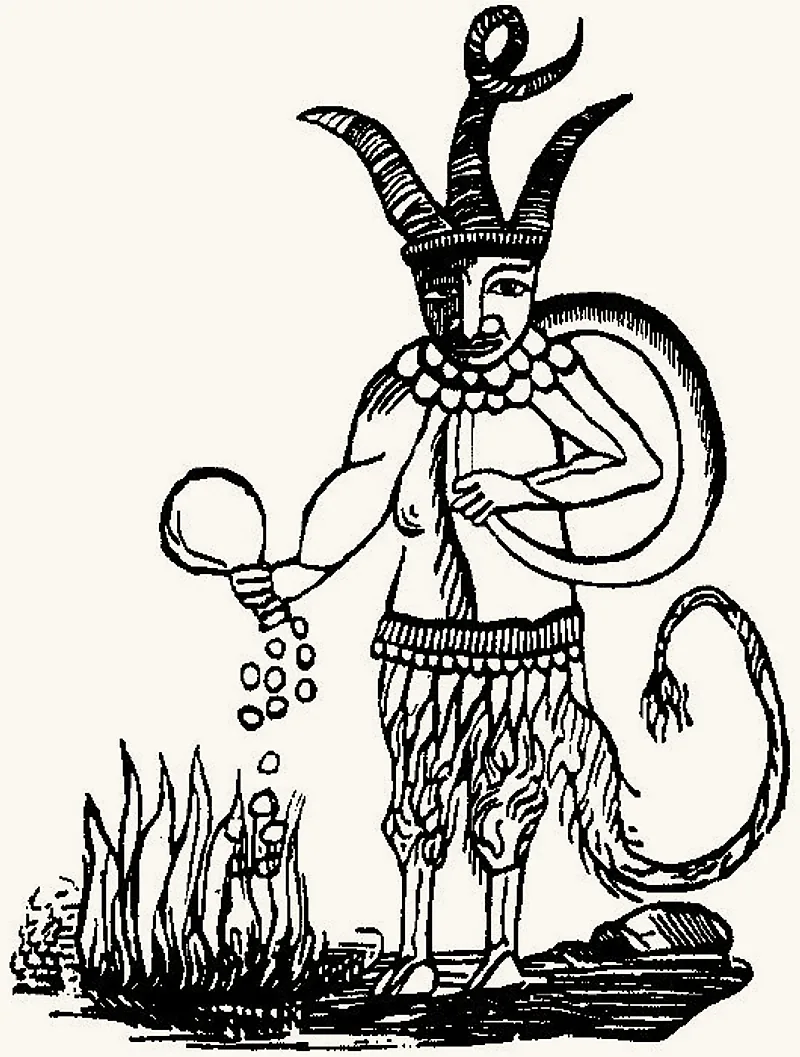
French popular grimoires of the eighteenth and nineteenth centuries, such as the Grand Grimoire (also sold as the Dragon Rouge), printed cheaply for a wide readership, included the character of Lucifuge Rofocale and other signs. These books, studied by Owen Davies in Grimoires: A History of Magic Books, show how spirit seals moved from manuscripts owned by learned men into the market for cheap print.
Seals of angels and benevolent spirits ran alongside the demonic ones. The Arbatel (1575) gave characters for the seven Olympic spirits, and the Key of Solomon filled its pentacles with divine names and figures, as discussed in The Key of Solomon. An early eighteenth-century manuscript copied from papers attributed to Dr Thomas Rudd (1583–1656) paired each Goetic spirit with one of the seventy-two angels of the Shem ha-Mephorash, whose seal was meant to protect the magician; Stephen Skinner and David Rankine edited it as The Goetia of Dr Rudd.
Editions, Errors and Variation§
The seals most people recognise today come from one edition. In 1904 S. L. MacGregor Mathers's transcription of the Goetia was published by Aleister Crowley as The Book of the Goetia of Solomon the King, with redrawn seals, Crowley's additions and an introductory essay. Most later reprints, websites and tattoo designs derive from this version.
Comparison with the manuscripts shows how much the seals vary. In the British Library manuscripts of the Lemegeton (notably Sloane 3825 and Sloane 2731) the same spirit can have noticeably different seals, and copyists introduced errors, simplifications and variants. Joseph H. Peterson's critical edition, The Lesser Key of Solomon (2001), and Jake Stratton-Kent's Pandemonium, a comparative catalogue of spirit lists, set these differences out. For historians, the variation is itself evidence: it shows that the seals were copied by hand from book to book, not handed down as fixed designs from a single original.
Goetic Seals in Modern Culture and Interpretation§
In the twentieth century the Goetic seals took on new meanings. Crowley's introduction to the 1904 edition suggested that the spirits might be understood as portions of the human brain, a psychological reading that later practitioners developed into a "Goetic psychology" of complexes and drives. Left-hand-path and Satanist groups, discussed in The Left-Hand Path, reinterpreted the spirits as allies or aspects of the self rather than beings to be compelled. Some chaos magicians treated the seals as one more set of symbols to be used pragmatically, much like the personal sigils described in Sigil Magic.
The seals also became a visual style. They appear on album covers, in horror films and video games, on jewellery, clothing and tattoos, frequently with little awareness of their source. This popularity has reshaped their reputation: once secret marks of forbidden books, they are now among the most recognisable images of the occult, and the "sigil of Lucifer" in particular has become a general emblem of rebellion or Satanist identity.
Scholars approach the seals historically, as artefacts of a long tradition of ritual magic. They show how medieval and early modern Europeans imagined the spirit world as an ordered hierarchy with ranks, offices and seals, modelled on court and Church, and how practitioners sought to work within that order through names and signs. Any description of the seals here is offered in that historical spirit, not as a guide to their use.
Frequently asked questions§
Where do the seals of the Goetia come from?§
They first appear in seventeenth-century English manuscripts of the Lemegeton, or Lesser Key of Solomon. The spirit list goes back largely to Johann Weyer's Pseudomonarchia Daemonum of 1577, which has no seals, so the designs were probably created or assembled by the compiler and copyists.
Are the Goetic seals the same in every source?§
No. The manuscripts differ, and copyists made errors and variants. The familiar versions mostly come from the 1904 Mathers–Crowley edition, which redrew the seals.
What is the sigil of Lucifer?§
It is a character attributed to Lucifer in versions of the Grimorium Verum, an eighteenth-century grimoire falsely dated to 1517. In modern culture it has become a popular emblem of Satanism and rebellion.
What were the seals made of?§
The Ars Goetia assigned each seal to a planetary metal according to the spirit's rank, such as gold for kings and copper for dukes. This reflects the wider system of planetary correspondences in Renaissance magic.
Sources and further reading§
- The Lesser Key of Solomon: Lemegeton Clavicula Salomonis — Joseph H. Peterson (ed.), 2001
- The Goetia: The Lesser Key of Solomon the King — S. L. MacGregor Mathers & Aleister Crowley, 1904
- Witches, Devils, and Doctors in the Renaissance: Johann Weyer, De praestigiis daemonum — Johann Weyer, 1991
- Forbidden Rites: A Necromancer's Manual of the Fifteenth Century — Richard Kieckhefer, 1997
- Grimoires: A History of Magic Books — Owen Davies, 2009
- Grimorium Verum: A Handbook of Black Magic — Joseph H. Peterson (ed.), 2007
- The Goetia of Dr Rudd — Stephen Skinner & David Rankine, 2007
- Pandemonium: A Discordant Concordance of Diverse Spirit Catalogues — Jake Stratton-Kent, 2016
- The Book of Oberon: A Sourcebook for Elizabethan Magic — Daniel Harms, James R. Clark & Joseph H. Peterson, 2015