Liber XXVIII · Solomonic Magic · Chapter I: Demonic Magic & Pacts
Grimorium Verum: History of the 'True Grimoire' of Black Magic
The Grimorium Verum or 'True Grimoire': its false 1517 Memphis imprint, its three infernal chiefs and their spirits, its sources and modern editions.
The Grimorium Verum ("True Grimoire") is a French grimoire of demonic magic that claims to have been published at Memphis in 1517 by "Alibeck the Egyptian" but was in fact produced in the eighteenth or early nineteenth century. It describes three chiefs of Hell — Lucifer, Beelzebuth and Astaroth — with their ministers and subordinate spirits, gives a seal or "character" for each, and adapts the ritual equipment of the Key of Solomon to the direct invocation of named demons, which made it one of the most frankly diabolical of the classic grimoires.
A grimoire with an Egyptian imprint§
The title page of the Grimorium Verum is a small masterpiece of false authority. It presents the book as the most approved keys of Solomon, translated from the Hebrew by a Dominican Jesuit named Plaingière, with "a collection of curious secrets", and published by "Alibeck the Egyptian" at Memphis in 1517. A Dominican cannot also be a Jesuit, the Jesuit order did not yet exist in 1517, and Memphis had long been a ruin; the details were meant to impress buyers rather than to survive inspection.
The work belongs to the same French publishing world as the Grand Grimoire and the Grimoire of Pope Honorius. The earliest printed editions are usually dated to the late eighteenth or early nineteenth century, with some bibliographers favouring a date around 1817; related French manuscripts may be somewhat older. Italian versions appeared in the later nineteenth century, and the catalogue entry for the Grimorium Verum summarises the editions. One detail of the content confirms a post-medieval origin: Astaroth is assigned dominion over America.
The three chiefs and their spirits§
The Grimorium Verum opens with a description of the spirits. Three are supreme:
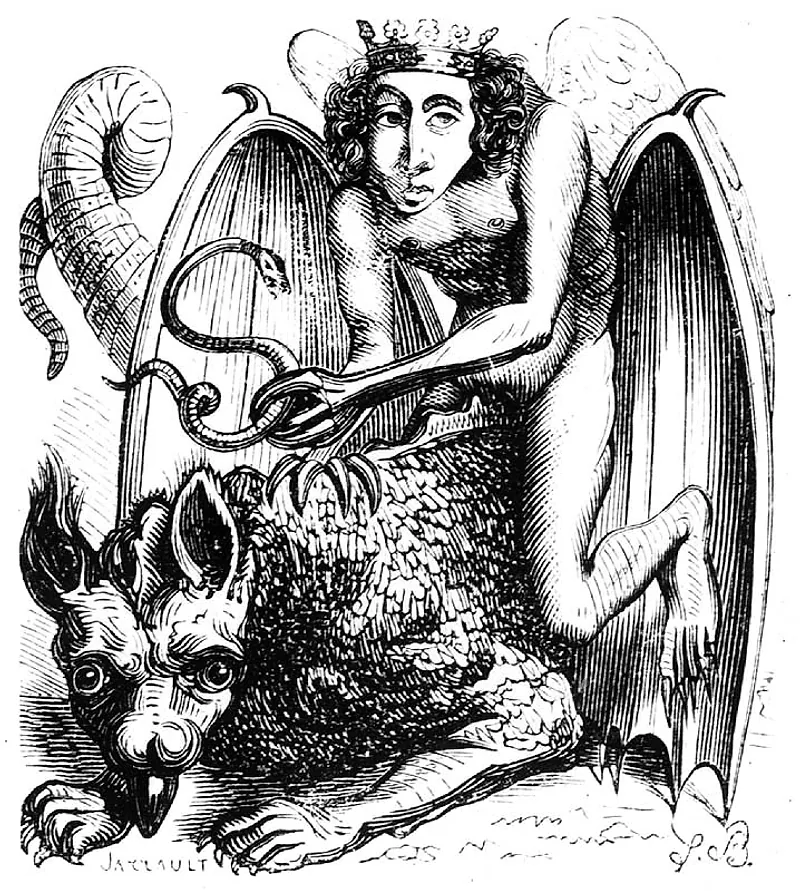
- Lucifer, who rules over Europe and Asia;
- Beelzebuth, who rules over Africa;
- Astaroth, who rules over America.
Each has two principal ministers: Satanachia and Agaliarept under Lucifer, Tarchimache and Fleurety under Beelzebuth, Sargatanas and Nebiros under Astaroth. Beneath them come eighteen further spirits, among them Bael, Agares, Marbas, Pruslas, Aamon, Barbatos, Buer, Botis, Bathim, Pursan, Loray, Valefar and Glasyabolas. Several of these names come, directly or indirectly, from Johann Weyer's Pseudomonarchia Daemonum of 1577, where the same spirits appear with ranks and descriptions; most of them also appear in the seventeenth-century Ars Goetia.
The hierarchy is almost identical to the one in the Grand Grimoire, where the six ministers appear under the "Prime Minister" Lucifuge Rofocale. The two books evidently drew on a common French tradition of infernal court-lists, in which the old Solomonic catalogues of spirits were reorganised around the three great names of biblical and medieval demonology. The name Astaroth derives ultimately from the Canaanite goddess Astarte, whom the Hebrew Bible condemns; Beelzebuth is the Beelzebub of the Gospels, "prince of the demons"; Lucifer is the morning star of Isaiah 14, identified by Christian tradition with Satan. The long history of these figures is told in the history of Satan and the Devil.
Characters, seals and the influence of the Key of Solomon§
Each spirit in the Grimorium Verum has a "character", a linear sign that functions like the seals of the Goetia. The book also describes the materials of the art at length: the knife and other instruments, the virgin parchment, the pen and ink, the incense, the aspersion with water, and the prayers to be said over them. As Joseph Peterson's edition shows in detail, much of this is adapted from the French versions of the Key of Solomon, which had circulated in manuscript since the seventeenth century.
What makes the Grimorium Verum distinctive is the combination. The Key of Solomon is primarily concerned with preparing the operator and his equipment and with commanding spirits through angels and divine names; it rarely names demons. The Grimorium Verum keeps the Solomonic apparatus but directs it openly at Lucifer and his court, and it frames the relationship with the spirits in terms of offerings and agreements. The book's own language mixes reassurance and menace: the spirits are to be compelled, yet they are also to be satisfied. Historians see in this the same ambiguity that runs through the whole tradition of demonic magic.
The "curious secrets"§
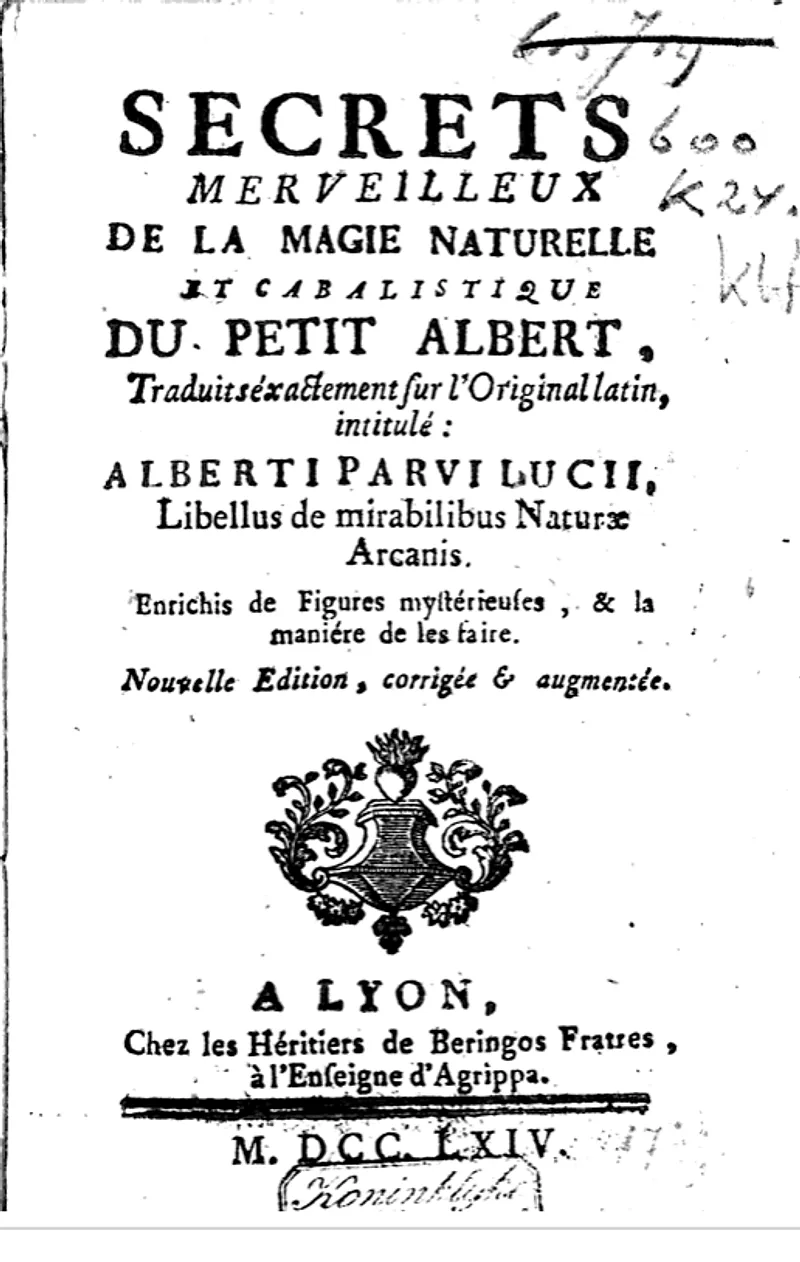
The second half of the book is a collection of short experiments of the kind found throughout popular magic: procedures attributed to the spirit Scirlin, who serves as a messenger summoning other spirits; charms for love and favour; ways to see spirits, to become invisible, to discover treasure, and to protect oneself. Many have parallels in the Petit Albert, in German Zauberbücher and in English cunning-folk manuscripts. Their interest for historians lies less in any particular recipe than in what they reveal about readers' desires — money, sexual success, safety, secret knowledge — and about the circulation of motifs between learned and popular magic.
Some of the experiments call for materials of animal origin, a feature the Grimorium Verum shares with many early modern recipe collections. Such elements are of historical interest only; the book is best understood as a document of eighteenth- and nineteenth-century popular culture, not as a manual.
Its place among the grimoires§
Seen against the longer history of ritual magic, the Grimorium Verum marks the end point of a gradual shift. Medieval necromantic handbooks such as the Munich Manual were written by clerics in Latin and wrapped their conjurations in the language of the liturgy. The Solomonic manuscripts of the sixteenth and seventeenth centuries organised spirits into catalogues and placed angels and divine names at the centre. The French printed grimoires of the following century kept the outward forms of this tradition but rearranged it around the Devil himself, in short, vernacular books sold to a wide public.
The Grimorium Verum is therefore valuable evidence for how learned demonology filtered into popular culture. Its three chiefs reflect the preaching and theology of the Church, which had long taught that Lucifer, Beelzebub and Astaroth were great princes of Hell; its seals reflect the Solomonic manuscript tradition; its secrets reflect the everyday concerns of village magic. It also shows how the idea of the pact, elaborated by theologians to condemn magic, had become by the eighteenth century a selling point.
Waite, Peterson and the modern reception§
In the English-speaking world the Grimorium Verum became known through A. E. Waite's Book of Black Magic and of Pacts (1898), which summarised and partly translated it, and through E. M. Butler's Ritual Magic (1949), which placed it among the degenerate descendants of the Solomonic tradition. Both writers treated it with distaste, Waite especially as an example of "black magic" in the full sense.
Since the 1990s the book has been re-edited and re-evaluated. Joseph H. Peterson's Grimorium Verum: A Handbook of Black Magic (2007) collates the French and Italian printed editions with manuscript versions, and is the standard text for scholars. Jake Stratton-Kent's The True Grimoire (2009) approaches it as a practitioner, arguing that it preserves a "goetic" current with roots in ancient Greek necromancy — a thesis that has been influential among modern occultists but is not shared by most academic historians, who emphasise the book's recent and composite character. Owen Davies' Grimoires (2009) traces its place in the international trade in printed magic books. The Grimorium Verum now sits alongside the Lesser Key of Solomon as one of the most frequently reprinted grimoires.
Frequently asked questions§
When was the Grimorium Verum written?§
The title page claims 1517, but the printed text is generally dated to the late eighteenth or early nineteenth century. It incorporates older material, especially from the Key of Solomon and from sixteenth-century spirit catalogues.
Who are the main spirits of the Grimorium Verum?§
The three chiefs are Lucifer, Beelzebuth and Astaroth, each with two ministers (Satanachia and Agaliarept; Tarchimache and Fleurety; Sargatanas and Nebiros). Eighteen further spirits, many shared with Weyer's catalogue and the Goetia, serve under them.
How is the Grimorium Verum related to the Grand Grimoire?§
They share almost the same infernal hierarchy and come from the same French popular book trade. The Grand Grimoire adds Lucifuge Rofocale as Prime Minister and centres on a pact; the Grimorium Verum is more concerned with characters, instruments and a collection of secrets.
Sources and further reading§
- Grimorium Verum: A Handbook of Black Magic — Joseph H. Peterson, 2007
- Grimoires: A History of Magic Books — Owen Davies, 2009
- The True Grimoire — Jake Stratton-Kent, 2009
- The Book of Black Magic and of Pacts — A. E. Waite, 1898
- Ritual Magic — E. M. Butler, 1949
- The Key of Solomon the King (Clavicula Salomonis) — S. L. MacGregor Mathers, 1889