Liber XXVIII · Solomonic Magic · Chapter I: Demonic Magic & Pacts
The Devil's Pact: Theophilus, Faust and Grandier in History
The Devil's pact in history and legend: Augustine's theory, the Theophilus miracle, Gerbert, witch-trial pacts, Urbain Grandier's Loudun 'pact' and Faust.

A pact with the Devil is an agreement, spoken or written, by which a human being is believed to give his soul, worship or obedience to the Devil in exchange for knowledge, wealth or power. The idea was formulated by Augustine in the fifth century, given its classic story in the legend of Theophilus of Adana, made a legal foundation of the witch trials, and turned into one of Europe's great myths by the Faust books, Marlowe and Goethe; the most famous "real" pact, attributed to the priest Urbain Grandier in 1634, is a document produced for his prosecution.
The theological idea of the pact§
Christian writers inherited from the Bible the conviction that demons were real and that some people sought their help. The prophet Isaiah speaks of rulers who boast of a "covenant with death" (Isaiah 28:15), a phrase later readers applied to magicians. But the systematic theory came from Augustine of Hippo. In On Christian Doctrine he described superstitious practices as resting on "pacts of signification" agreed with demons: signs and words have no power of their own, so if they seem to work, demons must be responding to an understood signal.
This allowed later theologians to distinguish an explicit pact, in which a person consciously invokes and bargains with a demon, from an implicit or tacit pact, in which someone uses a charm or ritual whose effect can only be demonic, even without meaning to deal with the Devil. Thomas Aquinas adopted the distinction in the thirteenth century, and it became standard in canon law and in confessors' manuals. The legal and theological consequences are traced in how theologians and inquisitors judged demonic magic.
Theophilus of Adana: the first pact legend§
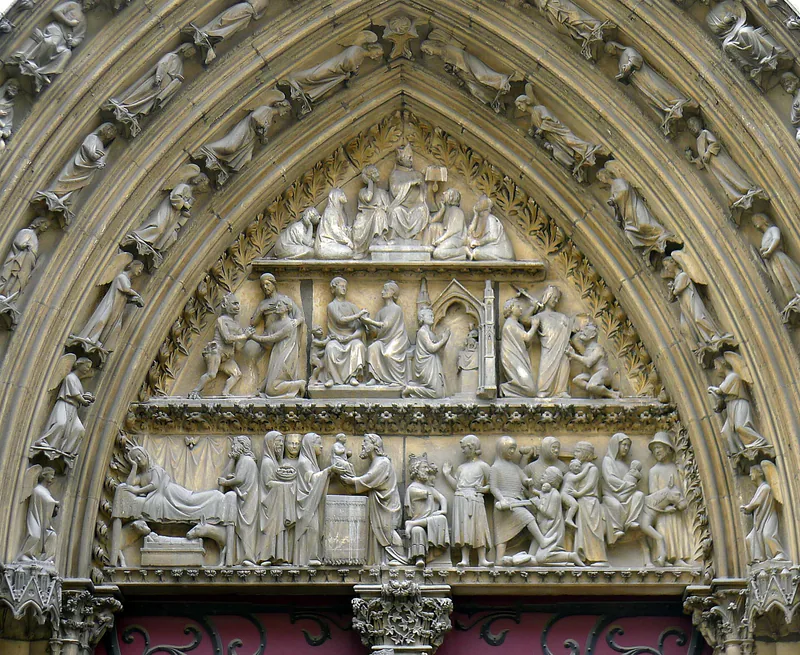
The founding story of the written pact concerns Theophilus, steward (oikonomos) of the church of Adana in Cilicia, in what is now southern Turkey, supposedly in the sixth century. According to the Greek legend, attributed to a certain Eutychianus who claimed to have witnessed the events, Theophilus declined to become bishop out of humility, was then removed from office by the new bishop, and in resentment sought out a sorcerer who brought him at night to the Devil. Theophilus renounced Christ and the Virgin and sealed the renunciation in a written document. He was restored to office and honour, but repented, fasted and prayed for forty days before an image of the Virgin, who appeared, rebuked him and finally restored the charter to him. He confessed publicly and died soon after.
The legend shows its age in one ugly detail: the sorcerer who leads Theophilus to the Devil is a Jew, a stereotype that medieval retellings repeated and that historians now read as part of the history of Christian anti-Judaism.
The story reached the Latin West through a translation made in the ninth century by Paul the Deacon of Naples. It was retold in verse by the canoness Hrotsvitha of Gandersheim in the tenth century, by Gautier de Coinci in his Miracles of Our Lady in the early thirteenth, and staged by the Parisian poet Rutebeuf in Le Miracle de Théophile around 1260. Sculptors carved it in stone: a twelfth-century relief at the abbey church of Souillac and the tympanum of the north transept portal of Notre-Dame de Paris, from the mid-thirteenth century, show the pact and its cancellation. For medieval audiences the point of the legend was not the Devil's power but the Virgin's: no contract with Hell was beyond her mercy.
Gerbert and the learned magician§
A second strand of pact legend attached itself to scholars. William of Malmesbury, writing in England around 1125, claimed that Gerbert of Aurillac — the brilliant mathematician who became Pope Sylvester II in 999 — had learned forbidden arts among the Saracens of Spain, had bound himself to the Devil and owned a bronze head that answered questions. The tale, which has no historical basis, shows how quickly unusual learning, especially learning associated with Arabic science, could be explained as demonic. Similar stories gathered around Michael Scot, Roger Bacon and Pietro d'Abano, and they prepared the ground for Faust.
The pact in the witch trials§
From the fifteenth century the pact moved from legend to law. Demonologists such as the authors of the Malleus Maleficarum (1486) taught that witches entered a pact with the Devil, sometimes "solemnly" at an assembly of witches, sometimes privately, and that this apostasy, rather than any particular harm done, was the essence of their crime. Interrogators therefore asked accused people when and how they had met the Devil, what he had promised and what they had given him.
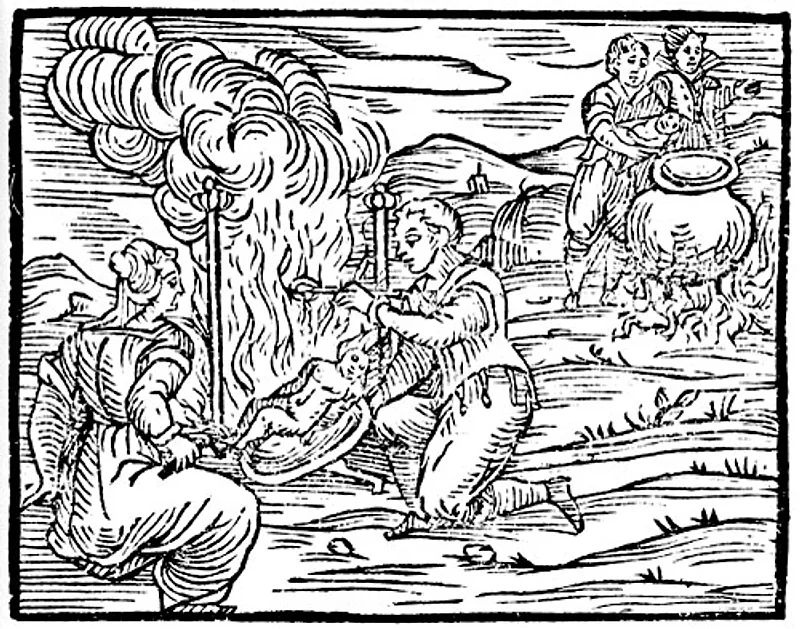
The resulting confessions rarely mention written contracts. They describe a meeting with a stranger, often in a moment of poverty or grief; a promise of money or revenge; a renunciation of baptism; and a mark on the body, sexual intercourse or a shared meal as the seal of the agreement. Historians read these narratives as products of the interrogation — of leading questions, torture and learned expectation — combined with the real anxieties of the accused. The wider context is described in the European witch trials.
Urbain Grandier and the Loudun "pact"§
The most famous written pact in history belongs to a trial. In 1632 nuns of the Ursuline convent at Loudun in western France, led by their prioress Jeanne des Anges, began to show signs of possession, and under exorcism their demons named the town's parish priest, Urbain Grandier, as the sorcerer responsible. Grandier was a gifted, worldly and politically exposed cleric with powerful enemies. A royal commissioner, Jean Martin de Laubardemont, conducted the case, the public exorcisms drew crowds from across France, and Grandier was tortured and burned alive on 18 August 1634, maintaining his innocence.
Among the evidence was a pact supposedly delivered by the demons: a document written in Latin back to front, signed with the names of Satan, Beelzebub, Lucifer, Leviathan, Astaroth and others, accepting Grandier's allegiance; a second paper was presented as Grandier's own declaration. Historians agree that these documents were fabricated, whether by the exorcists or within the convent, and the affair is a classic case study in the politics of possession. Aldous Huxley's The Devils of Loudun (1952) and Michel de Certeau's The Possession at Loudun (1970) are the best-known accounts. A later and better-documented case, that of the Bavarian painter Christoph Haizmann, who in 1677 confessed to two pacts and was exorcised at the shrine of Mariazell, was analysed by Sigmund Freud as a "demonological neurosis".
Faust: from wandering magician to myth§
A real Georg or Johann Faust travelled through southern Germany in the early sixteenth century as an astrologer, healer and fortune-teller; the abbot Johannes Trithemius mocked him in a letter of 1507 as a braggart. After his death, around 1540, stories gathered quickly. In 1587 the Frankfurt printer Johann Spies published the anonymous Historia von D. Johann Fausten, in which Faust signs a pact in his own blood with the spirit Mephostophiles for twenty-four years of service, enjoys travel, knowledge and pleasure, and is torn apart when the term expires. The book was a Lutheran warning against curiosity and pride.
An English translation inspired Christopher Marlowe's Doctor Faustus (performed around 1592, printed 1604), and German puppet plays kept the story alive until Lessing and Goethe transformed it. Goethe's Faust (Part One 1808, Part Two 1832) makes the pact a wager about human striving, and ends with Faust's salvation. In the eighteenth century German magic books such as the Höllenzwang circulated under Faust's name, and in France the Grand Grimoire built its whole ritual around a pact with Lucifuge Rofocale. The broader history of the figure Faust bargained with is told in the history of Satan and the Devil.
Frequently asked questions§
What was the first story of a pact with the Devil?§
The legend of Theophilus of Adana, in Greek from perhaps the sixth or seventh century and in Latin from the ninth, is the earliest fully developed Christian story of a written pact. Augustine's theory of the pact is older, but he did not tell a story of a signed contract.
Is Urbain Grandier's pact a real document?§
A document presented as his pact exists and has often been reproduced, but historians regard it as a fabrication created during the Loudun possession case. It is evidence of how his accusers worked, not of anything Grandier did.
Was Faust a real person?§
Yes. A magician and astrologer called Faust is mentioned in several documents of the early sixteenth century. The pact, the twenty-four years and the dramatic death come from the legend that grew after he died, especially the 1587 Historia.
Did witches sign pacts with the Devil?§
In trial records written pacts are rare. Most confessions describe an oral promise and a physical sign, and historians attribute their content largely to interrogators' questions and to demonological theory.
Sources and further reading§
- Lucifer: The Devil in the Middle Ages — Jeffrey Burton Russell, 1984
- Mephistopheles: The Devil in the Modern World — Jeffrey Burton Russell, 1986
- The Fortunes of Faust — E. M. Butler, 1952
- The Sources of the Faust Tradition from Simon Magus to Lessing — Philip Mason Palmer and Robert Pattison More, 1936
- Doctor Faustus — Christopher Marlowe, 1604
- Faust — Johann Wolfgang von Goethe, 1808
- The Devils of Loudun — Aldous Huxley, 1952
- The Possession at Loudun — Michel de Certeau, 1970