Liber XXXV · Witchcraft & Wicca · Chapter VIII: Witch Trials
The European Witch Trials: History, Causes and Death Toll
The European witch trials c.1450–1750: the Malleus Maleficarum, demonology, regional variation, the 40,000–60,000 executed, Salem and why the trials ended.

The European witch trials were a series of prosecutions for witchcraft that took place in Europe and its colonies between roughly 1450 and 1750, peaking between about 1560 and 1650. Modern scholarly estimates place the number of people executed at around 40,000 to 60,000, the majority of them women, far fewer than the millions sometimes claimed in popular writing. The trials grew from a new learned belief that witches were members of a Satanic conspiracy, combined with local fears of harmful magic and the legal machinery of early modern states.
From Sorcery to Diabolical Witchcraft§
Belief in harmful magic, or maleficium, is ancient and nearly universal. Roman law punished it, and medieval communities feared neighbours who might blight crops or cause illness through curses. For most of the Middle Ages, however, the Church was cautious. The tenth-century text known as the Canon Episcopi treated women's claims to fly by night with the goddess Diana as delusions sent by the Devil, rather than as real events.
A decisive shift came in the fifteenth century. Building on earlier campaigns against heretics such as the Waldensians and the dualist movements described in Cathars and Bogomils, and on a hardening scholastic theology of demons, theologians began to describe a new kind of criminal: the witch who made an explicit pact with the Devil, worshipped him at nocturnal gatherings called sabbats, and received powers to harm others. The earliest trials of this new type occurred in the 1420s and 1430s in the western Alps, in regions around Lake Geneva, Savoy, the Valais and the Dauphiné. Texts such as Johannes Nider's Formicarius (written c.1435–37) spread these ideas among the educated clergy.
The concept of witchcraft as an organised, devil-worshipping sect combined several elements: the theological idea of the demonic pact, older stereotypes once applied to heretics and Jews (secret night meetings, infanticide, cannibalism and orgies), and folk beliefs about night-flying women and harmful magic. The figure of Satan himself, whose development is traced in the history of Satan and the Devil, was central to this new picture.
The Malleus Maleficarum and Learned Demonology§
The most famous witch-hunting manual is the Malleus Maleficarum ("Hammer of Witches"), published in 1486 or 1487 at Speyer. It is traditionally attributed to the Dominican inquisitors Heinrich Kramer (Latinised as Institoris) and Jacob Sprenger, though many scholars now regard Kramer as its principal or sole author and Sprenger's involvement as uncertain. Kramer had obtained a papal bull from Innocent VIII, Summis desiderantes affectibus (1484), supporting his inquisitorial work in Germany, and printed it at the front of the book to lend it authority.
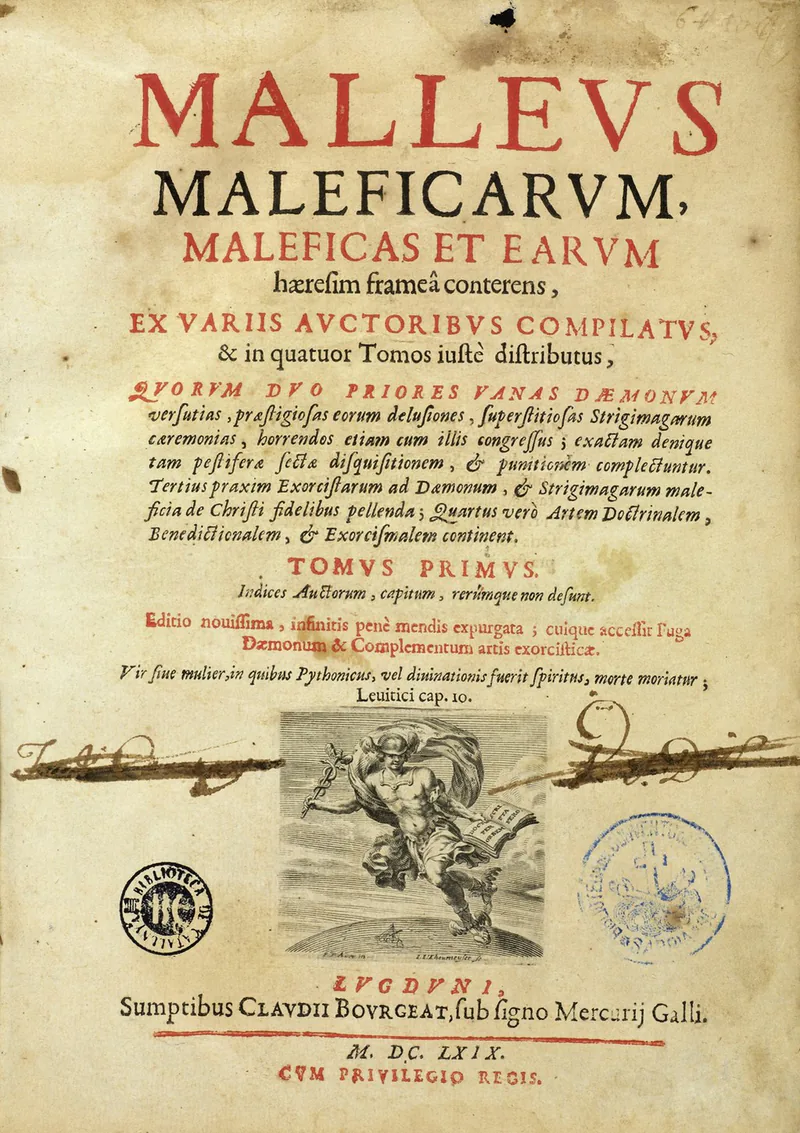
The Malleus argued that witchcraft was real, that denying its reality was itself suspect, and that witches were predominantly women, whom it portrayed as more credulous and carnal than men. It discussed how witches harmed people, livestock and crops, and offered guidance on prosecution, including the use of torture. It was reprinted many times, but its influence is sometimes exaggerated: it was never officially endorsed by the Church as a whole, it was criticised by some contemporaries, and its period of greatest reprinting did not coincide neatly with the peak of the trials.
Later demonological works were equally important. Jean Bodin's De la démonomanie des sorciers (1580), King James VI of Scotland's Daemonologie (1597), Martín Del Río's Disquisitionum magicarum (1599–1600) and Nicolas Rémy's Daemonolatreia (1595) all reinforced the idea of a vast Satanic conspiracy. As Stuart Clark showed in Thinking with Demons (1997), demonology was not an eccentric fringe belief but was woven into mainstream early modern ideas about nature, religion and politics.
How Witch Trials Worked§
Most trials began not with inquisitors but with neighbours. An accusation typically arose from a quarrel, followed by misfortune such as a sick child, a dead cow or a failed batch of butter. Historians such as Keith Thomas and Alan Macfarlane, working on English records, emphasised how often accusations followed a refused request for charity, where the accuser's guilt could be projected onto the person refused.
What turned local suspicion into mass prosecution was the legal system. In much of continental Europe, courts operated under inquisitorial procedure, in which judges investigated and could use torture to obtain confessions. The Constitutio Criminalis Carolina (1532), the criminal code of the Holy Roman Empire, permitted torture but set limits that local courts frequently ignored. Under torture, accused people confessed to attending sabbats and named others they had seen there, generating chain reactions of accusations. Where torture was restricted or forbidden, as in England, trials remained smaller and conviction rates lower.
Common elements in trials included searches for the "devil's mark", supposedly an insensitive spot on the body; in England, searches for a "witch's teat" from which familiars were thought to suckle; and occasional use of the "swimming" test, which was never part of formal English law.
Regional Variation Across Europe§
The trials were not a single continuous event but a patchwork of local panics separated by long periods of relative calm.
The Holy Roman Empire§
Germany and neighbouring territories accounted for perhaps half of all executions. Small ecclesiastical states were especially severe. The prince-bishoprics of Würzburg and Bamberg conducted massive hunts in the late 1620s and early 1630s, in which hundreds of people, including clergy, children and city councillors, were executed. The electorate of Trier and the duchy of Lorraine also saw major persecutions.
France, Switzerland and Scotland§
France saw substantial prosecutions, particularly in frontier regions, though the Parlement of Paris became notably sceptical in the seventeenth century. Switzerland, especially the Pays de Vaud, had very high per capita execution rates. Scotland, following the North Berwick trials of 1590–91 in which King James VI took a personal interest, experienced several major panics; the Scottish Survey of Witchcraft records around 3,800 accused people, and historians commonly estimate that well over a thousand of them were executed.
England§
English trials were comparatively restrained because torture was not normally permitted and juries decided guilt. The notorious exception was the campaign of Matthew Hopkins, the self-styled "Witchfinder General", and John Stearne in East Anglia during the Civil War in 1645–47, which led to roughly a hundred executions. In England witches were hanged rather than burned.
Spain, Italy and Portugal§
Paradoxically, the Spanish, Roman and Portuguese Inquisitions executed relatively few witches. The Spanish Inquisition, after investigating the Basque witch panic of 1609–14, was persuaded by the inquisitor Alonso de Salazar Frías that the confessions were unreliable, and thereafter treated witchcraft accusations with marked scepticism. Gustav Henningsen's study The Witches' Advocate (1980) documents this episode.
Scandinavia and Eastern Europe§
Norway's Finnmark region saw intense trials of both Norwegian women and Sámi men in the 1620s and 1660s. Sweden's Blåkulla trials (1668–76) were driven by children's testimony. In Iceland, unusually, most of those executed were men. Poland and Hungary saw trials continuing into the eighteenth century.
How Many People Were Executed?§
Nineteenth-century writers and some later popular authors claimed that nine million women died in the "burning times". This figure has no basis in the records. Modern historians, working from surviving court documents and careful extrapolation, generally estimate that around 90,000 to 100,000 people were tried and around 40,000 to 60,000 executed between 1450 and 1750. Brian Levack's widely used textbook, in its later editions, proposes roughly 45,000 executions; other scholars have proposed figures slightly higher or lower.
Around 75 to 80 percent of those executed across Europe were women, though the proportion varied sharply by region. Older women, widows and those on the margins of village society were especially vulnerable, but victims included men, children, and in the larger panics, prosperous and respected citizens.
Salem 1692 and the American Colonies§
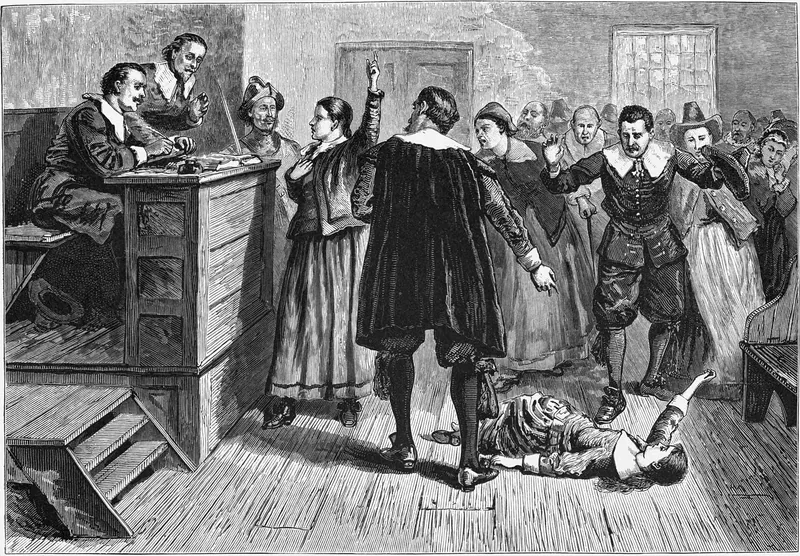
The best-known trials in the English-speaking world took place in Salem Village and the surrounding area of Massachusetts Bay Colony in 1692–93. They began when several girls, including Betty Parris and Abigail Williams in the household of the minister Samuel Parris, exhibited fits that were attributed to witchcraft. Accusations spread rapidly across Essex County. A special Court of Oyer and Terminer admitted "spectral evidence", testimony that the spectre of the accused had appeared to the victim, which made defence nearly impossible.
Nineteen people were hanged, one man, Giles Corey, was pressed to death with heavy stones for refusing to enter a plea, and several more died in jail. About 200 people were accused. Growing doubts among ministers, including Increase Mather, about spectral evidence and the high status of some of the accused led Governor William Phips to dissolve the court. In 1697 the colony held a day of fasting and repentance, and in 1711 the legislature reversed many convictions and paid compensation. Historians have explained Salem through local factional disputes, frontier wars with the Wabanaki, and Puritan religious anxieties, among other factors; Mary Beth Norton's In the Devil's Snare (2002) is a major study.
Why the Witch Trials Ended§
Prosecutions declined from the mid-seventeenth century and had largely ceased by the mid-eighteenth. Several factors contributed. Judges and legal scholars grew sceptical about confessions obtained under torture and about the standards of proof; the Jesuit Friedrich Spee's Cautio Criminalis (1631) was an influential critique of the use of torture in witch trials. Central governments and appellate courts increasingly reviewed and overturned local convictions. The scientific revolution and changing intellectual climate made the idea of the demonic pact less credible to the educated elite, though popular belief in witchcraft persisted much longer.
Legal changes followed. England's Witchcraft Act of 1735 abolished the crime of witchcraft, replacing it with an offence of pretending to magical powers; this was the Act repealed in 1951, a change discussed in Wicca and Gerald Gardner. The last legal executions for witchcraft in Europe are usually dated to the late eighteenth century, with the case of Anna Göldi in Glarus, Switzerland, in 1782 often cited.
Historiography: How Scholars Have Interpreted the Trials§
Interpretations of the trials have changed greatly. Nineteenth-century rationalists saw them as the product of clerical superstition. In the early twentieth century, Margaret Murray argued that the accused were members of a surviving pagan fertility cult; this theory inspired modern witchcraft but was refuted by historians, notably Norman Cohn in Europe's Inner Demons (1975). Feminist writers since the 1970s have rightly highlighted the gendered character of the persecution, though historians caution against the inflated death tolls once associated with the "burning times" narrative.
Since the 1970s, social historians have studied trials at the village level, uncovering the role of neighbourly conflict, while intellectual historians have reconstructed demonological theory. Carlo Ginzburg's study of the Friulian benandanti, and Éva Pócs's work on Hungarian folk beliefs, suggested that some genuine folk visionary traditions were reinterpreted by judges as witchcraft. Current scholarship, represented by Robin Briggs, Brian Levack, Lyndal Roper and Ronald Hutton, views the trials as arising from a combination of factors rather than a single cause. Later moral panics, including the Satanic panic of the 1980s, have often been compared to the early modern hunts.
Frequently asked questions§
How many people were killed in the European witch trials?§
Most historians estimate between 40,000 and 60,000 executions between about 1450 and 1750. The often-repeated figure of nine million has no documentary basis. Many more people were accused and tried without being executed.
Were witches burned at Salem?§
No. Nineteen people convicted at Salem were hanged, and Giles Corey was pressed to death. Burning was used for witches in parts of continental Europe and Scotland, usually after strangulation, but not in England or its American colonies.
Did the Catholic Church cause the witch trials?§
The trials involved both Catholic and Protestant authorities, and most prosecutions were carried out by secular courts. Some of the worst hunts occurred in Catholic prince-bishoprics, but Protestant territories also conducted major persecutions, while the Spanish and Roman Inquisitions were comparatively restrained.
Were the accused witches practising a pagan religion?§
Historians find no evidence that those accused belonged to an organised pagan religion. That idea, associated with Margaret Murray, was rejected after close study of the trial records. Confessions describing sabbats were usually shaped by judges' questions and obtained under torture or pressure.
Sources and further reading§
- Malleus Maleficarum — Heinrich Kramer (Institoris) and Jacob Sprenger (attrib.), 1486/87
- Daemonologie — King James VI and I, 1597
- The Witch-Hunt in Early Modern Europe — Brian P. Levack, 1987 (4th ed. 2016)
- Witches and Neighbours — Robin Briggs, 1996
- Thinking with Demons — Stuart Clark, 1997
- Europe's Inner Demons — Norman Cohn, 1975
- Religion and the Decline of Magic — Keith Thomas, 1971
- The Witches' Advocate — Gustav Henningsen, 1980
- In the Devil's Snare: The Salem Witchcraft Crisis of 1692 — Mary Beth Norton, 2002
- The Witch: A History of Fear, from Ancient Times to the Present — Ronald Hutton, 2017