Liber XXXIV · Witchcraft & Wicca · Chapter VII: Wicca
Wicca and Gerald Gardner: The Origins of Modern Witchcraft
Wicca and Gerald Gardner: the New Forest coven claims, the 1951 repeal, Witchcraft Today, Doreen Valiente, the Book of Shadows and Wicca's spread worldwide.
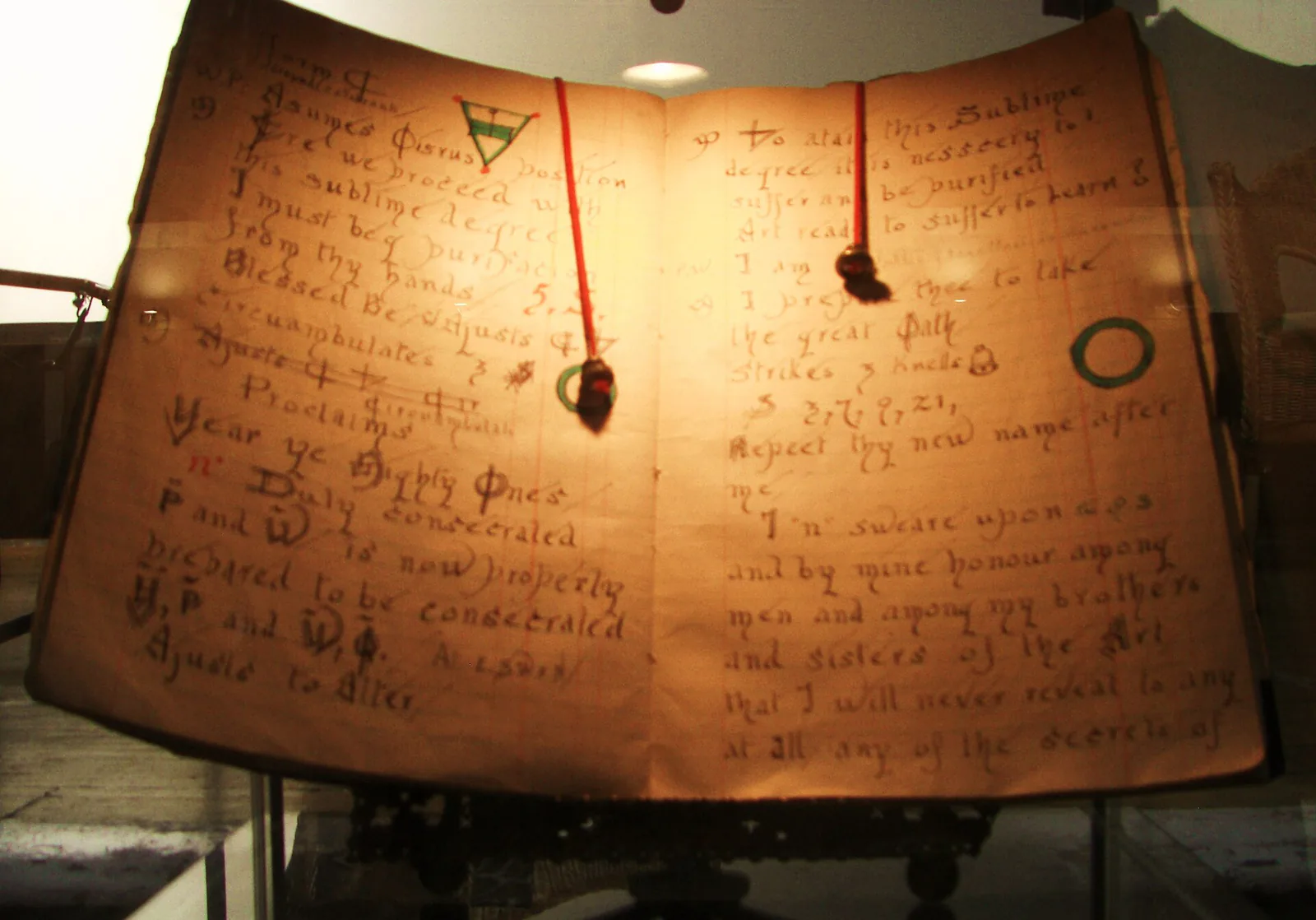
Wicca is a modern pagan witchcraft religion that emerged in England in the late 1940s and early 1950s around the retired civil servant Gerald Gardner (1884–1964). Gardner presented it as the survival of an ancient pre-Christian witch cult, but historians, most influentially Ronald Hutton, have shown that it was a twentieth-century creation assembled from ceremonial magic, folklore, Romantic paganism and the now-discredited theories of Margaret Murray.
Gerald Gardner's Life Before Wicca§
Gerald Brosseau Gardner was born in 1884 at Blundellsands, near Liverpool, into a prosperous family of timber merchants. A sickly child who suffered from asthma, he spent much of his youth abroad with a governess and received little formal schooling. As a young man he went to Ceylon (now Sri Lanka) to work on a tea plantation, and later spent decades in Borneo and Malaya, where he worked in rubber planting and then as a government customs officer. He developed a serious amateur interest in Malay weapons and folk magic, publishing a well-regarded study of the kris dagger in 1936, and took part in archaeological work in the region.
Gardner retired to England in 1936 and settled with his wife at Highcliffe, on the edge of the New Forest in Hampshire. There he became involved with the Rosicrucian Order Crotona Fellowship, a small esoteric group that ran a theatre in nearby Christchurch. According to Gardner's later account, it was through members of this circle that he encountered a group who revealed themselves as hereditary witches.
The New Forest Coven: Claims and Evidence§
Gardner said that in September 1939 he was initiated into a coven that had secretly preserved the old religion of the witches. He associated the group with a local woman, Dorothy Clutterbuck, whom he called "Old Dorothy". The identity of Dorothy was later established by Doreen Valiente through archival research, and the independent researcher Philip Heselton has argued in detail that a real circle of occultists around Edith Woodford-Grimes (known in the Craft as "Dafo") and members of the Crotona Fellowship lay behind Gardner's story.
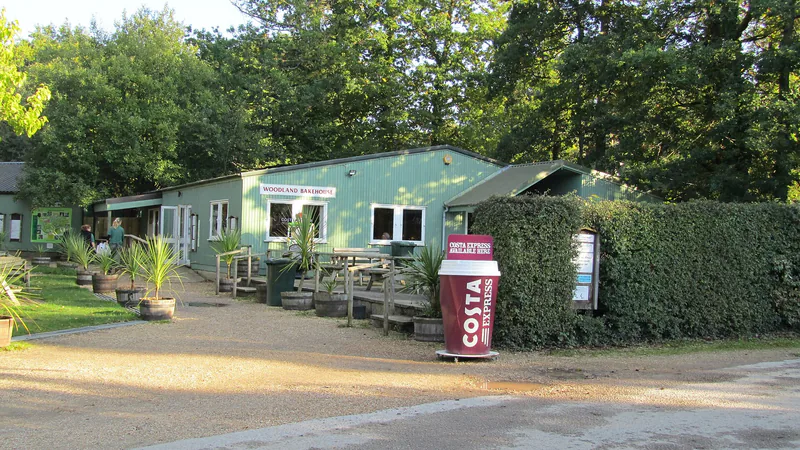
Historians accept that Gardner probably did join some kind of group with an interest in witchcraft and ritual in the New Forest area. What they do not accept is that this group was an unbroken survival of an ancient pagan religion. Hutton notes that the surviving diaries of Dorothy Clutterbuck show a conventional Anglican with no visible pagan commitments, and that the materials Gardner later called traditional are overwhelmingly traceable to modern sources. Whatever the New Forest group was, the religion that emerged from it bore Gardner's distinctive imprint.
The Murray Thesis Behind the Story§
Gardner's claims depended on a theory made respectable by the Egyptologist Margaret Murray. In The Witch-Cult in Western Europe (1921) and The God of the Witches (1931), Murray argued that the people prosecuted in the early modern witch trials were members of an organised pagan fertility religion, worshipping a horned god and meeting in covens of thirteen. The idea was attractive and widely read; Murray even wrote the article on witchcraft for the Encyclopaedia Britannica.
Historians of the trials have rejected the thesis. Norman Cohn's Europe's Inner Demons (1975) showed that Murray had selectively quoted trial records, omitting fantastic details that undercut her reading, and later research on the European witch trials found no evidence of an organised pagan cult behind the accusations. Murray's work nevertheless supplied the framework within which early Wiccans understood themselves.
From the 1951 Repeal to Witchcraft Today (1954)§
Before 1951 open publicity about witchcraft carried legal risk. The Witchcraft Act of 1735 no longer punished witchcraft as a real crime, but it criminalised pretending to exercise magical powers. In 1951 the Act was repealed and replaced by the Fraudulent Mediums Act, a change driven largely by Spiritualist campaigning rather than by witches.
Gardner had already published a novel, High Magic's Aid (1949), under the pseudonym "Scire", which contained thinly veiled ritual material. After the repeal he became increasingly public. He was associated with the Museum of Magic and Witchcraft at Castletown on the Isle of Man, originally opened by Cecil Williamson, which Gardner later bought and ran. In 1954 he published Witchcraft Today, with an introduction by Margaret Murray, presenting himself as an anthropologist reporting on a surviving cult to which he happened to belong. The Meaning of Witchcraft followed in 1959.
Gardner was a willing self-publicist, and his cooperation with newspapers produced both curiosity and hostile tabloid coverage in the 1950s. Interviews and press stories drew new seekers, while some members of his own circle worried that publicity endangered the movement.
The Book of Shadows and Ritual Sources§
The core text of Gardnerian Wicca is the Book of Shadows, a manuscript collection of rituals, laws and teachings copied by hand by each initiate from that of their teacher. Gardner's earliest surviving ritual notebook, known as Ye Bok of ye Art Magical, shows the material in an early, evolving form.
Scholarly analysis, notably by Aidan Kelly and later Hutton, shows the Book of Shadows drew on many recognisable sources:
- Ceremonial magic, particularly the Mathers edition of the Key of Solomon and the circle-casting and elemental structures of the Hermetic Order of the Golden Dawn.
- Aleister Crowley's writings, including passages from his Gnostic Mass. Gardner met Aleister Crowley in 1947, shortly before Crowley's death, and obtained a charter from him for the Ordo Templi Orientis.
- Freemasonry, from which the three-degree system of initiation is evidently modelled.
- Folklore and literature, including Charles Godfrey Leland's Aradia, or the Gospel of the Witches (1899), Murray's theories, and Romantic images of the Horned God and the Great Goddess.
The ritual year that later became the Wheel of the Year also developed during this period, with Gardner's covens initially emphasising four seasonal festivals.
Core Practices of Gardnerian Wicca§
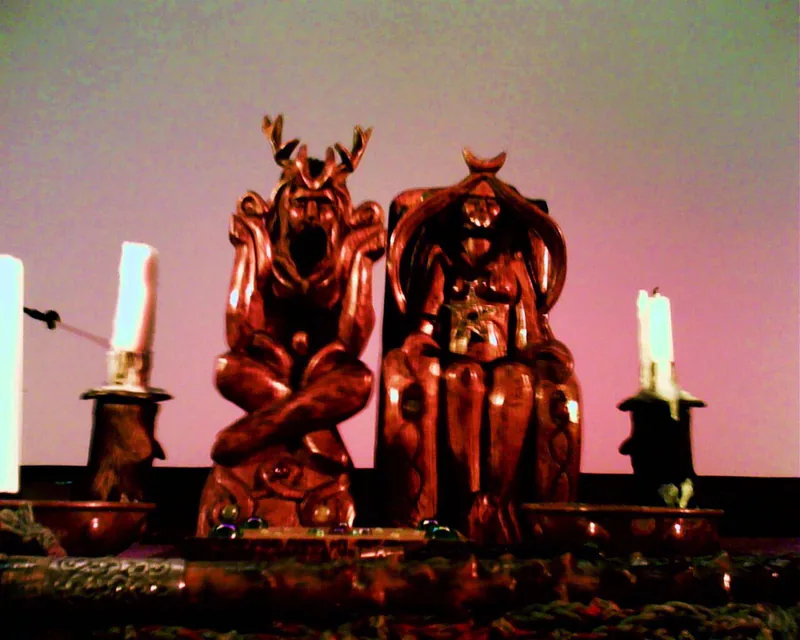
Gardnerian Wicca is an initiatory mystery religion practised in covens led by a High Priestess and High Priest. Rituals take place within a cast circle, with the four quarters called and the Goddess and God invoked. Distinctive features include ritual nudity (described as working "skyclad"), the use of the athame (a black-handled ritual knife), the ritual of Drawing Down the Moon in which the High Priestess is understood to embody the Goddess, and a three-degree system of initiation conferred only in person. Lineage, the documented chain of initiations back to Gardner, is central to Gardnerian identity.
Doreen Valiente and the Reshaping of the Craft§
Doreen Valiente (1922–1999) was initiated by Gardner in 1953 and quickly became his High Priestess at the coven based at Bricket Wood, Hertfordshire, beside a naturist club with which Gardner was closely involved. Recognising Crowley's prose in the rituals, she argued that the association would damage the movement's reputation. With Gardner's agreement she rewrote substantial parts of the Book of Shadows in verse and prose of her own. Her best-known contribution is the Charge of the Goddess, a liturgical address spoken in the Goddess's voice, which Valiente reworked from earlier materials drawing on Aradia and Crowley.
In 1957 Valiente and others separated from Gardner, partly over his publicity-seeking and partly over a set of "Craft Laws" he produced, which they suspected he had composed himself rather than inherited. Valiente later worked briefly with Robert Cochrane, whose very different approach is discussed in traditional witchcraft, and became an important author in her own right with books such as Witchcraft for Tomorrow (1978) and The Rebirth of Witchcraft (1989). She is widely credited with popularising the ethical maxim known as the Wiccan Rede, which she articulated in 1964 in the form "an it harm none, do what ye will".
Alexandrian Wicca and Other Branches§
In the 1960s Alex Sanders (1926–1988) and his wife Maxine Sanders founded what became known as Alexandrian Wicca. Sanders claimed a family initiation from his grandmother, a claim most historians regard as unlikely; his Book of Shadows was substantially Gardnerian, and he added more explicitly ceremonial and Kabbalistic material. Sanders was a flamboyant figure who courted the media, and Alexandrian covens multiplied rapidly in Britain and abroad during the late 1960s and 1970s. Janet and Stewart Farrar, initiated into the Alexandrian line, became influential writers whose books made much of the ritual material public.
The two lineages remain distinct but closely related, and are often grouped together as "British Traditional Wicca". From the 1970s onward many other forms emerged: eclectic covens, solitary practice, feminist and goddess-centred traditions, and the reconstruction-influenced paganisms that sometimes reject the label Wicca altogether.
How Wicca Spread to the United States and Beyond§
Wicca reached the United States primarily through Raymond Buckland (1934–2017), an Englishman living on Long Island who corresponded with Gardner and was initiated in 1963 in Perth, Scotland, by Gardner's High Priestess Monique Wilson. Buckland and his wife Rosemary established the first Gardnerian coven in America and later opened a museum of witchcraft. In 1973 Buckland founded his own tradition, Seax-Wica, which was open to self-initiation.
The counterculture of the 1960s and 1970s, second-wave feminism and the environmental movement all fed American interest. Starhawk's The Spiral Dance (1979) combined witchcraft with feminist and activist politics, and Margot Adler's Drawing Down the Moon (1979) offered a journalistic survey of the whole pagan scene. Scott Cunningham's Wicca: A Guide for the Solitary Practitioner (1988) opened the religion to practitioners working alone, outside coven lineage. Wicca also gained legal recognition: in Dettmer v. Landon (1986) a US federal appeals court treated Wicca as a religion for constitutional purposes, and the pentacle was later added to the list of emblems available on US veterans' grave markers.
Today Wicca is practised across the English-speaking world and in much of Europe and Latin America. Accurate numbers are difficult, but census data in the United Kingdom, Australia and elsewhere record tens of thousands of self-identified Wiccans and pagans.
Ronald Hutton and the Historiography of Wicca§
The standard academic account is Ronald Hutton's The Triumph of the Moon: A History of Modern Pagan Witchcraft (1999). Hutton traced the components of Wicca to nineteenth- and twentieth-century sources: Romantic enthusiasm for a nature goddess and the god Pan, ceremonial magic, folklore scholarship, Freemasonry and the Murray thesis. He concluded that there was no evidence of a surviving pagan witch religion and that Wicca was best understood as a genuinely new religion, and has suggested it may be the only religion England has given to the wider world.
Hutton's work was received with mixed feelings by practitioners. Some felt it undercut cherished foundation myths; many others welcomed it, and today a large part of the Wiccan community accepts that the religion is modern, finding its value in its practice rather than in claims of continuity. Researchers such as Philip Heselton have added detail about Gardner's circle, while the scholar of religion Ethan Doyle White has surveyed Wicca as a contemporary movement. The academic consensus is that Wicca is a creative modern synthesis rooted in a long European fascination with paganism and magic.
Frequently asked questions§
Did Gerald Gardner invent Wicca?§
Most historians regard Gardner as Wicca's principal founder and compiler, even if he worked with a group of collaborators in the New Forest and later with Doreen Valiente. There is no evidence that the religion existed in recognisable form before the 1940s. Gardner presented it as an ancient survival, but its rituals draw clearly on modern ceremonial magic and literature.
What is the difference between Gardnerian and Alexandrian Wicca?§
Both are initiatory, coven-based traditions with three degrees and a Book of Shadows passed down by lineage. Alexandrian Wicca, founded by Alex and Maxine Sanders in the 1960s, adds more ceremonial magic and is often described as more flexible about ritual nudity and innovation. The two are close enough that cross-initiation between them is common.
Was Wicca connected to Aleister Crowley?§
Gardner met Crowley in 1947 and some early Wiccan rituals borrowed directly from Crowley's writings. Doreen Valiente later rewrote much of this material to reduce the Crowley content. Wicca is not a branch of Thelema, but the two share roots in the Golden Dawn tradition of ceremonial magic.
Is the Murray thesis still accepted?§
No. Margaret Murray's claim that the victims of the witch trials belonged to an organised pagan fertility cult has been rejected by historians since the 1970s. Trial records do not support it, and Murray's own handling of the sources was shown to be selective.
Sources and further reading§
- Witchcraft Today — Gerald B. Gardner, 1954
- The Meaning of Witchcraft — Gerald B. Gardner, 1959
- The Witch-Cult in Western Europe — Margaret A. Murray, 1921
- The Triumph of the Moon: A History of Modern Pagan Witchcraft — Ronald Hutton, 1999
- Europe's Inner Demons — Norman Cohn, 1975
- Wiccan Roots: Gerald Gardner and the Modern Witchcraft Revival — Philip Heselton, 2000
- The Rebirth of Witchcraft — Doreen Valiente, 1989
- Drawing Down the Moon — Margot Adler, 1979
- Wicca: History, Belief, and Community in Modern Pagan Witchcraft — Ethan Doyle White, 2016