Liber XXVIII · Solomonic Magic · Chapter II: Demonology
How Theologians and Inquisitors Judged Demonic Magic
How the Church judged demonic magic: Augustine's pact, Aquinas, John XXII, Eymerich's Directorium, the Paris condemnation of 1398 and Del Rio.

Christian theologians and inquisitors judged demonic magic as a form of idolatry and, from the fourteenth century, as heresy, on the principle laid down by Augustine that any dealing with demons implies a pact with them. Thomas Aquinas gave the argument its scholastic form, Pope John XXII and inquisitors such as Nicholas Eymerich turned it into law, the University of Paris condemned learned defences of ritual magic in 1398, and the same reasoning, transferred from clerical magicians to supposed witches, underpinned the witch trials of the early modern period.
Augustine and the early Church§
The early Church inherited a world in which magic was everywhere — in amulets, curse tablets, love charms and the theurgy of the Neoplatonists — and in which Roman law already punished harmful sorcery. Christian writers added a theological reason for condemnation. Since the gods of the pagans were in their view demons, any rite addressed to unseen powers other than God was worship of demons.
Augustine of Hippo developed this into a theory. Magical signs and words, he argued in On Christian Doctrine and The City of God, have no natural efficacy; they are a language agreed between humans and demons, a "pact" that may be explicit or tacit. Even the theurgy of philosophers such as Porphyry, which claimed to purify the soul through contact with higher beings, was in Augustine's view a commerce with deceiving spirits. This position, transmitted through Isidore of Seville, Hrabanus Maurus and the canon law collections, governed Western thinking for more than a thousand years. It is outlined in the context of the Devil's pact in history and legend.
Early medieval penitentials and canon law treated magic mainly as a sin requiring penance. The famous canon Episcopi, first recorded by Regino of Prüm around 906, even dismissed the belief that women rode at night with the goddess Diana as a demonic illusion that Christians should not credit — an attitude very different from that of later witch-hunters.
Scholastic theology: can demons be compelled?§
The revival of learned magic in the twelfth and thirteenth centuries, fed by translations from Arabic, forced theologians to think more precisely. William of Auvergne, bishop of Paris (d. 1249), who admitted he had read magical books in his youth, described and condemned image magic and necromancy in detail. In 1277 Bishop Étienne Tempier of Paris condemned books of necromancy and conjurations alongside philosophical errors.
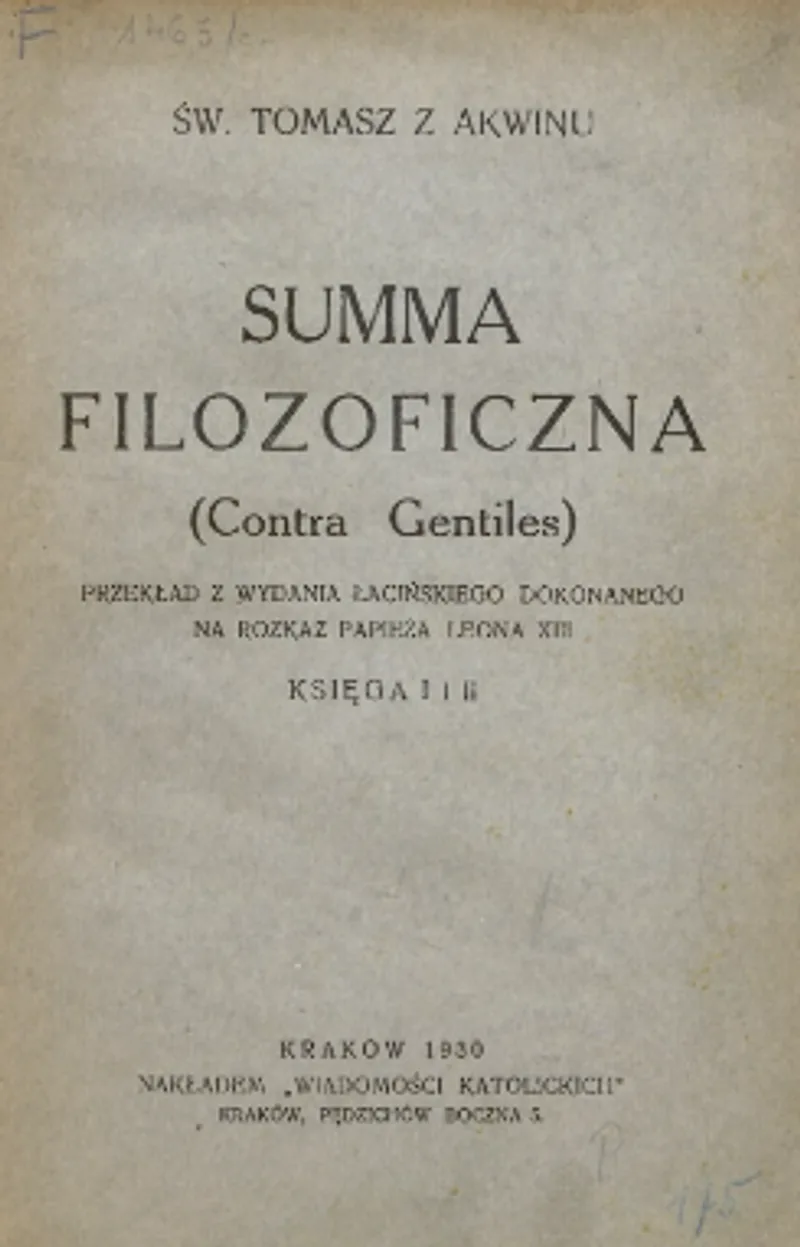
Thomas Aquinas (c. 1225–1274) provided the decisive arguments. In the Summa contra gentiles and the Summa theologiae he asked whether magical words and figures could have any power of their own. His answer was that natural things act through their natural forms, and that words and characters, being signs, can only act by being understood by an intelligence. If a magician's words produce effects, a spirit must be responding to them; since good angels would not cooperate with illicit arts, the spirit must be a demon. And since demons cannot be truly compelled by human words, the magician is not commanding them at all: he is entering an agreement, whether he admits it or not. Aquinas thus refuted the necromancers' claim to be pious masters of spirits, the claim on which handbooks like the Munich Manual rested.
From sin to heresy: John XXII and the inquisitors§
The papacy of John XXII (1316–1334) marked a turning point. The pope believed himself the target of murderous sorcery, and in 1320 he asked a commission of theologians whether those who invoked demons were heretics. In the bull Super illius specula, usually dated 1326 or 1327, he declared that those who made pacts with demons, sacrificed to them, or made images, rings, mirrors and phials to enclose demons fell under the penalties for heresy.
Inquisitors now needed criteria. Bernard Gui's manual for inquisitors, the Practica inquisitionis (c. 1323–24), included questions to be put to sorcerers and diviners. The Catalan Dominican Nicholas Eymerich, inquisitor of Aragon, set out the most influential analysis in his Directorium inquisitorum (1376). He distinguished between magicians who offered demons the worship due to God (latria), those who offered them the veneration due to saints (dulia), and those who claimed merely to command them. Sacrifice, prayer, kneeling, burning incense or lighting candles to a demon were signs of worship and therefore manifest heresy; even the third group, Eymerich argued, usually mixed worship into their rites. Eymerich's book was reprinted in the sixteenth century with a commentary by Francisco Peña and remained a standard reference for the Roman Inquisition.
The Paris condemnation of 1398§
The most articulate response to learned magic came from the University of Paris. In 1398, at a time when magicians were offering cures for the madness of King Charles VI, the faculty of theology under its chancellor Jean Gerson condemned twenty-eight articles. They rejected propositions such as that it is permissible to use magic for good ends, that demons can be constrained by magical arts, that certain spirits are good, and that one may seek knowledge through them. Gerson developed the argument in later treatises, warning that magicians were deceived by demons who feigned obedience in order to ensnare them. The context of these condemnations is set out in necromancy in the Middle Ages.

The theologians' position is striking for its psychological insight. They understood that most magicians thought of themselves as good Christians, and they directed their arguments precisely at that self-image. A magician who used the names of God, fasted and heard Mass was, in their view, all the more dangerous, because he added sacrilege to idolatry.
From the necromancer to the witch§
In the first half of the fifteenth century the theory of the pact moved from the learned magician to a new figure: the witch. Treatises written in the western Alps and in Basel around the 1430s, such as Johannes Nider's Formicarius, described sects of men and women who renounced Christ, paid homage to the Devil and received from him the power to harm. The Malleus Maleficarum (1486) by the Dominican Heinrich Kramer made the pact the defining element of witchcraft.
Historians such as Richard Kieckhefer and Michael D. Bailey have stressed the irony of this development. The pact theory had been designed to judge literate clerics who really did conjure demons. Applied to largely illiterate villagers, few of whom practised anything resembling ritual magic, it became the legal foundation for tens of thousands of executions. Meanwhile, learned necromancers were punished — the Oxford cleric Roger Bolingbroke was executed in 1441 for treasonable magic — but much less often. The story of the trials is told in the European witch trials.
Early modern verdicts: Del Rio, the Inquisitions and their critics§
Catholic demonology reached its fullest form in the Disquisitionum magicarum libri sex (1599–1600) of the Jesuit Martín Del Rio, an encyclopedic survey that defined magic, classified its kinds and set out procedures for judges and confessors. Pope Sixtus V's bull Coeli et terrae (1586) condemned judicial astrology and all divination involving demons, and Urban VIII renewed the condemnation in 1631. Protestant theologians, from Luther and Calvin to William Perkins, whose Discourse of the Damned Art of Witchcraft was published posthumously in 1608, agreed that magic rested on a covenant with Satan — Perkins's discourse can be read in the reading room as A Discourse of the Damned Art of Witchcraft.
In practice the Roman and Spanish Inquisitions dealt with learned and popular magic mostly through abjuration, penance, banishment and the burning of books, and became notably cautious about witchcraft accusations from the early seventeenth century. Critics within the tradition, above all Johann Weyer, argued that the theologians' own principles — the Devil's power to deceive the imagination — implied that most confessing witches were deluded rather than guilty; see Pseudomonarchia Daemonum for Weyer's career. The long theological judgement on demonic magic thus contained the seeds of its own moderation.
Frequently asked questions§
Why did the Church consider demonic magic heresy?§
Because theologians held that invoking a demon implied a pact with it and usually some form of worship, which gave to a creature the honour due to God. John XXII made this explicit in the 1320s, and inquisitors such as Eymerich defined when invocation became manifest heresy.
Did magicians claim to be good Christians?§
Yes. Many necromantic texts are full of prayers and divine names, and their users claimed to command demons by God's power. Theologians like Aquinas and Gerson argued that this was self-deception, since demons cannot truly be compelled by words.
Was demonic magic punished by death?§
Sometimes, especially when combined with treason or harm, but medieval and early modern church courts more often imposed penance, imprisonment, loss of office and the burning of books. The mass executions of the witch trials mostly involved people accused of witchcraft rather than practitioners of learned magic.
Sources and further reading§
- The City of God — Augustine of Hippo, 426
- On Christian Doctrine (De doctrina christiana) — Augustine of Hippo, 397
- Summa Theologiae — Thomas Aquinas, 1270
- Practica inquisitionis heretice pravitatis — Bernard Gui, 1324
- Directorium Inquisitorum — Nicholas Eymerich, 1376
- Malleus Maleficarum — Heinrich Kramer, 1486
- Investigations into Magic — Martín Del Rio, 2000
- Satan the Heretic: The Birth of Demonology in the Medieval West — Alain Boureau, 2006
- The Magician, the Witch, and the Law — Edward Peters, 1978
- Magic and Superstition in Europe: A Concise History from Antiquity to the Present — Michael D. Bailey, 2007