Liber II · Ancient Magic · Chapter V: Greco-Roman Magic
Defixiones: Greek and Roman Curse Tablets and Binding Spells
Defixiones, the curse tablets of Greece and Rome: lead sheets that bound rivals in court, love, sport and trade, the Bath tablets, and how scholars read them.

Defixiones, or curse tablets, are thin sheets of lead and other metals inscribed with spells meant to "bind" another person, usually a rival in a lawsuit, a love affair, a chariot race or a business. More than fifteen hundred have been found across the Greek and Roman world, from Sicily and Athens in the fifth century BCE to Roman Britain and North Africa in late antiquity, and they are among the most direct evidence we have for how ordinary people used magic.
Katadesmoi and Defixiones: Names and Definitions§
The vocabulary of curse tablets centres on binding. Greek texts use the verb katadein, "to bind down", and the tablets are called katadesmoi. Latin writers speak of defigere, "to fix" or "to pierce", from which modern scholars take the term defixio. The image is of a person immobilised: tongue, mind, hands and feet held fast so that the victim cannot speak against the writer in court, run swiftly in the stadium or love anyone else.
Curse tablets differ from the literary curses of tragedy or the public curses pronounced by cities against traitors. They were private acts, written for individual purposes and hidden from view. Their purpose was often defensive or pre-emptive, made before a trial or a race whose outcome was uncertain. They form one of the most widely attested practices of Greco-Roman magic, and their wider history in European culture is traced in Maleficium, Curses and Protective Magic.
The earliest securely dated examples come from Selinous in Sicily, from the late sixth or early fifth century BCE. Attica, the territory of Athens, has yielded a large group from the fifth and fourth centuries BCE. The practice then spread throughout the Mediterranean, and Latin tablets multiplied in the Roman imperial period, with major finds at Rome, Carthage, Hadrumetum in Tunisia, Germany, Gaul and Britain. Tablets continued to be made into the fifth and sixth centuries CE.
How Curse Tablets Were Made and Deposited§
Lead was the usual material. It was cheap, soft enough to scratch with a stylus, and associated in the ancient imagination with coldness, heaviness and the underworld. Some tablets are tiny strips bearing only a name; others are large sheets covered with dozens of lines. Many were rolled or folded after writing, and a considerable number were pierced with a bronze or iron nail, a physical expression of the "pinning" the text describes.
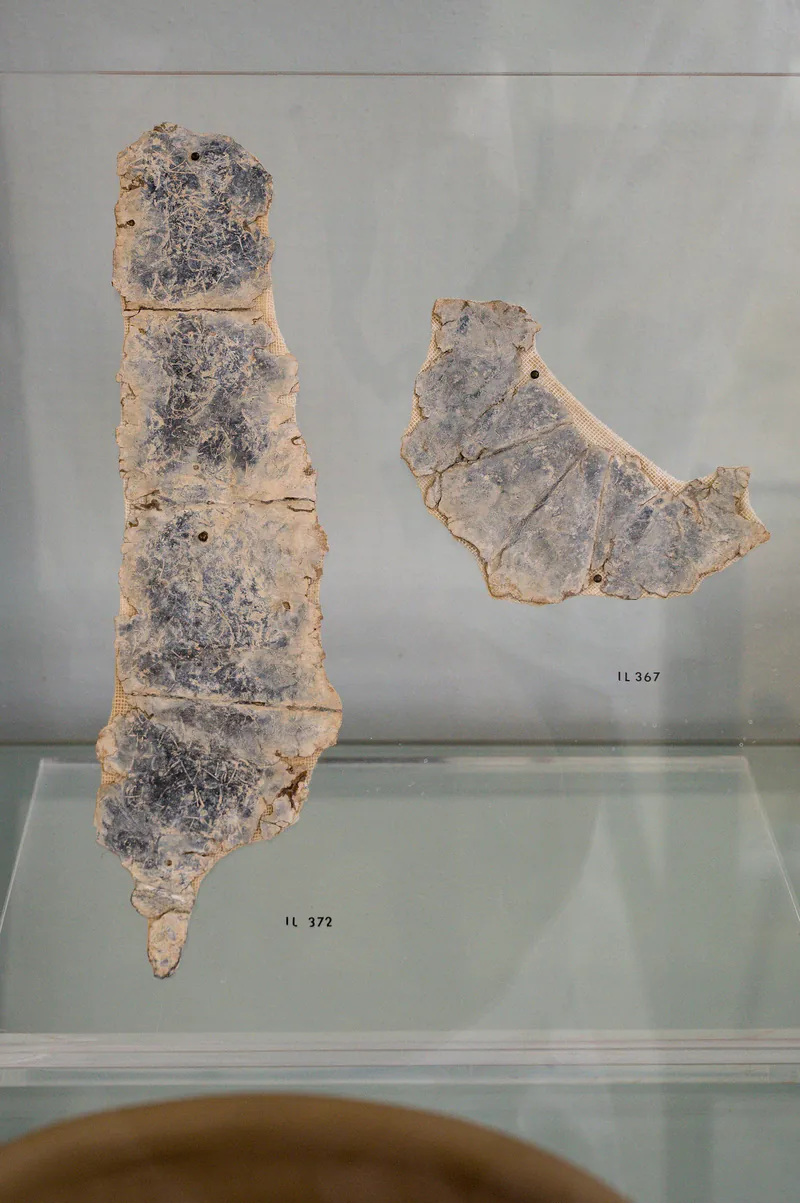
Archaeology shows where tablets were placed. Graves were favoured, especially those of people believed to have died young or by violence, whose restless spirits were thought able to carry messages to the powers below. Wells, springs and baths offered another route to the underworld, and sanctuaries of chthonic deities such as Demeter and Kore received tablets as well. At Rome, a sacred spring of the goddess Anna Perenna, excavated around 1999–2000, yielded tablets together with small figures enclosed in containers.
The deities most commonly invoked were those linked to the earth and the dead: Hermes in his role as the "restrainer" (katochos), Persephone, Hecate, Gē (Earth) and, in Latin tablets, the Di Manes and other infernal powers. Later tablets addressed a much wider range of names, including Egyptian and Jewish divine names, angels and long strings of voces magicae.
The Four Great Types of Binding Curse§
Scholars since the French epigrapher Auguste Audollent, who published a large corpus in 1904, have grouped the tablets by their social setting. John Gager's 1992 sourcebook and Christopher Faraone's studies refined these categories.
Legal and Political Disputes§
The largest early group concerns lawsuits. In classical Athens, where litigants spoke for themselves before large juries, tablets ask that an opponent's tongue and mind be bound so that he forgets his speech or speaks badly. They frequently name several people at once: the opposing litigant, his witnesses and his supporters.
Competition in Sport and Theatre§
Athletes, charioteers and performers were frequent targets. Roman circus curses from Carthage, Hadrumetum and Rome name rival charioteers and their horses, asking that they fall, stumble or fail to start. These texts reflect the intense partisanship of the circus factions, the Blues and the Greens.
Love and Desire§
Erotic tablets seek either to separate a beloved from a rival or to draw the beloved to the writer. The latter form, often called agōgē ("leading"), overlaps with the love spells found in the Greek Magical Papyri. A fourth-century BCE tablet from Pella in Macedonia, written by a woman hoping to prevent a man from marrying another, is one of the best-known early examples.
Trade and Workshops§
A fourth group targets business rivals, such as tavern keepers, potters or smiths, binding their workshops, goods and earnings. These tablets are a reminder that magic was used in the most ordinary economic competition, not only in dramatic personal feuds.
Prayers for Justice: The Tablets of Bath and Uley§
The Dutch scholar Henk Versnel identified a group of texts that, he argued, differ in spirit from binding curses. In these "prayers for justice" the writer usually names himself or herself, describes a wrong suffered, often a theft, and asks a god to punish the culprit until the property is returned or the wrong made good. The tone is that of a petition to a divine judge rather than a secret attack.

The most famous collection comes from the sacred spring of Sulis Minerva at Bath, where some 130 tablets were recovered during excavations in 1979–1980 and published by Roger Tomlin in 1988. Written in everyday British Latin, many concern stolen cloaks, gloves, rings or small sums of money, and some dedicate the stolen item to the goddess so that the thief becomes guilty of sacrilege. A similar group comes from the temple of Mercury at Uley in Gloucestershire. These tablets have become important evidence for the language, names and concerns of ordinary people in Roman Britain.
Figurines, Voces Magicae and the Late Roman Tablets§
Some curse tablets were accompanied by small figurines of wax, clay or lead, their limbs bound or twisted, sometimes pierced. The best-known example, now in the Louvre, is a clay female figure from Roman Egypt pierced with thirteen needles and found with a lead tablet; its text closely parallels a love spell preserved in the Greek Magical Papyri. Such figures belong to a very old Mediterranean and Near Eastern practice of acting on an image in place of a person, which can be compared with the Mesopotamian rite described in Maqlû.
Tablets of the Roman imperial period also became longer and more elaborate. They include magical signs called charaktēres, drawings of demons, and lengthy invocations of divine names in Greek, Egyptian, Hebrew and invented forms. These features show the influence of professional practitioners and written handbooks, and they link the curse tablets with the broader world of late antique ritual traced in Black Magic: A History.
What Ancient Writers Said About Binding Spells§
Ancient literature confirms that binding spells were widely known and widely feared. Plato, in the Republic and the Laws, mentions itinerant specialists who offered, for a fee, to harm an enemy with spells and bindings, and he proposed legal penalties for those who used them. Pliny the Elder remarked that there was nobody who did not fear being bound by curses. Tacitus reports that when the Roman general Germanicus fell ill and died in 19 CE, remains, spells and lead tablets inscribed with his name were found hidden in the walls and floor of his house. The fourth-century orator Libanius described how a mysterious illness that afflicted him ended after a mutilated chameleon was discovered in his lecture room.
Roman law treated harmful magic as a crime from the Twelve Tables onward, and later imperial legislation punished practitioners severely. The tablets themselves, however, show that the practice was neither rare nor confined to the margins of society. Their writers included litigants, lovers, sports fans and shopkeepers, and some tablets were evidently produced by skilled scribes for paying clients.
How Scholars Interpret Curse Tablets§
Modern study of defixiones began with nineteenth-century corpora, above all Richard Wünsch's edition of the Attic tablets in 1897 and Audollent's collection of 1904. Since the 1990s the field has expanded rapidly. Faraone emphasised the "agonistic" setting of the tablets, arguing that they were used in competitive situations whose outcome was uncertain, often before rather than after the event. Gager made a broad selection available in English translation, and many new tablets continue to be published from excavations.
Scholars now tend to read the tablets as a rational response, within ancient assumptions, to the risks of public life: they offered a way to act when the outcome of a trial, a race or a courtship lay beyond one's control. This approach, also discussed in What Is Ancient Magic?, avoids treating the writers as simply superstitious or malicious and uses the tablets to illuminate law, sport, sexuality and religion in the ancient city.
Frequently asked questions§
What is a defixio?§
A defixio is a curse tablet: a small sheet of lead or other metal inscribed with a spell intended to bind or restrain another person. The term comes from the Latin defigere, "to fix" or "to pin down".
Where were curse tablets placed?§
They were usually hidden in graves, especially of those who died young or violently, or thrown into wells, springs and baths, or deposited at sanctuaries of underworld deities. These places were thought to give access to the powers below.
What are the Bath curse tablets?§
They are about 130 inscribed tablets recovered from the sacred spring of Sulis Minerva at Bath, mostly from the second to fourth centuries CE. Most ask the goddess to punish thieves of small personal items such as cloaks, rings and coins.
Were curse tablets illegal?§
Harmful magic was a crime under Greek and Roman law, and Roman imperial law punished it severely. In practice, the large number of surviving tablets shows that the custom was widespread at all levels of society.
Sources and further reading§
- Curse Tablets and Binding Spells from the Ancient World — John G. Gager, 1992
- Magika Hiera: Ancient Greek Magic and Religion — Christopher A. Faraone and Dirk Obbink, 1991
- Defixionum Tabellae — Auguste Audollent, 1904
- Tabellae Sulis: Roman Inscribed Tablets of Tin and Lead from the Sacred Spring at Bath — R. S. O. Tomlin, 1988
- Witchcraft and Magic in Europe: Ancient Greece and Rome — Valerie Flint, Richard Gordon, Georg Luck and Daniel Ogden, 1999
- Magic in the Ancient Greek World — Derek Collins, 2008