Liber II · Ancient Magic · Chapter V: Greco-Roman Magic
Ephesia Grammata: The Ephesian Letters in Greek Magic
The Ephesia grammata, six mysterious Greek words of power: their link to Artemis of Ephesus, early lead tablets from Sicily and Crete, and their uses.

The Ephesia grammata, or "Ephesian letters", were a set of six obscure Greek words — usually given as askion, kataskion, lix, tetrax, damnameneus and aision — that ancient Greeks spoke, wrote and wore as protection against harm and evil spirits. Tradition connected them with the great cult statue of Artemis at Ephesus, lead tablets show that they were in use by the fifth or fourth century BCE, and they remained proverbial for magical words throughout antiquity, puzzling philosophers who tried to explain what they meant.
The Six Ephesian Letters and Their Names§
The standard list of the Ephesian letters, as given by ancient lexicographers and by Clement of Alexandria, runs askion, kataskion, lix, tetrax, damnameneus, aision (sometimes aisia). Spellings vary in the sources, and some lists add further words. None of them is ordinary Greek in its context. Askion and kataskion look like formations from skia, "shadow", meaning something like "shadowless" and "overshadowed"; lix resembles words for something flat or smooth; tetrax recalls the number four or a kind of bird; damnameneus contains the verb "to subdue" or "to tame"; and aision resembles the word for "auspicious" or "fated".
These resemblances may be accidental or may have been heard as meaningful by ancient users. What mattered was that the words were recognised as a fixed, ancient and powerful formula. In the classical world, Ephesia grammata became a byword for magical words generally, much as "abracadabra" is today. The formula belongs to the larger history of verbal power traced in Greco-Roman Magic.
Artemis of Ephesus and the Origin of the Formula§
Ephesus, on the western coast of Asia Minor, was the site of the Artemision, one of the largest temples of the Greek world and later counted among the Seven Wonders. Its goddess was represented by a distinctive cult statue, richly adorned, wearing a tall crown and a garment covered with animal figures, with rows of rounded forms on her chest that have been explained as breasts, eggs, gourds or the scrota of sacrificed bulls.

Greek lexicographers of the Roman and Byzantine periods report that the Ephesian letters had originally been inscribed, obscurely and enigmatically, on the crown, girdle and feet of this statue. Whether that was literally true is impossible to verify, since the archaic statue has not survived and the surviving Roman copies show no such words. The tradition nonetheless reflects the city's reputation. Ephesus was proverbial for magical expertise, and the Acts of the Apostles reports that converts there burned their books of "curious arts" to the value of fifty thousand pieces of silver (Acts 19).
Other ancient writers gave a different origin. Some connected the name damnameneus with one of the Idaean Dactyls, the mythical smith-daimones of Mount Ida who were credited with discovering iron-working and with founding incantation. These competing stories show that already in antiquity the formula's origin was a subject for speculation.
The Earliest Evidence: Lead Tablets from Sicily and Crete§
For a long time the Ephesian letters were known mainly from literary references. Archaeology has changed that picture. Lead tablets from the Greek cities of Sicily contain hexameter verses in which several of the Ephesian words appear. A tablet from Himera, a city destroyed by Carthage in 409 BCE, and a longer text on a lead tablet now in the J. Paul Getty Museum, attributed to Selinous and published as the "Getty Hexameters", show that versions of the formula were circulating in the West by the fifth century BCE.
A lead tablet found in a grave at Phalasarna in western Crete, usually dated to the fourth century BCE, carries a hexameter incantation intended to ward off harm, in which the words askion, kataskion, lix, tetrax and damnameneus appear among invocations and commands. These texts suggest that the Ephesian letters began as part of a longer protective song, perhaps an oral charm in verse, from which the six key words were later extracted and used on their own.
The Sicilian and Cretan finds are written on lead, the same material used for binding curses (see Defixiones), but their purpose is protective. They illustrate how early Greek magic combined epic verse, divine names and powerful nonsense words in a single performance.
Amulets, Wrestlers and Exorcists: How the Letters Were Used§
Ancient references describe three main uses. First, the words could be spoken aloud. Plutarch, writing around 100 CE, says that the magoi instructed people possessed by daimones to recite and name the Ephesian letters to themselves; the words acted as an exorcism. Second, they could be written and carried. Comic poets of the fourth century BCE joke about characters who carry Ephesian letters sewn into little leather pouches, which implies that such amulets were familiar enough to be mocked on stage. Third, they could be inscribed on durable objects, such as the lead tablets already mentioned and later the metal sheets discussed in Lamellae: Inscribed Gold and Silver Amulets.
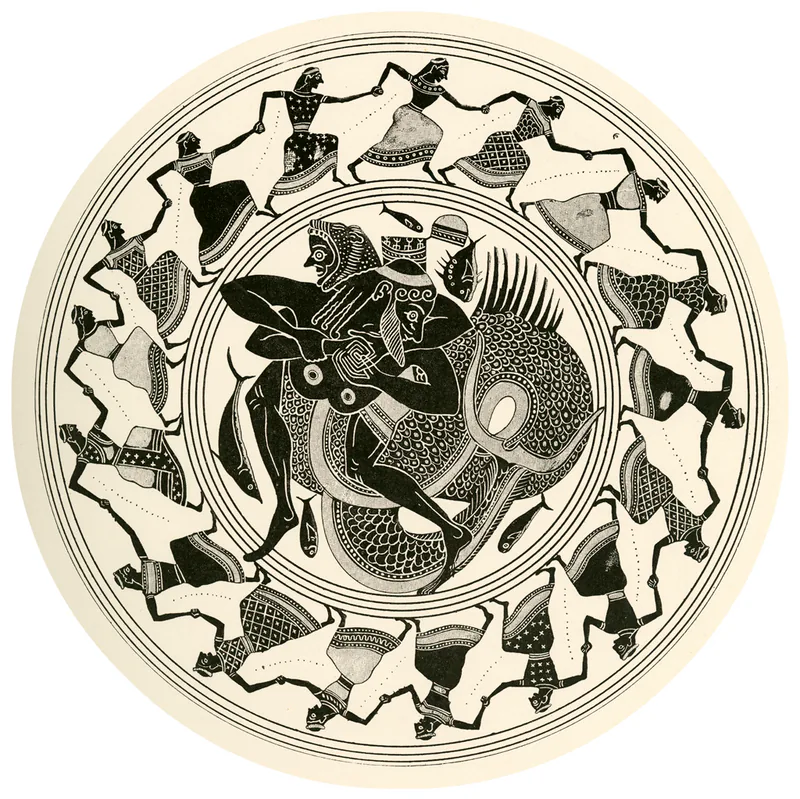
A celebrated anecdote, preserved in later Greek lexicographical sources, tells of an Ephesian wrestler at the Olympic Games who could not be beaten while he wore the Ephesian letters bound to his ankle. When his opponent discovered them and had them removed, he lost three bouts in succession. The story, whatever its truth, shows the letters regarded as a source of invincibility in contests. Another late tradition claims that King Croesus of Lydia recited them on his pyre.
Because the words were famous, they also served as social shorthand. To accuse someone of using Ephesian letters was to say that he relied on magic rather than skill, and the phrase appears in contexts of competition, law and rhetoric as well as healing.
Philosophers Interpret the Letters§
Educated writers who encountered the formula sought to read it as a hidden philosophy. Clement of Alexandria, writing in the late second century CE, reports in his Stromata the interpretation of Androcydes, a Pythagorean. According to this reading, askion means darkness, since it has no shadow; kataskion means light, which casts shadows; lix is an ancient name for the earth; tetrax is the year, because of its four seasons; damnameneus is the sun, which subdues all things; and aision is the true voice. The six words thus become a compressed account of the cosmos.
Clement cites this interpretation as an example of symbolic teaching among the Greeks, alongside Pythagorean maxims and Egyptian hieroglyphs. The approach is typical of ancient allegory, which tended to find philosophy hidden under ritual and myth; on the wider Pythagorean taste for symbols, see Pythagoras and Pythagorean Number Mysticism. Modern scholars do not think the words were invented to encode such a cosmology, but the interpretation shows how Greek intellectuals tried to make sense of popular practice.
From Ephesia Grammata to Voces Magicae§
In the Roman imperial period, the Ephesian letters were absorbed into a far larger vocabulary of voces magicae, the strings of strange words, divine names and vowel sequences that fill the Greek magical papyri and appear on amulets and gems. Words such as damnameneus recur in papyrus spells, sometimes as divine names, alongside Iao, Abrasax and Ablanathanalba.
Scholars such as Fritz Graf, Christopher Faraone and Radcliffe Edmonds have used the Ephesia grammata to study how magical language worked. Its power seems to have rested on three features: it was ancient, being associated with a famous sanctuary and a mythical past; it was foreign or unintelligible, and so suitable for addressing gods and spirits; and it was fixed, so that correct repetition mattered more than understanding. These features remained central to Western verbal magic, from late antique charms to the barbarous names of later grimoires.
Frequently asked questions§
What are the Ephesia grammata?§
They are six obscure Greek words of power, usually listed as askion, kataskion, lix, tetrax, damnameneus and aision. Ancient Greeks spoke them and carried them in writing for protection, especially against demons and misfortune.
Why are they called Ephesian?§
Ancient tradition held that they were inscribed on the cult statue of Artemis at Ephesus, a city famous for its temple and for magical expertise. The tradition cannot be confirmed, but it explains the name.
How old are the Ephesian letters?§
Lead tablets from Sicily, including one from Himera, which was destroyed in 409 BCE, show that the words were used in verse incantations by the fifth century BCE. A fourth-century tablet from Phalasarna in Crete contains several of them as well.
What did ancient philosophers think the words meant?§
Clement of Alexandria records a Pythagorean interpretation by Androcydes that read the words as darkness, light, earth, the year, the sun and the true voice. This was an allegorical reading and probably does not reflect the formula's original meaning.
Sources and further reading§
- The Getty Hexameters: Poetry, Magic, and Mystery in Ancient Selinous — Christopher A. Faraone and Dirk Obbink (eds.), 2013
- Magika Hiera: Ancient Greek Magic and Religion — Christopher A. Faraone and Dirk Obbink (eds.), 1991
- Magic in the Ancient World — Fritz Graf, 1997
- Magic in the Ancient Greek World — Derek Collins, 2008
- Drawing Down the Moon: Magic in the Ancient Greco-Roman World — Radcliffe G. Edmonds III, 2019
- Greek Magical Amulets: The Inscribed Gold, Silver, Copper, and Bronze Lamellae — Roy Kotansky, 1994