Liber II · Ancient Magic · Chapter II: Amulets & Talismans
Lamellae: Inscribed Gold and Silver Amulets of Antiquity
Lamellae, the inscribed gold, silver and bronze amulets of antiquity: Ketef Hinnom, Greek phylacteries, healing historiolae, Jewish and Christian texts.

Lamellae are thin sheets of gold, silver, copper or bronze inscribed with prayers, incantations, divine names and magical signs, then rolled or folded and worn on the body as amulets. They were used across the ancient Mediterranean and Near East for more than a thousand years, from the silver scrolls of Ketef Hinnom in Jerusalem around 600 BCE to the Greek, Latin, Aramaic and Christian phylacteries of late antiquity, and they are among the most personal written records of ancient religion and healing.
What a Lamella Is: Metal, Capsule and Text§
Scholars use the Latin word lamella for the metal sheets themselves; ancient Greek speakers more often called the finished object a phylaktêrion, "safeguard". A scribe incised the text with a fine stylus or point, sometimes in neat lines, sometimes spiralling or diminishing to a point. The sheet was then rolled tightly, often into a cylinder no longer than a finger joint, and slipped into a capsule of gold, silver or bronze with a loop for suspension. Many capsules have been found without their contents, and many lamellae have been found still rolled, so that reading them requires careful unrolling or, increasingly, non-invasive scanning.
The choice of metal carried meaning. Gold was incorruptible and associated with the gods and the sun; silver was bright and pure; copper and bronze were cheaper but durable. This set lamellae apart from the lead tablets used to bind and curse, described in Defixiones: Greek and Roman Curse Tablets. Lead was cold, heavy and associated with the dead, and curse tablets were buried or deposited; protective lamellae were kept close to the living body. Both, however, relied on the idea that writing fixes and activates words of power.
Lamellae belong to the broader history traced in Amulets and Talismans, and they share a repertoire of names and signs with the engraved stones described in Graeco-Egyptian Magical Gems. A gem relied chiefly on image and stone; a lamella relied chiefly on text, and it could carry far longer formulas.
Ketef Hinnom and the Earliest Metal Amulets§
In 1979 the archaeologist Gabriel Barkay excavated burial caves at Ketef Hinnom, on the slope opposite Mount Zion in Jerusalem. Among the grave goods were two minute rolled silver sheets. When unrolled, they proved to carry Hebrew texts closely related to the Priestly Blessing of the book of Numbers, which in the King James Version begins "The LORD bless thee, and keep thee" (Numbers 6:24). Further phrases ask for protection and refer to rebuking evil.
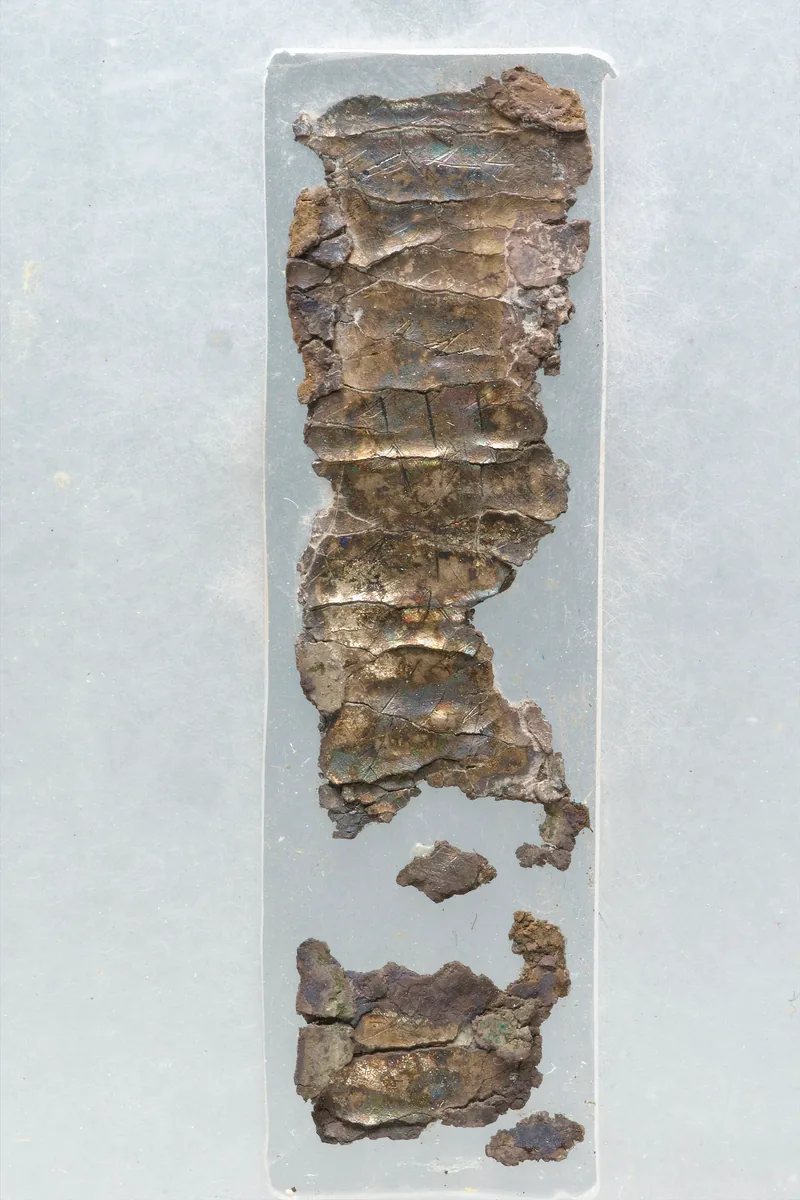
The excavators dated the scrolls to the late seventh or early sixth century BCE, before the Babylonian destruction of Jerusalem. Some scholars argued for a later, Hellenistic date on palaeographic grounds, but a new photographic and digital study published in 2004 supported the earlier dating. If correct, the scrolls contain the oldest known text that parallels a passage of the Hebrew Bible. They also show that a scriptural blessing could be worn as a protective object long before the rabbinic rules for tefillin and mezuzah were formulated.
Elsewhere in the Iron Age Mediterranean, Phoenician and Punic communities wore small cylindrical cases, often topped with an animal head, containing strips of metal engraved with rows of Egyptian-style deities and protective symbols. These Carthaginian and Sardinian amulet cases show that the capsule-and-sheet format was established well before the Roman period.
Greek Phylacteries and Words of Power§
In the Greek world, written amulets appear by the classical period. Some early lead and metal texts contain the Ephesia grammata, a group of obscure protective words discussed in Ephesia Grammata: The Ephesian Letters. By the Roman imperial period, gold and silver lamellae were being produced throughout the empire, from Syria and Egypt to Italy, the Danube provinces and Britain.
Their texts combine several elements. There are strings of divine names in Greek letters, many drawn from Hebrew (Iao, Sabaoth, Adonai, Eloai) and from Egyptian and Greek religion; palindromes and vowel series; charaktêres, the ring-tipped signs also found on gems; and direct commands to illnesses or demons. The client is often named, sometimes with the mother's name, a convention also found in the Greek magical papyri, which preserve instructions for writing such amulets on gold, silver or tin leaf. Recurrent purposes include protection from fever and shivering, epilepsy, migraine, eye disease, scorpion stings, the evil eye and difficult childbirth, as well as more general safekeeping of a person, household or animal.
Roy Kotansky's corpus Greek Magical Amulets (1994) gathered the published Greek lamellae of known provenance and showed how standardised their formulas were. The same phrases recur in widely separated places, which suggests that professional writers worked from shared models, much as the makers of magical gems did.
Historiolae and Healing: The Antaura Amulet and Others§
Many lamellae heal by telling a story. A historiola is a short narrative in which a god, hero or saint once met and defeated an illness; by recounting it, the amulet makes the past victory present for the wearer. The device is very old, with parallels in Egyptian and Mesopotamian incantations, and it lived on in medieval charms against worms, bleeding and toothache.
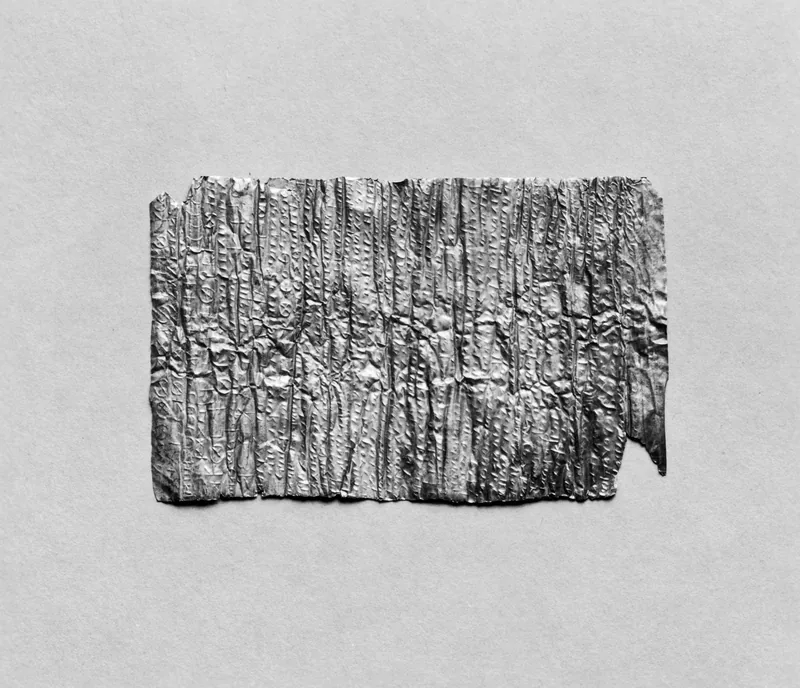
A well-known Greek example concerns Antaura, a demon of migraine. In the text, Antaura comes up out of the sea, shrieking like a hind and roaring like a cow, and is met by Artemis of Ephesus, who asks where she is going and turns her away from the sufferer's head. Versions of this story appear on late antique metal amulets and in later Greek and Syriac charm traditions, showing how a pagan narrative could be adapted and handed on for centuries.
Other lamellae address fever as a person to be driven out, adjure demons by the names of powerful gods or angels, or invoke the authority of Solomon, who in late antiquity was imagined as master of the demons (see Solomon the Exorcist in Antiquity). Their language is concrete and urgent, often closing with "now, now, quickly, quickly", a formula shared with spells in the papyri.
Jewish, Christian and Romano-British Lamellae§
Jewish communities of Roman and Byzantine Palestine produced metal amulets in Aramaic and Hebrew, inscribed on bronze, copper and silver, some found in or near synagogues. Joseph Naveh and Shaul Shaked edited a large group in Amulets and Magic Bowls (1985) and Magic Spells and Formulae (1993), showing their links with the Aramaic incantation bowls of Mesopotamia. They invoke angels and divine names against fever, the evil eye and evil spirits, and some name the client and the client's mother. Later Jewish amulet practice is described in Angelic Amulets in Jewish and Christian Folk Practice.
Christians took over the form. Christian lamellae quote the Lord's Prayer, the opening verses of the Gospels, the Trisagion ("Holy, holy, holy") and lists of saints. Church leaders were uneasy: the Council of Laodicea in the fourth century forbade clergy to make phylacteries, and preachers such as John Chrysostom condemned amulets while acknowledging how common they were. In 2024 archaeologists in Frankfurt announced that a tiny rolled silver sheet from a third-century grave, read by computed tomography, carried a Latin Christian text; if the dating holds, it is among the earliest evidence of Christianity north of the Alps.
Roman Britain has yielded several lamellae, including a gold sheet from the fort at Segontium (Caernarfon) with Greek letters spelling divine names and a row of charaktêres, and Latin lead and silver texts from shrines and towns. These finds show that the same amuletic culture reached the empire's northern frontier.
How Lamellae Were Found and Are Read Today§
Most lamellae come from graves, where they were buried with their owners, or from chance finds with little context. Rolled sheets are fragile, and early attempts to open them sometimes destroyed parts of the text. Conservators now flatten them slowly after treatment, or use X-ray and CT imaging to read the text without unrolling at all. Many lamellae remain unpublished in museum stores.
For historians they offer something rare: the names of ordinary clients, their fears and illnesses, and the words they trusted. They also show how freely ancient people combined Jewish, Greek, Egyptian and Christian elements in practice, whatever theologians said. The gold leaves placed in graves by Bacchic and Orphic initiates, discussed in Orphism and the Orphic Gold Tablets, are a related but distinct genre: they guide the dead rather than protect the living.
Frequently asked questions§
What is a lamella amulet?§
A lamella is a thin sheet of metal, usually gold, silver or bronze, inscribed with protective or healing text and signs. It was typically rolled and placed in a small capsule worn around the neck. Lamellae were used by pagans, Jews and Christians throughout the Roman world.
What do the Ketef Hinnom scrolls say?§
The two silver scrolls from Ketef Hinnom carry Hebrew texts close to the Priestly Blessing of Numbers 6:24–26, together with phrases asking for protection from evil. Most scholars date them to around 600 BCE, which makes them the oldest known texts parallel to a biblical passage.
How are rolled metal amulets read without damaging them?§
Conservators may slowly flatten a sheet after stabilising the metal, but many are now read by X-ray or computed tomography, which allows the text to be reconstructed digitally. This technique made it possible to read the third-century silver amulet from Frankfurt without opening it.
How do lamellae differ from curse tablets?§
Curse tablets were usually made of lead and deposited in graves, wells or sanctuaries to bind an opponent. Lamellae were mostly made of precious or durable metals and worn by their owners for protection and healing. Both rely on the power of written names and formulas.
Sources and further reading§
- Greek Magical Amulets: The Inscribed Gold, Silver, Copper, and Bronze Lamellae — Roy Kotansky, 1994
- Amulets and Magic Bowls: Aramaic Incantations of Late Antiquity — Joseph Naveh and Shaul Shaked, 1985
- Magic Spells and Formulae: Aramaic Incantations of Late Antiquity — Joseph Naveh and Shaul Shaked, 1993
- Ancient Jewish Magic: A History — Gideon Bohak, 2008
- The Transformation of Greek Amulets in Roman Imperial Times — Christopher A. Faraone, 2018
- Binding Words: Textual Amulets in the Middle Ages — Don C. Skemer, 2006