Liber II · Ancient Magic · Chapter II: Amulets & Talismans
The Sator Square: History and Meaning of the Ancient Word Square
The Sator square (SATOR AREPO TENET OPERA ROTAS) explained: the Pompeii graffiti, the Pater Noster theory, rival readings and its long life as a charm.

The Sator square is a five-by-five arrangement of the Latin words SATOR AREPO TENET OPERA ROTAS that reads the same forwards, backwards, upwards and downwards. Its earliest known examples were scratched on walls at Pompeii before the eruption of 79 CE, and for nearly two thousand years afterwards it was copied in churches, manuscripts and charm books as a protection against fire, fever, dog bites and witchcraft, while scholars still debate whether it began as a Christian cipher, a Jewish emblem or a clever Latin word game.
The Five Words and How the Square Works§
Written in a grid, the square's twenty-five letters produce the same five words whichever way they are read:
| S | A | T | O | R |
|---|---|---|---|---|
| A | R | E | P | O |
| T | E | N | E | T |
| O | P | E | R | A |
| R | O | T | A | S |
Four of the words are ordinary Latin. Sator means "sower" or "planter", and by extension "creator"; tenet means "holds"; opera is "work" or "with effort"; and rotas is "wheels". The fifth word, arepo, is not otherwise known in Latin. It has been explained as a proper name, as a borrowing of a Gaulish word for a plough, or simply as a filler demanded by the palindrome. A common rendering is "The sower Arepo holds the wheels with effort", but no translation has won general agreement, and some scholars doubt that the sentence was ever meant to make much sense.
What makes the square remarkable is its structure. TENET appears twice, across and down, crossing at the central N. The outer words mirror one another: SATOR read backwards is ROTAS, and AREPO reversed is OPERA. Many Latin palindromic sentences were composed as literary games, but a five-line square that is also a palindrome in every direction is unusually tight, and its compactness made it easy to remember, to scratch on a wall and to write on a scrap of parchment. In this respect it resembles the numerical squares described in Magic Squares, Kameas and Planetary Seals, though its power lay in letters rather than numbers.
The Pompeii Graffiti and Other Early Finds§
The decisive evidence for the square's age comes from Pompeii. A fragmentary example was found in 1925 in the house associated with Paquius Proculus, and a complete one, beginning with ROTAS, was discovered in 1936 scratched on a column of the Great Palaestra near the amphitheatre. Both must predate the burial of the city in 79 CE.
Other ancient examples come from the Roman garrison town of Dura-Europos on the Euphrates, abandoned around 256 CE, where several versions were found on walls of military buildings, and from Roman Britain. A square painted on wall plaster at Cirencester, ancient Corinium, came to light in 1868. A fragment of an amphora found in Manchester in 1978 bears part of the ROTAS form and has been dated to the late second century, though the dating and reading of this small piece have been questioned.
The early finds share one feature: they usually begin with ROTAS. The SATOR-first order became standard only later, in medieval copies. The geographical spread, from Italy to Syria to Britain, suggests that by the second and third centuries the square was known across the empire, often in military settings, and that soldiers and travellers may have carried it from place to place.
The Pater Noster Theory and Its Critics§
In the mid-1920s several researchers, among them the German pastor Felix Grosser, noticed independently that the square's letters could be rearranged into a cross formed by PATER NOSTER ("Our Father") written twice and sharing the central N. Two A's and two O's remain, which can be placed at the ends of the arms. Alpha and Omega, "the first and the last", is a title of Christ in the Book of Revelation, so the square appeared to be a concealed Christian prayer and symbol, devised at a time when Christians needed discretion.
The theory is elegant and still widely repeated, but it has serious difficulties. If the Pompeii examples are original, the square was in use before 79 CE, when the Lord's Prayer in its Latin form, the Alpha-Omega title and the cross as a Christian emblem are not well attested, and the presence of a Christian community at Pompeii is itself uncertain. Defenders reply that Christians were in Italy by the 50s, that Paul's letter to the Romans shows a community there, and that the graffito could have been scratched shortly before the eruption. Critics answer that A and O are Greek letter names forced onto a Latin puzzle, and that any twenty-five letters can be rearranged to yield some meaning if one looks hard enough.
Other Theories: Jewish, Mithraic and Playful§
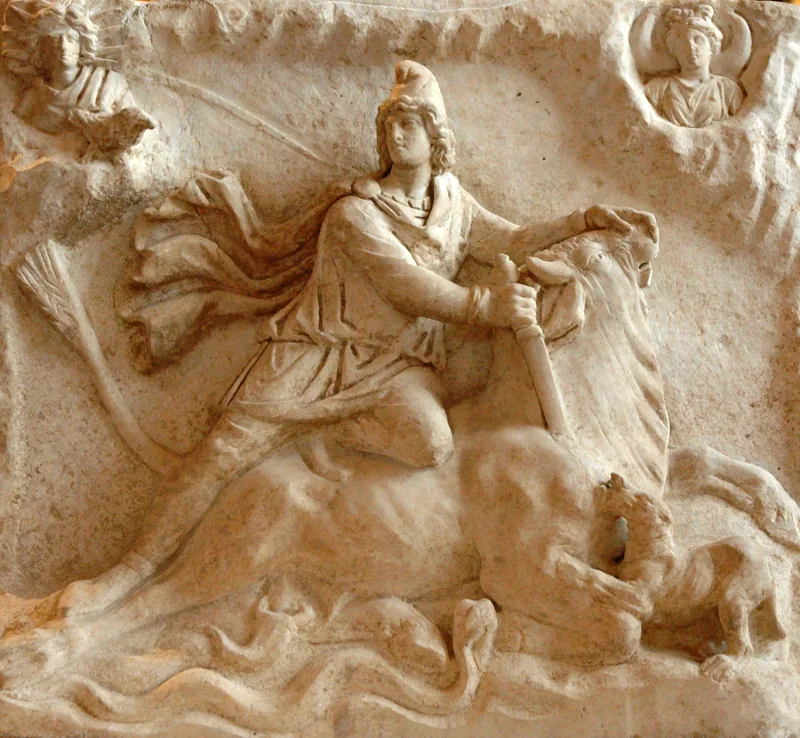
Several alternatives have been proposed. Some scholars suggest a Jewish origin, noting that Jews were certainly present in Campania, that the central TENET cross can be read as a tau, a sign of protection in Ezekiel 9, and that the square could have expressed devotion to the Creator, the sator. Walter O. Moeller argued in 1973 for a Mithraic and numerological reading tied to Roman astral religion, an interpretation that has found few followers but shows how open the square is to symbolic decoding.
A more sceptical view treats the square as a sophisticated piece of Latin wordplay, like other palindromes scratched on Pompeian walls, which acquired religious meaning only later. On this reading its ancient users enjoyed it as a puzzle and perhaps as a lucky sign, and Christians later recognised in it the hidden prayer and cross that made it suitable for their own use. Whatever its origin, it belonged to a wider ancient habit of investing written words and letter patterns with power, visible in the Greco-Roman magic of curse tablets and amulets and in formulas such as the abracadabra triangle described in the spellbook.
The Sator Square as a Medieval Charm§
Whatever its first meaning, by the early Middle Ages the square was firmly Christian and firmly protective. It appears in Carolingian manuscripts, in Byzantine and Coptic contexts, and in churches across Europe, carved on walls and floors in Italy and France. In Ethiopian Christian tradition its five words became names for the nails of Christ's cross, and in some Eastern Christian texts they were treated as the names of the shepherds at the Nativity. Such reinterpretations show the words being absorbed into sacred story once their Latin sense had faded.
Medieval healers and scribes used the square as a textual amulet. It was written on parchment, bread, cheese or fruit and given against fever, the bite of a mad dog, toothache and difficult childbirth, sometimes combined with names of God, saints or the Magi. Don Skemer's study of medieval textual amulets shows the Sator formula as one of the most widely copied protective texts, alongside Gospel verses and the names of the Seven Sleepers. The broader place of such written charms is described in Amulets and Talismans.
Fire Plates, Folk Medicine and Charm Books§
In the German-speaking lands of the early modern period the square became especially associated with fire. Pewter or wooden "fire plates" inscribed with the formula were kept in houses and, according to folk belief, could be thrown into a blaze to quench it. The square was also written on slips fed to animals against rabies and placed in stables against witchcraft.
German emigrants carried these uses to North America. The Pennsylvania German charm book of Johann Georg Hohman, published in 1820 and later translated as The Long Lost Friend, includes the square among its remedies, and it remained part of the healing repertoire described in Pennsylvania German Powwow. Through printed charm books and their reprints, the formula entered the wider world of popular magic surveyed in Folk Magic. A historical note on the practice appears in the spellbook entry on the Sator square charm.
The square has never lost its fascination. Twentieth-century scholars filled journals with competing solutions, and the five words have reappeared in novels, puzzles and films. For the historian of magic, its interest lies less in a single hidden key than in its long survival: a short Latin palindrome scratched on a Roman wall that became, for many centuries, a prayer, an amulet and a household guard against disaster.
Frequently asked questions§
What does SATOR AREPO TENET OPERA ROTAS mean?§
A literal rendering is "The sower Arepo holds the wheels with effort", but arepo is not a known Latin word and no translation is universally accepted. Many scholars think the square's structure mattered more than its sense.
Is the Sator square Christian?§
It was certainly used by Christians from late antiquity onward, and its letters can be rearranged as PATER NOSTER with A and O. Whether it was Christian in origin is disputed, because the earliest examples at Pompeii predate 79 CE, when Christian use of such symbols is not otherwise attested.
Where is the oldest Sator square?§
The oldest securely dated examples were scratched on walls at Pompeii, including one on a column of the Great Palaestra found in 1936. They must be earlier than the eruption of Vesuvius in 79 CE.
What was the Sator square used for?§
From the Middle Ages to the nineteenth century it served as a written charm against fire, fever, rabies, witchcraft and the dangers of childbirth, written on parchment, food or metal plates.
Sources and further reading§
- The Mithraic Origin and Meanings of the Rotas-Sator Square — Walter O. Moeller, 1973
- Binding Words: Textual Amulets in the Middle Ages — Don C. Skemer, 2006
- Magic in the Middle Ages — Richard Kieckhefer, 1989
- Charms, Charmers and Charming: International Research on Verbal Magic — Jonathan Roper, 2009
- The Long-Lost Friend: A 19th Century American Grimoire — Daniel Harms, 2012