Liber II · Ancient Magic · Chapter II: Amulets & Talismans
Graeco-Egyptian Magical Gems: Abrasax, Chnoubis and Womb Stones
Graeco-Egyptian magical gems explained: the Abrasax anguipede, Galen's Chnoubis stone, haematite womb amulets, their inscriptions and the 'Gnostic gem' myth.

Graeco-Egyptian magical gems are small engraved stones of the Roman imperial period, made roughly between the first and fourth centuries CE, that combine Egyptian, Greek and Jewish divine figures with secret names, vowel strings and symbols in order to heal, protect and bring favour to their wearers. Several thousand survive in museum collections. They include the cock-headed, snake-legged god usually labelled Iao or Abrasax, the lion-headed serpent Chnoubis worn against stomach complaints, and haematite "womb stones" carried by women to regulate the uterus.
What Graeco-Egyptian Magical Gems Are§
The term covers engraved gemstones that carry images or inscriptions intended to act on the world rather than simply to decorate or to serve as a seal. They are usually small ovals of a few centimetres, cut in intaglio on one or both faces and sometimes on the bevelled edge. Many were set in rings; others were mounted in pendants or bored to hang on a cord. Most come from the eastern Mediterranean, and the stylistic and textual evidence points to workshops in Roman Egypt, with others in Syria and Asia Minor, though exact findspots are known for only a small fraction of them.
They form part of a much older history of protective objects described in Amulets and Talismans: A History. What distinguishes them is their mixture of traditions. A single stone may show the Egyptian child-god Harpocrates seated on a lotus, frame him with an ouroboros serpent, and surround the scene with Greek letters spelling the Hebrew divine names Iao, Sabaoth and Adonai. The same mixture fills the handbooks discussed in The Greek Magical Papyri, whose recipes for engraving and consecrating stones show that gem and papyrus belonged to one professional culture.
The choice of stone mattered. Ancient lapidaries, such as the Greek poem known as the Orphic Lithika and the compilation called the Kyranides, credited minerals with sympathies and powers of their own. Green jasper, red jasper, haematite, lapis lazuli, chalcedony and the green, red-spotted heliotrope or bloodstone were especially favoured, and particular images tended to be cut in particular stones.
Abrasax, the Anguipede and the Number 365§
The figure most closely associated with magical gems is a composite being with the head of a cock, a human torso in a Roman cuirass and two serpents in place of legs. He usually holds a whip in one hand and a round shield in the other, and the shield very often bears the name IAŌ, the Greek rendering of a Hebrew divine name. Scholars call him the anguipede ("snake-footed"). On the reverse of the stone, or around the figure, the name ABRASAX frequently appears.
Abrasax (later spelled Abraxas) was a name of power in its own right. In Greek, letters also served as numerals, and the seven letters of ABRASAX add up to 365, the number of days in the solar year. The Christian heresiologist Irenaeus of Lyon, writing around 180 CE, reports that followers of the Alexandrian teacher Basilides gave the name Abrasax to the ruler of 365 heavens. This report is the origin of the long-standing assumption that the gems were Basilidean. In fact Abrasax appears as one divine name among many in the magical papyri, and there is no good evidence that the people who wore these stones belonged to a Gnostic sect.
The meaning of the anguipede's form is debated. The cock was a solar bird, the serpents suggest chthonic power, and the whip and shield belong to a warrior who drives away hostile forces. Whatever its origin, the anguipede was the most widely reproduced magical image of the imperial period, and it was used for general protection rather than for any single complaint.
Chnoubis and Galen's Stomach Stone§
A second large group shows a serpent with the head of a lion, crowned with seven or twelve rays, often accompanied by a sign of three S-shaped strokes crossed by a bar. The name inscribed beside it is usually Chnoubis or Chnoumis, a figure whose name has been linked with the Egyptian ram-god Khnum and with one of the astrological decans, the thirty-six star groups of Egyptian astronomy that each ruled ten degrees of the zodiac.
Chnoubis gems were medical amulets for the digestive organs. Many are cut in green stone, and the evidence of a physician confirms their use. In his treatise on simple drugs, Galen of Pergamum (129–c. 216 CE) mentions that some people wore green jasper engraved with a radiate serpent, as recommended in a book attributed to the legendary Egyptian king Nechepsos, to benefit the stomach and the oesophagus. Galen adds that he tested such stones himself and found them helpful even without the engraving, a remark that shows how respectable such amulets could be among the educated. Later lapidaries continued to recommend Chnoubis stones for the stomach, and the image survived into Byzantine and medieval collections.
Womb Stones and Haematite Gems§
Among the most numerous and specific magical gems are those made for the uterus. They are usually cut in haematite, a dark, heavy iron oxide whose name comes from the Greek word for blood, because its powder turns red. The typical design shows a stylised womb shaped like a cupping vessel or jar, closed at the mouth by a key, and enclosed by an ouroboros. Egyptian deities stand above or around it: Isis, Anubis, the household god Bes, Chnoubis, or a figure of the ram-headed creator. A recurring word on these stones is ORŌRIOUTH, a name associated specifically with uterine amulets, and many carry vowel series or short Greek commands addressed to the womb.
Ancient medicine, from the Hippocratic writers onward, often described the uterus as an organ that could move, open or close, and bleed in the wrong measure. The key on the gems has accordingly been read as a sign that the womb should be locked and held in place, for example to preserve a pregnancy or to stop heavy bleeding, while some designs may have been intended to open it at the right moment. They are also rare direct evidence for objects owned and worn by women in antiquity, since much of the literary record on women's health was written by men.
Other haematite gems were linked with blood in different ways. A well-known type shows a horseman spearing a prostrate female demon and names him Solomon, a theme discussed in Solomon the Exorcist in Antiquity; it was used against illness and demonic attack and was later absorbed into Christian and Byzantine protective imagery.
Inscriptions, Charaktêres and the Making of a Gem§
Inscriptions on magical gems are often more important than the images. They include the Greek vowels (alpha, epsilon, eta, iota, omicron, upsilon, omega) arranged in rows, triangles or wing-shaped diminishing patterns; divine names drawn from Egyptian, Greek, Jewish and Persian sources; palindromes such as ABLANATHANALBA; and long voces magicae, strings of sound that practitioners regarded as the true names of gods. Some stones bear charaktêres, letter-like signs with small circles at their ends, which modern writers sometimes call "ring letters" and which reappear in later Byzantine, Arabic and medieval European magic.
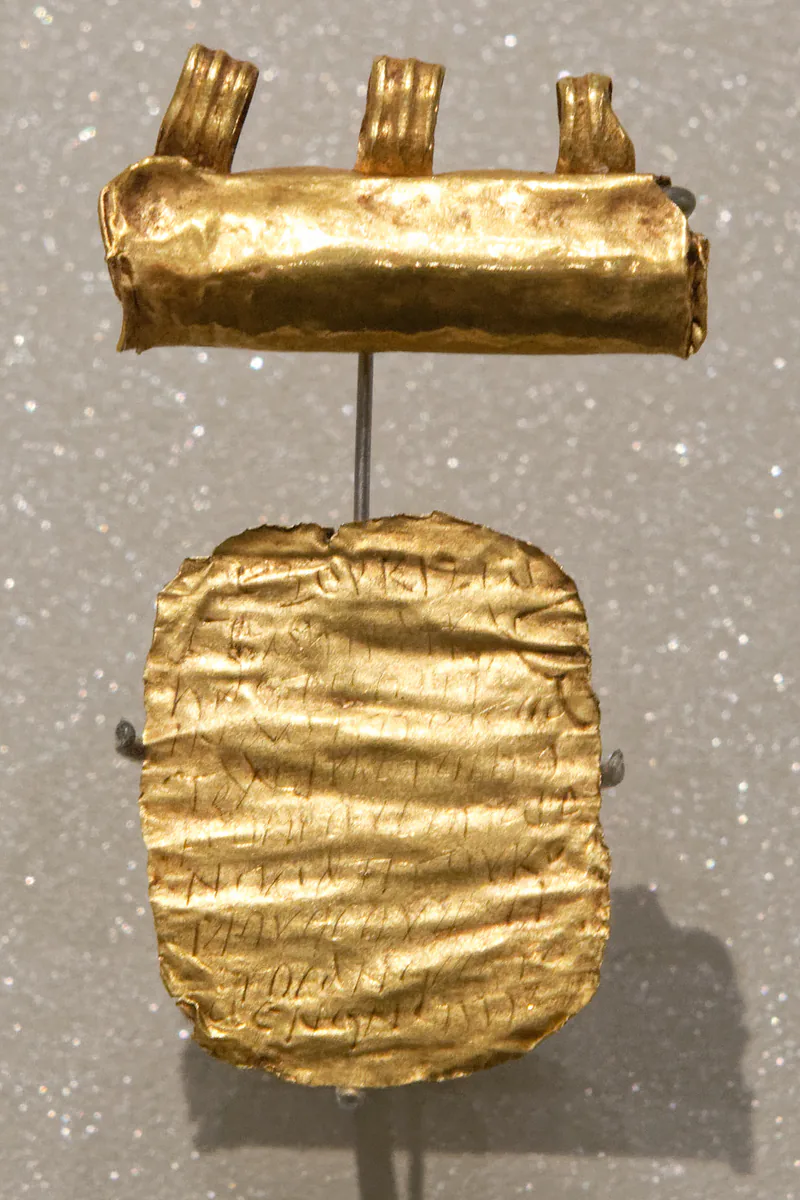
The papyri describe making such objects as a ritual act. A practitioner chose a suitable stone, engraved the figure and names, and then consecrated it with prayers, offerings and sometimes the breath or the recitation of the names. The finished gem might be "given life" in the same way that a statue was animated. Because the same designs recur across hundreds of examples, most buyers probably acquired them ready-made from workshops.
From "Gnostic Gems" to Modern Scholarship§
Magical gems were collected in Europe from the Renaissance onwards. Antiquarians, influenced by Irenaeus's remark about Abrasax, called them "Abraxas stones" or "Gnostic gems". A treatise on them by the French scholar Jean L'Heureux (Macarius), published with additions by Jean Chifflet in 1657 as Abraxas seu Apistopistus, established the label, and Bernard de Montfaucon illustrated many examples in his great survey of antiquities in the early eighteenth century. In 1864 the English collector Charles William King published The Gnostics and Their Remains, which presented the stones as relics of Gnostic religion and was widely read by occultists.
The shift to the modern view came with Campbell Bonner's Studies in Magical Amulets, Chiefly Graeco-Egyptian (1950). Bonner compared the gems systematically with the magical papyri and with medical writers, showed that most were practical amulets for health and protection, and introduced a typology still used today. Later catalogues, notably Simone Michel's Die magischen Gemmen (2004), and large scholarly databases have made thousands of examples comparable. Current research asks how gems relate to inscribed metal amulets, to the Egyptian amulet tradition from which many of their figures come, and to later medieval lapidaries.
The image of Abraxas also took on a new life in modern esotericism. Carl Gustav Jung's privately printed Seven Sermons to the Dead (1916) made Abraxas a god who unites opposites (see Jung's Red Book), and Hermann Hesse's novel Demian (1919) carried the name to a wide audience.
Frequently asked questions§
What is an Abraxas gem?§
An Abraxas gem is a Roman-period engraved stone bearing the name Abrasax (Abraxas), most often together with a cock-headed figure with serpent legs, a whip and a shield marked IAŌ. The name was valued because its letters total 365.
Were magical gems used by Gnostics?§
Irenaeus says that the followers of Basilides used the name Abrasax, which led collectors from the seventeenth century onward to call these stones "Gnostic gems". Modern scholarship regards that label as misleading: the images and names match the wider magical culture of Roman Egypt and its papyri, and the wearers were probably ordinary clients seeking health and protection.
What were haematite womb gems for?§
Haematite uterine amulets show a womb closed by a key within a serpent ring, often with Egyptian gods and the word ORŌRIOUTH. They were meant to keep the uterus in its proper place and to regulate bleeding and pregnancy, reflecting ancient medical ideas about the womb and the blood-like nature of haematite.
When were magical gems made?§
Most were made between the first and fourth centuries CE, with a peak in the second and third centuries. Some types continued into Byzantine times, and many were reused and copied in medieval and Renaissance Europe.
Sources and further reading§
- Studies in Magical Amulets, Chiefly Graeco-Egyptian — Campbell Bonner, 1950
- Die magischen Gemmen — Simone Michel, 2004
- The Transformation of Greek Amulets in Roman Imperial Times — Christopher A. Faraone, 2018
- The Gnostics and Their Remains, Ancient and Mediaeval — Charles William King, 1864
- The Greek Magical Papyri in Translation — Hans Dieter Betz (ed.), 1986
- Magic in the Ancient World — Fritz Graf, 1997