Birth lore · Your birthday
Gemstones · Birthstone of March and December
Bloodstone
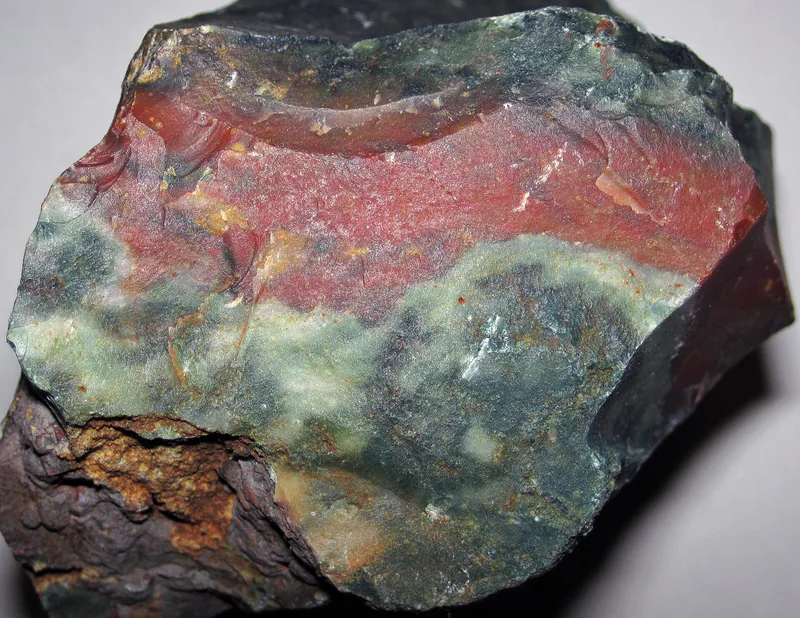
The dark green, red-spotted chalcedony that ancient writers called heliotrope, 'sun-turner'; Christian legend made it the stone of Christ's blood, and it is the traditional birthstone of March.
History and lore
The older name of bloodstone is heliotrope, Greek for "sun-turner". Pliny the Elder describes the heliotropium as a leek-green stone streaked with red, and explains the name by a curious property: placed in a basin of water in sunlight, it was said to turn the reflected light blood red. He adds, with open contempt, that the magi claimed the stone, combined with the herb of the same name and an incantation, would make its wearer invisible. The idea had a long life. In Boccaccio's Decameron (Day 8, story 3) the gullible painter Calandrino is persuaded to search the river Mugnone for the heliotrope, convinced it will make him invisible, and the joke depends on readers knowing the belief.
The name bloodstone comes from the red spots. In the later Middle Ages a Christian legend explained them as drops of Christ's blood that fell on a green stone at the foot of the cross, and bloodstone was carved with scenes of the Passion and the heads of martyrs. Some of the finest of these carvings date from the sixteenth and seventeenth centuries, and the stone is sometimes still called the martyr's stone.
In the traditions
Medieval lapidaries gave bloodstone (often under the names heliotrope or jasper) the power to stanch bleeding, a belief that follows from its colour and was applied by laying the stone on wounds or wearing it; it has no such medical effect. Renaissance magical writers, among them Agrippa, placed the heliotrope among the solar stones, as its name suggests. Modern correspondence tables more often give it to Mars, the planet of blood and iron, and to Aries.
Bloodstone has no clear place in the breastplate lists or the Navaratna, though some writers have suggested that one of the breastplate's jaspers might have been a dark green stone of this kind. For the green jaspers and chalcedonies in general, see jasper.
Meaning and symbolism
Bloodstone is the traditional March stone of the old "Gregorian" list of month poems published by Tiffany & Co. around 1870, and the American list of 1912 kept it beside aquamarine (see March). It also appears under December in some older lists. Its symbolism of courage, vitality and sacrifice comes from the red-on-green colouring and the Passion legend. These are traditional associations; scientific studies have not found that stones influence health or strength.
The mineral
Bloodstone is a variety of chalcedony, the fine-grained, compact form of quartz. Its dark green body colour comes from tiny inclusions of green minerals such as chlorite or hornblende, and its red spots from iron oxides. Similar stone with few or no red spots is called plasma. India, especially the Deccan region, has long been the main source, with others in Brazil, Australia and the United States.
Bloodstone is tough and takes a fine polish, which made it a favourite material for seals, signet rings and carved cameos. Imitations are uncommon, though dyed chalcedony and glass are occasionally seen; natural bloodstone shows irregular spots of different sizes rather than a uniform pattern. At 6.5 to 7 on the Mohs scale it is durable; clean with mild soap and water and avoid harsh chemicals that can affect the spots.
Sources and further reading
- Natural History, Book 37 — Pliny the Elder, c. 77 CE
- The Decameron — Giovanni Boccaccio, c. 1353
- The Curious Lore of Precious Stones — George Frederick Kunz, 1913
- Magical Jewels of the Middle Ages and the Renaissance — Joan Evans, 1922
- Three Books of Occult Philosophy — Heinrich Cornelius Agrippa, 1533
- Gemstones of the World — Walter Schumann, 1977 (later editions)