Birth lore · Your birthday
Gemstones · Birthstone of March
Jasper
Jasper is opaque, richly coloured quartz used for seals and amulets since antiquity; it is the first foundation of Revelation's heavenly city, though the ancient 'jasper' may have been a different, translucent stone.
History and lore
Jasper is one of the oldest gem names in continuous use. The Greek and Latin iaspis comes from a Semitic word found in Hebrew as yashpheh and in Akkadian as yashpu, and the stone was carved into cylinder seals in Mesopotamia, amulets in Egypt and seals in Minoan Crete. Yet the name poses a puzzle. Pliny the Elder describes the best iaspis as green and often translucent, and Revelation compares jasper to crystal. The modern jasper, by definition opaque, cannot be as clear as crystal, so the ancient name may often have referred to green chalcedony or other translucent stones. Scholars therefore treat every ancient mention of jasper with caution.
Opaque jasper in the modern sense has nonetheless been worked everywhere. Florentine craftsmen used it extensively in pietre dure, inlaid pictures in hardstone, especially after the Medici founded their grand-ducal workshop in 1588. The potter Josiah Wedgwood named his matte stoneware "jasperware" in the 1770s after the stone's look, though it contains no jasper.
In the traditions
Jasper is the twelfth stone of the High Priest's breastplate in the King James Bible: "a beryl, and an onyx, and a jasper" (Exodus 28:20). In Revelation the one seated on the throne appears "like a jasper and a sardine stone" (Revelation 4:3), the light of the holy city is compared to jasper, its wall is built of jasper, and jasper is the first of its twelve foundations (Revelation 21). As with the other breastplate stones, the identifications rest on ancient translations, and the jasper of these texts may not be the stone sold under that name today.
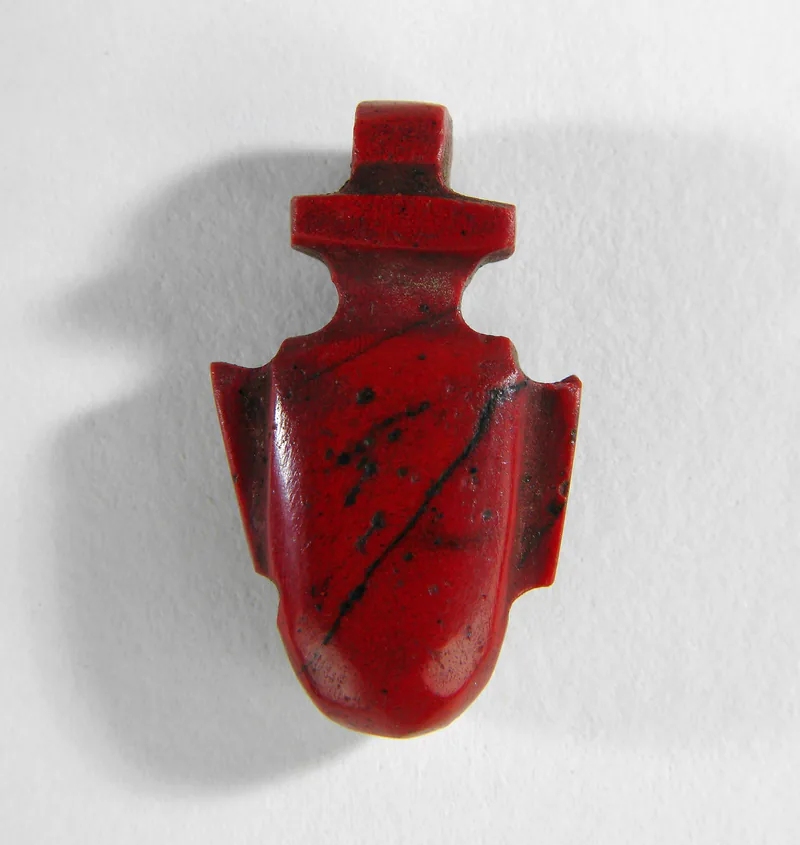
In Egypt the tit amulet, the knot of Isis, was to be made of red jasper according to spell 156 of the Book of the Dead, the colour standing for the goddess's protective blood. Medieval lapidaries in Marbode's tradition credited jasper with checking bleeding and helping women in childbirth; these are historical beliefs, not remedies. Agrippa distributes jaspers by colour among several planets, giving jasper to Mars, green jasper to Jupiter and Venus, and brown jasper to Saturn; this entry follows the Martial attribution. Older month lists give jasper to March, now held by bloodstone, a green chalcedony or jasper spotted with red, and aquamarine.
Meaning and symbolism
Jasper's opaque, earthy colours make it a stone of endurance, stability and protection, and red jasper in particular of blood and vitality. In Christian allegory the jasper that begins the foundations of the heavenly city was often read as faith, the first and firmest of virtues, though medieval interpretations vary. Modern crystal books call jasper a "nurturing" stone; scientific studies have not found that stones have healing or protective effects.
The mineral
Jasper is microcrystalline quartz with a granular texture that can contain up to about a fifth of other minerals, which make it opaque and give its colours: haematite for reds, goethite for yellows and browns, and chlorite or other minerals for greens. Patterned varieties carry descriptive or trade names, such as picture jasper, orbicular "ocean jasper" from Madagascar, ribbon jasper and Biggs jasper from Oregon; some stones sold as jasper are really other rocks, such as rhyolite.
Jasper has a hardness of 6.5–7, is tough and takes a high polish, which suits it to carving, beads and inlay. Imitations include dyed howlite or magnesite marketed under names such as "imperial jasper" or "sea sediment jasper", and glass. Clean jasper with warm soapy water; it needs no special care.
Sources and further reading
- Exodus 28; Revelation 4 and 21 — King James Bible, 1611
- Natural History, Book 37 — Pliny the Elder, c. 77 CE
- The Egyptian Book of the Dead (Papyrus of Ani) — E. A. Wallis Budge (trans.), 1895
- De lapidibus — Marbode of Rennes, c. 1090
- Three Books of Occult Philosophy — Heinrich Cornelius Agrippa, 1533
- The Curious Lore of Precious Stones — George Frederick Kunz, 1913