Birth lore · Your birthday
Gemstones · Birthstone of March and October
Aquamarine
The sea-blue beryl of March, the stone of sailors in later folklore, whose clear crystals gave Europe its scrying 'beryls' and the German word for spectacles.
History and lore
Aquamarine takes its name from the Latin aqua marina, "sea water", a name used for the stone from the early modern period. The ancients knew it simply as a kind of beryl. Pliny the Elder, who devoted a passage of his Natural History to beryls, praised most highly those that imitate the clear green of the sea, and he reports that gem cutters shaped them as long six-sided prisms to bring out their colour, following the natural form of the crystal.
The clarity of beryl made it a material for lenses and for gazing. Medieval and Renaissance scryers used polished crystal balls and beryls, and "beryl" became a general English word for a scrying crystal. The German word for spectacles, Brille, is usually derived from beryllus, because early reading lenses were sometimes ground from clear beryl. In later folklore aquamarine became a talisman of sailors, said to calm storms and guard against seasickness; these associations are found mainly in nineteenth- and twentieth-century gem books, and their age is hard to establish.
In the traditions
In the King James Version the first stone of the fourth row of the High Priest's breastplate (Exodus 28:20) is called "beryl", translating the Hebrew tarshish. The word may refer to a stone named after Tarshish, a distant trading place, and some scholars think it meant a yellow stone such as chrysolite, so the link with aquamarine is uncertain. Revelation 21:20 names beryl as the eighth foundation stone of the heavenly Jerusalem.
Older lists of month stones, including one that George Frederick Kunz attributed to Jewish tradition and that follows the order of the breastplate, assign beryl to October, which is why aquamarine appears as a traditional October stone (see October). Aquamarine has no place in the Navaratna, though some modern Vedic astrologers associate it with the Moon or with Saturn. Western crystal books link it with water and therefore with the Moon and with Pisces.
Meaning and symbolism
The American jewellers' list of 1912 gave March to bloodstone and aquamarine together, and aquamarine has since become the more popular choice (see March and bloodstone). Its modern meanings are calm, clarity, courage and safe passage over water. These are symbolic and folkloric associations; scientific study has not found that gemstones influence mood, health or luck.
The mineral
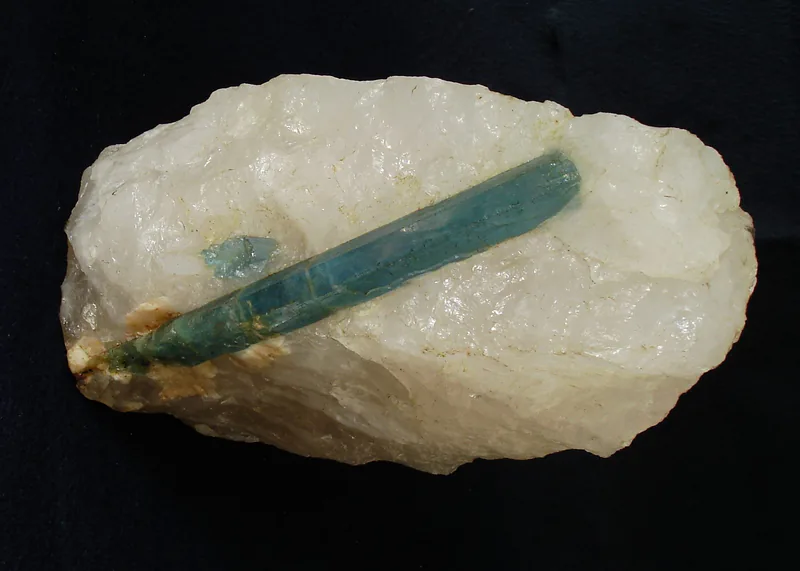
Aquamarine is beryl coloured by iron, the same mineral that, coloured by chromium or vanadium, becomes emerald. It forms in granite pegmatites, where crystals can grow very large and clean. Brazil, especially Minas Gerais, is the classic source; others include Madagascar, Mozambique, Nigeria, Zambia and Pakistan. The Dom Pedro aquamarine, an obelisk of about 10,000 carats cut from a single Brazilian crystal, is in the Smithsonian Institution.
Most aquamarine on the market is heated to remove a greenish or yellowish tint and leave a purer blue; the treatment is stable and generally accepted. Blue topaz, synthetic spinel and glass are the usual imitations; aquamarine is doubly refractive and, unlike glass, cool to the touch and free of bubbles. With a hardness of 7.5 to 8 it is durable, though a blow can chip it. Clean with warm soapy water.
Sources and further reading
- Natural History, Book 37 — Pliny the Elder, c. 77 CE
- The Curious Lore of Precious Stones — George Frederick Kunz, 1913
- Gems: Their Sources, Descriptions and Identification — Robert Webster, 1962 (6th ed., ed. Michael O'Donoghue, 2006)
- Gemstones of the World — Walter Schumann, 1977 (later editions)
- English Mediaeval Lapidaries — Joan Evans and Mary S. Serjeantson (eds.), 1933