Birth lore · Your birthday
Gemstones · Birthstone of May
Emerald
The green beryl of May, mined in Roman Egypt and later in Colombia, praised by Pliny as the most restful of colours, linked with the Emerald Tablet of Hermes, and the Navaratna stone of Mercury.
History and lore
The Greek smaragdos, from which "emerald" descends through Latin and Old French, was used in antiquity for many green stones, so not every ancient "emerald" was the beryl we know. True emerald was mined in Egypt's Eastern Desert, at sites such as Wadi Sikait, in Ptolemaic and Roman times; the popular name "Cleopatra's mines" is romantic rather than documented, and claims of older pharaonic working are doubtful. Pliny the Elder ranked the emerald third among gems and said nothing was more restful to the eye, reporting that gem engravers rested their tired eyes on it and that Nero watched gladiators in a smaragdus.
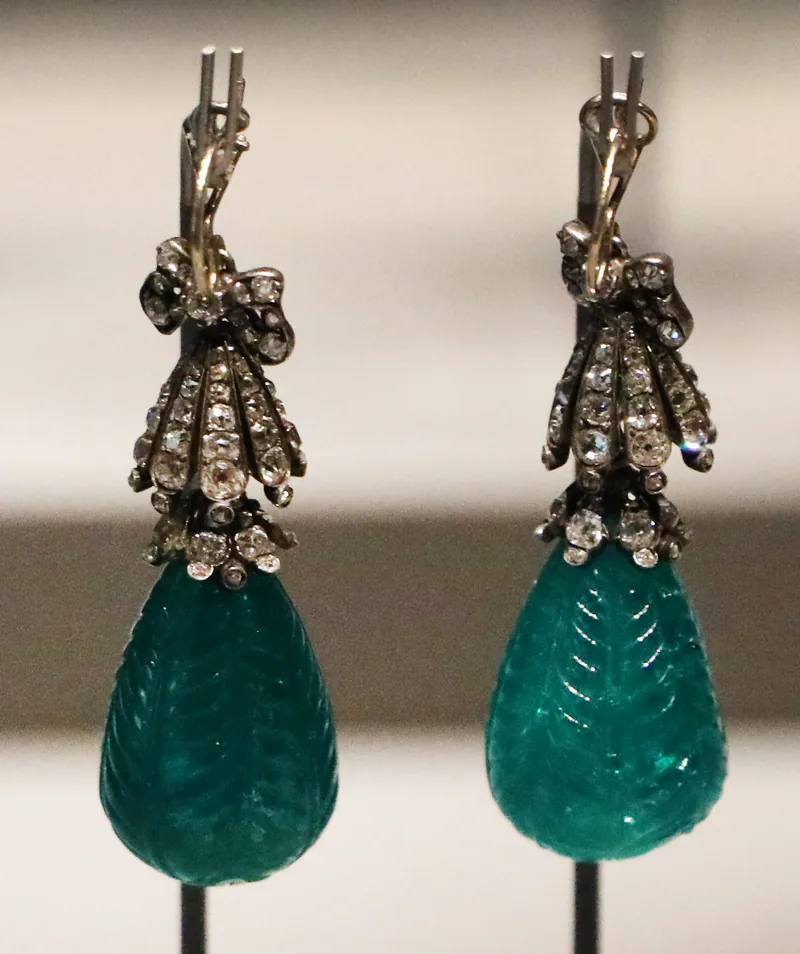
The richest emeralds came from the Americas. The Muisca of present-day Colombia worked the deposits of Muzo and Chivor long before the Spanish conquest, and from the sixteenth century Spanish ships carried Colombian stones to Europe, and through trade to the Ottoman and Mughal courts. Mughal jewellers carved large emeralds with flowers and inscribed some with prayers; one well-known carved stone, the "Mogul Emerald", bears a date corresponding to 1695.
In the traditions
In the King James Version the first stone of the second row of the High Priest's breastplate (Exodus 28:18) is an "emerald", though the Hebrew nophek is uncertain and the Greek Septuagint renders it differently. Revelation describes a rainbow around the heavenly throne "in sight like unto an emerald" (4:3) and names emerald as the fourth foundation of the New Jerusalem (21:19).
The most famous text of Western esotericism, the Emerald Tablet, takes its name from the green stone on which Hermes was said to have inscribed it; the text itself survives first in Arabic sources of about the eighth or ninth century, and "emerald" there probably means any precious green stone. A legend elaborated by later esoteric writers says the Holy Grail was cut from an emerald that fell from Lucifer's crown.
In Vedic astrology emerald (panna, Sanskrit marakata) is the Navaratna stone of Mercury, Budha (see Vedic astrology). Agrippa lists the emerald under more than one planet, including Jupiter, Venus and Mercury, and Western tables most often give it to Venus. In Islamic culture green is the colour of paradise, which added to the stone's prestige.
Meaning and symbolism
Emerald is the May birthstone in both the traditional and modern lists (see May), and the stone of the fifty-fifth wedding anniversary. It stands for spring, renewal, hope and faithful love; medieval lapidaries held that it revealed the truth of lovers' vows and strengthened the eyes. These are traditional associations; no scientific study has shown that emeralds heal or influence fortune.
The mineral
Emerald is beryl coloured green by chromium, vanadium or both, the same mineral as aquamarine. Because chromium and beryllium rarely meet in the same rocks, emerald forms only in unusual geological settings, and nearly every crystal contains inclusions, the "garden" (French jardin) that gem dealers accept as natural. Colombia remains the classic source; Zambia, Brazil, Afghanistan's Panjshir Valley, Pakistan, Ethiopia and the Russian Urals are also important.
Almost all emeralds are treated by filling surface-reaching fissures with oil or resin to hide them; the practice is centuries old but should always be disclosed. Synthetic emeralds have been grown since the 1930s by flux and hydrothermal methods; imitations include green glass and assembled stones. Emerald is hard (7.5 to 8) but brittle, so avoid knocks, heat, ultrasonic cleaners and solvents, which can remove the filling. Clean gently with lukewarm water.
Sources and further reading
- Natural History, Book 37 — Pliny the Elder, c. 77 CE
- The Curious Lore of Precious Stones — George Frederick Kunz, 1913
- Three Books of Occult Philosophy — Heinrich Cornelius Agrippa, 1533
- Brihat Samhita — Varahamihira, 6th century
- Gems: Their Sources, Descriptions and Identification — Robert Webster, 1962 (6th ed., ed. Michael O'Donoghue, 2006)
- The Emerald Tablet (Tabula Smaragdina), Arabic recension c. 8th–9th century