Liber XII · Hermeticism · Chapter IV: Emerald Tablet
The Emerald Tablet of Hermes: Origins, Text and Meaning
The Emerald Tablet of Hermes Trismegistus explained: its Arabic origins, Latin translations, alchemical readings, Newton's version and 'as above, so below'.

The Emerald Tablet (Latin Tabula Smaragdina) is a brief, cryptic text of about a dozen sentences attributed to Hermes Trismegistus, which became the most quoted founding document of Western alchemy. Its earliest known versions are in Arabic, most famously at the end of the Book of the Secret of Creation ascribed to "Balinus" (Apollonius of Tyana), usually dated to the eighth or ninth century CE. Translated into Latin in the twelfth century, it gave the world the principle summarised as "as above, so below," and was later translated by Isaac Newton.
What the Emerald Tablet Says§
The text is short enough to summarise sentence by sentence, though its wording differs between versions. In the standard medieval Latin form it proceeds roughly as follows.
It opens by declaring that what follows is true, certain and without falsehood. It then states that what is below corresponds to what is above, and what is above to what is below, so as to accomplish the wonders of a single thing. Just as all things came from the One through the meditation or mediation of the One, so all things are born from this one thing by adaptation.
The tablet then gives the one thing a genealogy: its father is the Sun, its mother the Moon, the wind carried it in its belly, and its nurse is the Earth. It is the father of all perfection (the obscure Latin word telesmus) in the whole world, and its power is complete if it is turned into earth. The reader is told to separate earth from fire and the subtle from the gross, gently and with great skill. The substance rises from earth to heaven and descends again to earth, receiving the power of things above and below. By this means one will have the glory of the whole world, and all obscurity will flee.
The closing lines describe this power as the strongest of all strengths, able to overcome every subtle thing and penetrate every solid one. Thus the world was created, and from this come marvellous adaptations. The speaker identifies himself as Hermes, called Thrice-Great because he possesses the three parts of the philosophy of the whole world, and ends by saying that what he has said about the operation of the Sun is complete.
The famous phrase "as above, so below" is a later compression of the second sentence. The Latin vulgate reads quod est inferius est sicut quod est superius, literally "that which is below is like that which is above."
Arabic Origins: Balinus and the Secret of Creation§
For centuries readers assumed that the Emerald Tablet was a translation of an ancient Egyptian or Greek inscription. Twentieth-century scholarship established that its earliest attested forms are in Arabic. The German historian of chemistry Julius Ruska gathered and compared these versions in his monograph Tabula Smaragdina (1926), and later work, notably Ursula Weisser's critical study of the Secret of Creation, refined the picture.
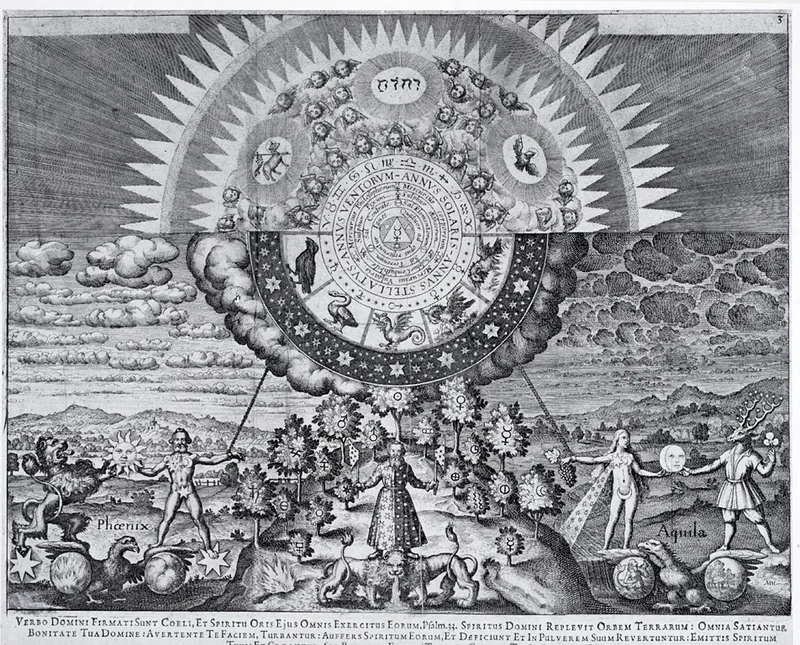
The Sirr al-khalīqa§
The most important source is the Kitāb sirr al-khalīqa wa-ṣanʿat al-ṭabīʿa (Book of the Secret of Creation and the Art of Nature), attributed to Balīnūs, the Arabic name for Apollonius of Tyana, the first-century Pythagorean wonder-worker. The work is a cosmological treatise explaining how the world arose from a primal principle and how the four natures (hot, cold, moist and dry) combine to form minerals, plants and animals. Its theory that metals are formed from sulphur and mercury became foundational for Arabic and later Latin alchemy. Scholars generally place its composition in the late eighth or early ninth century, perhaps during the reign of the caliph al-Maʾmūn (813–833), though some argue that it reworks earlier Greek or Syriac material.
The tablet appears at the end of the book within a frame story. Balinus relates that he entered a vault beneath a statue of Hermes, where he found an old man seated on a throne, holding an emerald tablet inscribed with the words that follow, and a book explaining the secrets of creation. This legend of discovery in a hidden chamber, later elaborated with variants that credit Alexander the Great or Sarah, the wife of Abraham, gave the text its aura of recovered antiquity.
Other Arabic witnesses§
A version of the tablet also appears in a work of the Jabirian corpus, the alchemical writings attributed to Jābir ibn Ḥayyān, which the historian E. J. Holmyard identified in the 1920s. Another occurs in some recensions of the Sirr al-asrār (Secret of Secrets), a popular advice book presented as Aristotle's counsel to Alexander. Whether a Greek or Syriac original lies behind the Arabic remains debated; Kevin van Bladel's The Arabic Hermes (2009) shows how Arabic authors developed their own image of Hermes as an antediluvian prophet, sometimes identified with the Qur'anic Idrīs.
Latin Translations of the Tabula Smaragdina§
The tablet entered Latin Europe in the twelfth century, the great age of translation from Arabic. Hugo of Santalla translated the Secret of Creation as De secretis naturae, including a version of the tablet. A shorter, freestanding Latin version, conventionally called the "vulgate," circulated independently and became the standard text. A version also travelled with the Latin Secretum secretorum, which was widely read as a mirror for princes.
In the fourteenth century an author writing under the name Hortulanus ("the gardener") composed a commentary on the vulgate, reading every line as a concealed description of the preparation of the philosophers' stone. Hortulanus' interpretation was copied with the text in numerous manuscripts and later printed collections, and it set the template for how alchemists read the tablet for the next three centuries. Printed editions from the sixteenth century, including the alchemical anthologies of the period, spread the text across Europe. Its passage from Arabic to Latin learning is part of the wider story told in our history of Western alchemy.
Alchemical Readings of the Emerald Tablet§
Medieval and early modern alchemists treated the tablet as a compressed recipe for the Great Work. In the most common reading, the "one thing" is the prime matter of the philosophers' stone. Sun and Moon stand for the alchemical principles symbolised by gold and silver, or by sulphur and mercury, the two parents whose union generates the stone. The wind that carries it signifies volatile processes such as sublimation and distillation, while the earth that nurses it is the fixed, solid state into which the volatile spirit must be bound.
The instruction to separate earth from fire and the subtle from the gross was read as a description of purification. The rising from earth to heaven and descending again matched the repeated cycles of distillation and cohobation in which a substance is vaporised and condensed many times. The final claim that the power penetrates every solid thing suited the properties expected of the finished stone, which was thought to transmute base metals and heal the body.
Other readers emphasised cosmology rather than laboratory practice. In Renaissance natural philosophy, influenced by the newly translated Corpus Hermeticum, the correspondence of above and below expressed the doctrine of macrocosm and microcosm: the human being as a small world reflecting the structure of the great one. Thinkers such as Cornelius Agrippa built on this idea when they described how celestial influences descend through a chain of correspondences into stones, plants and human bodies.
Isaac Newton's Translation and Commentary§
Among the large body of alchemical manuscripts left by Isaac Newton is an English translation of the Emerald Tablet with a commentary, now held at King's College, Cambridge, as Keynes MS 28. It is usually dated to the 1680s or early 1690s, the period of Newton's most intense alchemical work. His rendering of the second sentence begins: "That which is below is like that which is above & that which is above is like that which is below..."
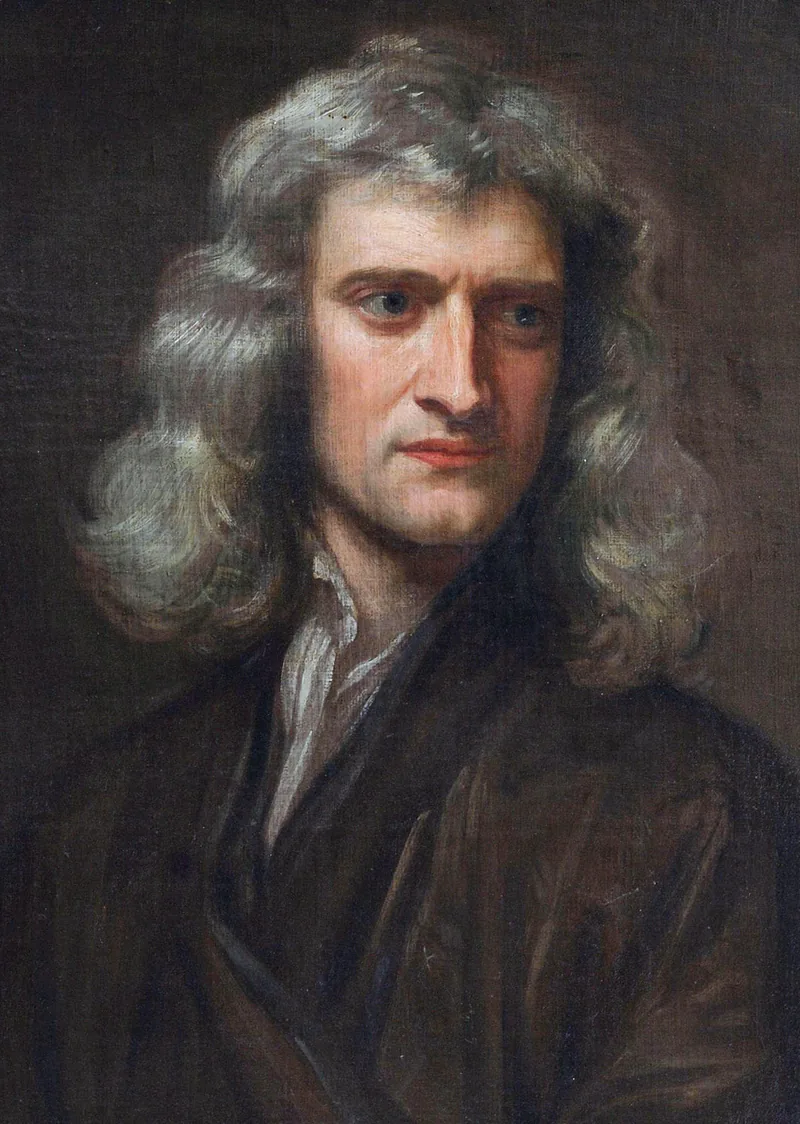
Newton's commentary interprets the text in terms of chemical operations and the generation of a vital, active principle in matter. The historian Betty Jo Teeter Dobbs, who studied this manuscript closely in The Janus Faces of Genius (1991), argued that Newton saw alchemy as a means of investigating the active spirit through which God acts in nature, and that these concerns were bound up with his theology and physics. Newton's translation, made public through the dispersal and study of his papers in the twentieth century, has become one of the best-known English versions.
"As Above, So Below" in Modern Esotericism§
In the nineteenth and twentieth centuries the Emerald Tablet moved from the alchemical laboratory into the broader occult revival. Helena Blavatsky cited it, the Hermetic Order of the Golden Dawn treated it as part of its Hermetic inheritance, and popular works such as The Kybalion (1908) turned "as above, so below" into a general "principle of correspondence." In these settings the phrase became shorthand for the idea that patterns at one level of reality, from the stars to the human psyche, reflect patterns at every other level.
A more speculative modern literature claims that the tablet came from Atlantis or from an advanced lost civilisation, and some books present an entirely different modern text as "the Emerald Tablets of Thoth." These works have no connection with the historical Arabic and Latin text. Comparative studies sometimes also set the tablet beside the inner alchemy of China, discussed in our article on Taoist internal alchemy, where cosmic and bodily processes are likewise understood to correspond, although the two traditions developed independently.
Frequently asked questions§
Who wrote the Emerald Tablet?§
It is attributed to Hermes Trismegistus, but its real author is unknown. The earliest surviving versions are Arabic, embedded in works such as the Secret of Creation attributed to Balinus, and most scholars date them to the eighth or ninth century. Whether they translate a lost Greek or Syriac original is uncertain.
Does the original emerald tablet exist?§
No physical tablet has ever been found. The emerald slab held by Hermes in a hidden vault is part of a literary frame story that accompanied the text in Arabic sources and lent it an air of great antiquity.
What does "as above, so below" mean?§
It condenses the tablet's second sentence, which says that what is below corresponds to what is above. Alchemists read it as describing the link between heavenly and earthly substances in the Great Work, while later esotericists took it as a general principle that the microcosm mirrors the macrocosm.
Did Isaac Newton practise alchemy?§
Yes. Newton wrote and copied a very large number of pages on alchemy, including a translation of and commentary on the Emerald Tablet. Historians such as B. J. T. Dobbs have argued that this work was closely connected with his natural philosophy and theology.
Is the Emerald Tablet part of the Corpus Hermeticum?§
No. The Corpus Hermeticum is a collection of Greek philosophical treatises from the Roman period, while the Emerald Tablet is a short alchemical text first known in Arabic. Both are attributed to Hermes Trismegistus and belong to the broader Hermetic tradition.
Sources and further reading§
- Tabula Smaragdina: Ein Beitrag zur Geschichte der hermetischen Literatur — Julius Ruska, 1926
- Das "Buch über das Geheimnis der Schöpfung" von Pseudo-Apollonios von Tyana — Ursula Weisser, 1980
- Hermès Trismégiste: La Table d'émeraude et sa tradition alchimique — Didier Kahn, 1994
- The Arabic Hermes: From Pagan Sage to Prophet of Science — Kevin van Bladel, 2009
- The Janus Faces of Genius: The Role of Alchemy in Newton's Thought — Betty Jo Teeter Dobbs, 1991
- The Secrets of Alchemy — Lawrence M. Principe, 2013