Liber I · Alchemy · Chapter VI: Spiritual Alchemy
Spiritual Alchemy: History of the Inner Reading of the Great Work
Spiritual alchemy explained: religious themes in early alchemy, Khunrath and Boehme, the Victorian spiritual reading, Jung and the historians' debate.

Spiritual alchemy is the interpretation of alchemy as a process of inner, moral or psychological transformation rather than, or as well as, a laboratory craft: the "base metal" is the unrefined self and the "gold" is the purified soul or the integrated personality. Religious language was part of alchemy from its beginnings, but the view that alchemy was essentially spiritual was developed mainly in the nineteenth century and popularised in the twentieth by C. G. Jung; historians now debate how far it reflects what premodern alchemists actually believed.
Religious language in early alchemy§
Even the earliest alchemists did not separate matter and spirit as moderns do. Zosimos of Panopolis, writing around 300 CE, urged his correspondent Theosebeia to calm her passions and turn to the divine, and his visionary dreams of figures tortured and transformed on an altar mixed chemical meaning with religious imagery. Greek alchemical writers spoke of "bodies" and "spirits" in metals and of the release of a volatile "soul" from matter. Byzantine commentators such as Stephanus of Alexandria gave the art a markedly devotional and philosophical tone.
In the Islamic world and in medieval Latin Europe, alchemy was usually treated as a branch of natural philosophy, yet it was framed by religious belief. Practitioners prayed for success, attributed the secret to divine revelation and insisted on purity of life. The death and resurrection of matter in the vessel naturally suggested the passion of Christ, and by the late Middle Ages some texts drew an explicit parallel between the Stone and Christ. The fifteenth-century Aurora consurgens, falsely attributed to Thomas Aquinas, weaves alchemical teaching into the language of the biblical Wisdom books. The broader setting appears in What Is Alchemy?.
Laboratory and oratory in the early modern period§
In the sixteenth and seventeenth centuries alchemy became entangled with new forms of Christian mysticism and reform. The physician Heinrich Khunrath published Amphitheatrum sapientiae aeternae (1595, enlarged 1609), whose famous engraving shows a room divided between an oratory, where the alchemist kneels in prayer, and a laboratory. The joining of ora et labora, prayer and work, captured his conviction that chemical and spiritual illumination belonged together.
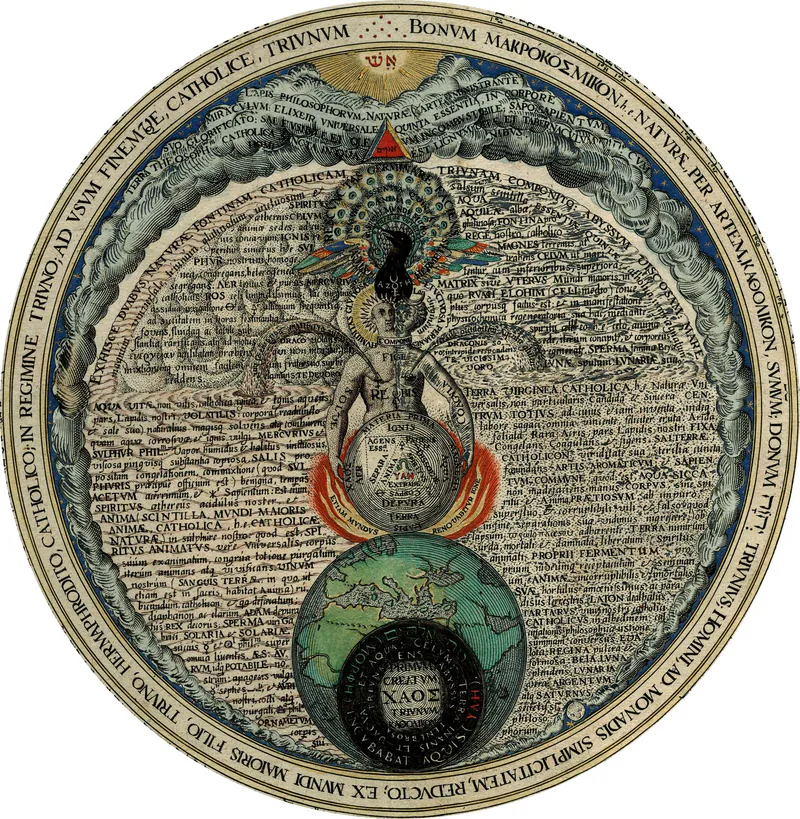
The German shoemaker and mystic Jacob Boehme used alchemical terms such as sulphur, mercury and salt, and the language of tincture and rebirth, to describe the divine nature and the regeneration of the soul, and his followers developed a "theosophical" alchemy. The Rosicrucian manifestos (1614–1616) promised reform of learning and religion and spoke of alchemical gold as secondary to true wisdom. In England, Thomas Vaughan wrote mystical alchemical treatises in the 1650s. Such authors show that a spiritual dimension existed well before the modern era, though usually alongside real laboratory practice rather than in place of it.
The Victorian spiritual interpretation§
The idea that alchemy had never really been about chemistry at all crystallised in the mid-nineteenth century. In 1850 Mary Anne Atwood published A Suggestive Inquiry into the Hermetic Mystery, which argued that alchemy was a secret science of the soul connected with mesmeric trance. She and her father, alarmed at its reception, withdrew and destroyed most copies soon after publication. In 1857 the American soldier Ethan Allen Hitchcock published Remarks upon Alchemy and the Alchemists, contending that the alchemists' true subject was man and his moral perfection.
These readings suited an age in which chemistry had become a professional science and in which occultists sought a spiritual alternative to materialism. The Hermetic Order of the Golden Dawn incorporated alchemical symbolism into its grades, and A. E. Waite edited and translated alchemical texts for a new esoteric readership. In 1914 the Viennese psychoanalyst Herbert Silberer published Probleme der Mystik und ihrer Symbolik (translated as Problems of Mysticism and Its Symbolism), the first sustained psychological interpretation of an alchemical parable.
Jung and psychological alchemy§
The Swiss psychiatrist C. G. Jung (1875–1961) made spiritual alchemy famous. From the late 1920s he collected alchemical books and came to believe that alchemists, unable to see into matter, had projected the contents of their own unconscious onto the processes in the flask. Their images of dragons, marriages, deaths and rebirths were, he argued, symbols of a psychological transformation he called individuation: the integration of the conscious and unconscious personality.
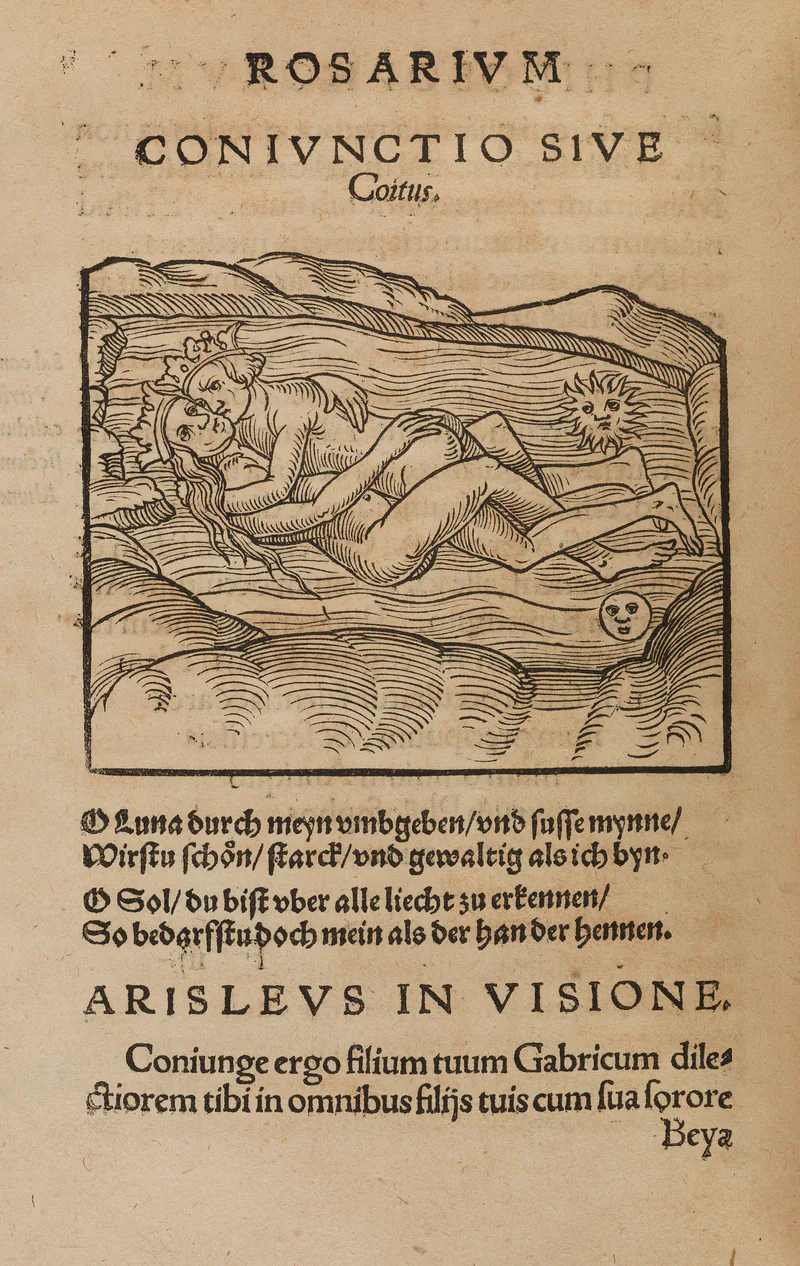
In Psychology and Alchemy (1944), The Psychology of the Transference (1946), which interpreted the woodcuts of the Rosarium philosophorum, and Mysterium Coniunctionis (1955–1956), Jung linked the nigredo to the encounter with the "shadow", the coniunctio of king and queen to the union of masculine and feminine aspects of the psyche, and the Stone to the "Self". His collaborator Marie-Louise von Franz continued this work, editing Aurora consurgens. Jung's reading has had immense influence on art, therapy and popular spirituality.
Traditionalist and esoteric readings§
Other twentieth-century writers read alchemy as an initiatory spiritual science rather than a psychology. The Italian Julius Evola's The Hermetic Tradition (1931) presented it as a path of inner regeneration within his Traditionalist philosophy. Titus Burckhardt's Alchemy: Science of the Cosmos, Science of the Soul (first published in German in 1960) treated it as a sacred cosmology comparable to Sufi and other traditional doctrines. In France the mysterious Fulcanelli and his pupil Eugène Canseliet presented alchemy as simultaneously laboratory and spiritual work. Contemporary esoteric schools often teach "spiritual alchemy" as a meditative discipline, sometimes borrowing from Taoist internal alchemy, which offers the closest historical parallel: a tradition that consciously transferred the furnace into the body.
The historians' critique§
From the 1980s historians of science began to question the spiritual interpretation. In an influential article published in 2001, Lawrence Principe and William Newman argued that the idea of alchemy as essentially spiritual was largely a creation of nineteenth-century occultism, reinforced by Jung, and that it had led scholars to ignore the large body of practical, reproducible chemistry in alchemical texts. By reconstructing historical experiments, they and others have shown that many obscure symbols described real substances and reactions.
Their critique does not deny that alchemists were religious or that some wrote spiritual allegories. It warns rather against reading all alchemy through a single modern lens. Most scholars now see alchemy as a field in which practical chemistry, natural philosophy and religious meaning could coexist in different proportions from author to author. The chemical side of the Work is described in the guide to the Great Work.
Frequently asked questions§
Is alchemy a science or a spiritual path?§
Historically it was often both. Most premodern alchemists believed they were working with real substances and practised genuine chemistry, but many also understood their work in religious terms. The idea that alchemy was purely spiritual became prominent only in the nineteenth century.
What did Jung say about alchemy?§
Jung argued that alchemists projected unconscious psychological contents onto matter, so their symbols record a process of psychic transformation he called individuation. He developed this view in Psychology and Alchemy and Mysterium Coniunctionis.
What is the difference between spiritual alchemy and Taoist inner alchemy?§
Taoist inner alchemy (neidan) is a historical religious practice, developed from about the Tang and Song dynasties, that deliberately reinterpreted alchemical language as bodily and meditative cultivation. Western spiritual alchemy is mostly a later interpretation of texts that were originally, at least in part, about laboratory work.
Sources and further reading§
- Psychology and Alchemy — C. G. Jung, 1944
- Mysterium Coniunctionis — C. G. Jung, 1956
- A Suggestive Inquiry into the Hermetic Mystery — Mary Anne Atwood, 1850
- Problems of Mysticism and Its Symbolism — Herbert Silberer, 1917
- Alchemy: Science of the Cosmos, Science of the Soul — Titus Burckhardt, 1967
- The Secrets of Alchemy — Lawrence M. Principe, 2013
- Alchemy Tried in the Fire: Starkey, Boyle, and the Fate of Helmontian Chymistry — William R. Newman & Lawrence M. Principe, 2002