Liber I · Alchemy · Chapter VI: Spiritual Alchemy
Mary Anne Atwood and the Suggestive Inquiry into Alchemy
Mary Anne Atwood and A Suggestive Inquiry into the Hermetic Mystery (1850): mesmerism, the burned book, Victorian occultism and spiritual alchemy.

Mary Anne Atwood (1817–1910), born Mary Anne South, was an English writer whose book A Suggestive Inquiry into the Hermetic Mystery (1850) argued that alchemy had never been chiefly about metals but was a secret science of the soul, practised through a state akin to mesmeric trance. Shortly after publication she and her father withdrew the book and burned most of the copies, which only increased its mystique. Republished in the twentieth century, it became one of the founding texts of the modern spiritual interpretation of alchemy.
Mary Anne South and her father§
Mary Anne South was born in 1817 and grew up in a scholarly household near Gosport in Hampshire. Her father, Thomas South, was a gentleman of independent means with a strong interest in Greek philosophy, mysticism and the occult sciences. He educated his daughter himself, and the two read together through a large library of Platonist, Hermetic and alchemical works, including the Neoplatonists in the translations of Thomas Taylor and the writings of seventeenth-century authors such as Jacob Boehme, Thomas Vaughan and the alchemist who called himself Eirenaeus Philalethes.
Father and daughter came to believe that a single ancient wisdom ran through the mysteries of Greece and Egypt, the Neoplatonists and the alchemists, and that this wisdom concerned the purification and illumination of the human soul. According to later accounts, they planned to set out their discovery jointly, he in a long poem and she in prose. Her part of the plan became the Suggestive Inquiry; his poem was never published.
Mesmerism and Early Magnetism§
The key to the Souths' interpretation was mesmerism, or animal magnetism, the practice of inducing trance by passes of the hands that had spread from France to Britain in the 1830s and 1840s. Mesmerists reported that some subjects in deep trance showed clairvoyance, insight into disease and a heightened, almost ecstatic state of consciousness. The wider history of this movement is told in the article on mesmerism and animal magnetism.
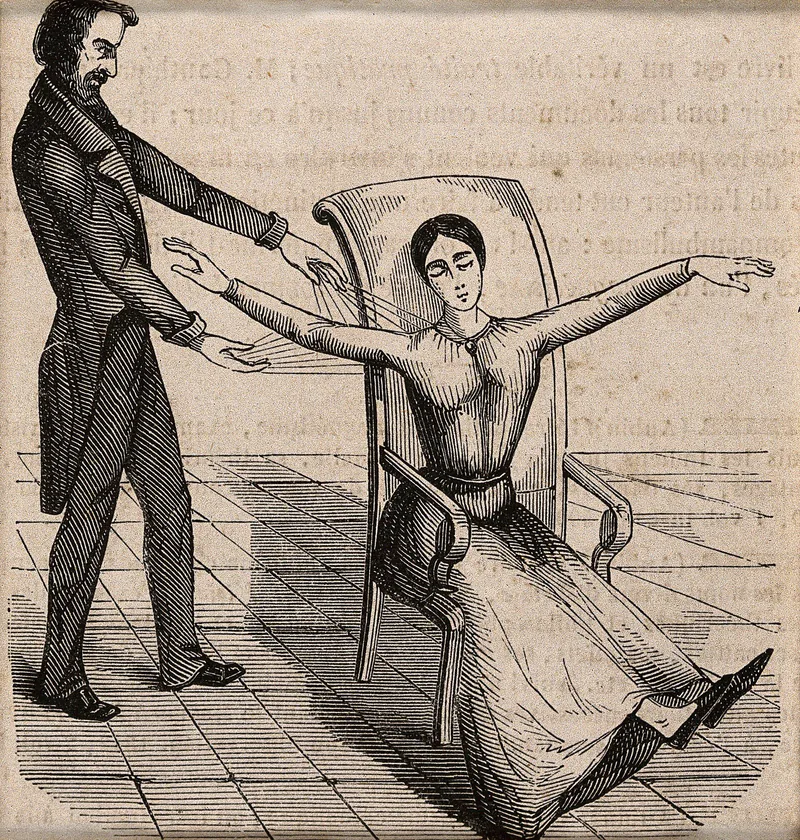
In 1846 Mary Anne published Early Magnetism, in Its Higher Relations to Humanity, under a Greek pseudonym. The book argued that the ancient poets and prophets had known the mesmeric state and that it underlay the oracles and mysteries of antiquity. This was the bridge to alchemy. If trance could free the vital spirit within the human being from its ordinary limitations, then perhaps the alchemists' talk of dissolving, purifying and fixing a hidden "matter" referred to the same living substance, worked upon in a disciplined, experimental way.
A Suggestive Inquiry into the Hermetic Mystery§
A Suggestive Inquiry into the Hermetic Mystery appeared anonymously in London in 1850. It is a long, learned and difficult book, divided into four parts that move from a historical survey of alchemy and its theories to a more "esoteric" consideration of the art, then to the laws and conditions of what the author called the Hermetic experiment, and finally to its practice. It quotes alchemical authors extensively alongside Plato, Plotinus, Iamblichus and Proclus.
The central thesis is that the alchemists' prima materia, their mercury and their Stone were not mineral substances. They were names for a universal life or ether present within the human being, which in its ordinary state is clouded and dispersed. Through a purified form of the mesmeric trance, practised under strict conditions, this vital principle could be separated, purified and concentrated, leading to a transformation of consciousness and an experience of union with the divine. The vessel of the work was the human being, and the fire was the directed energy of will and spirit.
Atwood did not claim that alchemy was simply moral allegory. She insisted that the work was real and experimental, but that its laboratory was the human constitution. This distinguished her from the American writer Ethan Allen Hitchcock, whose Remarks upon Alchemy and the Alchemists (1857) argued, independently, that the alchemists' true subject was man and his moral perfection. Together the two books are usually cited as the beginning of the Victorian spiritual reading of alchemy.
The burning of the book§
The most famous episode in Atwood's life followed almost immediately. Within a short time of publication, Thomas South and his daughter became convinced that the book disclosed sacred matters that should not be made public. They withdrew it from sale, bought back the copies they could trace, and burned them, reportedly on the lawn of their house; his poem is said to have been destroyed as well. Only a small number of copies, already in the hands of buyers or libraries, survived.
The details come mainly from Atwood's own later recollections and from friends who knew her, and the exact number of surviving copies is uncertain. The story nevertheless shaped the book's reputation. For later occultists, a work suppressed by its own author for fear of revealing too much seemed to carry an unusual authority, and rare copies were sought out and passed among students of the Hermetic tradition.
Later life in Yorkshire§
In 1859 Mary Anne South married the Reverend Alban Thomas Atwood, and she spent the rest of her long life in his parish of Knayton, a village near Thirsk in North Yorkshire. She published nothing further of significance, but she continued to study and to correspond with a small circle of friends interested in mysticism and the occult. Her husband died before her, and she lived on as a widow until her death in 1910.
Her most important later friendship was with Isabelle de Steiger, a painter and writer active in the Theosophical Society and in the occult circles described in the article on the nineteenth-century occult revival. De Steiger corresponded with her for many years and later wrote about her in her memoirs, Memorabilia (1927). Through such contacts, Atwood's ideas reached readers who would never see the original edition.
Republication and influence on occultism§
After Atwood's death the Suggestive Inquiry was republished in Belfast in 1918, with an introduction by the Freemason and mystical writer Walter Leslie Wilmshurst and with selections from her notes and conversation. Further editions followed, including a widely circulated American edition in 1960, so that the book reached a far larger audience in the twentieth century than it had in the nineteenth.
Its influence was considerable but diffuse. Members of the Hermetic Order of the Golden Dawn and other esoteric groups read alchemy, as Atwood had, as a symbolic language for the regeneration of the soul, and the idea that alchemical texts concealed a spiritual discipline became widespread in occult literature. Not every occultist agreed with her. A. E. Waite, who edited many alchemical texts, came to argue in The Secret Tradition in Alchemy (1926) that the alchemists had generally been concerned with physical transmutation, and that the purely spiritual interpretation could not be read back into most of their writings.
Atwood and the historians of alchemy§
In the twentieth century the spiritual interpretation of alchemy took a new form in the psychological work of Herbert Silberer and C. G. Jung, discussed in the article on Psychology and Alchemy. Jung did not depend on Atwood, but his view that alchemists were really describing inner processes continued the line of thought that she and Hitchcock had opened.
Historians of science have been sharply critical of this tradition. In an influential essay of 2001, Lawrence Principe and William Newman argued that the "spiritual" reading of alchemy was largely a creation of Victorian occultism, beginning with Atwood and Hitchcock, and that it had distorted the study of a field that for most of its practitioners was a real laboratory science. Their work, and that of other historians of "chymistry", has shown how much of the old literature describes actual chemical operations.
Atwood thus occupies a double position. For historians she is a source for the nineteenth-century reinvention of alchemy rather than a reliable guide to its earlier history. For students of Western esotericism she is a significant figure in her own right: a learned woman who, in an age of rising materialism, tried to recover what she believed to be a lost science of the spirit, and whose suppressed book helped to shape how alchemy is imagined today.
Frequently asked questions§
Who was Mary Anne Atwood?§
She was an English writer on Hermetic philosophy (1817–1910), born Mary Anne South. She is known for A Suggestive Inquiry into the Hermetic Mystery (1850), which interpreted alchemy as a spiritual science of the soul linked to mesmeric trance.
Why was A Suggestive Inquiry into the Hermetic Mystery burned?§
Soon after publication, Atwood and her father decided that the book revealed sacred secrets that should not be public. They recalled it and burned the copies they could recover, so that only a few survived until it was reprinted in 1918.
Was Mary Anne Atwood right about alchemy?§
Most historians think not, at least as a general account. Many alchemical texts describe real chemical work, and scholars see her book as part of the Victorian reinterpretation of alchemy. It remains important for the history of esotericism and of spiritual alchemy.
Sources and further reading§
- A Suggestive Inquiry into the Hermetic Mystery — Mary Anne Atwood, 1850
- Remarks upon Alchemy and the Alchemists — Ethan Allen Hitchcock, 1857
- Memorabilia: Reminiscences of a Woman Artist and Writer — Isabelle de Steiger, 1927
- The Secret Tradition in Alchemy — A. E. Waite, 1926
- Secrets of Nature: Astrology and Alchemy in Early Modern Europe — William R. Newman & Anthony Grafton, 2001
- Mesmerized: Powers of Mind in Victorian Britain — Alison Winter, 1998
- Problems of Mysticism and Its Symbolism — Herbert Silberer, 1917
- The Secrets of Alchemy — Lawrence M. Principe, 2013