Liber I · Alchemy · Chapter VI: Spiritual Alchemy
Psychology and Alchemy: Jung's Book on the Alchemical Psyche
Jung's Psychology and Alchemy (1944): its origins, the dream series and mandalas, alchemy as projection, the lapis–Christ parallel, its influence and critics.

Psychology and Alchemy is a book by the Swiss psychiatrist C. G. Jung, published in German in 1944 and in English in 1953, which argues that the images of European alchemy express unconscious psychological processes, above all the process of inner integration that Jung called individuation. Combining a long series of a patient's dreams with hundreds of alchemical illustrations, it became the most influential modern interpretation of alchemy, shaping both popular "spiritual alchemy" and Jungian psychology, while historians of science have criticised it for misreading what alchemists actually did.
How Jung came to alchemy§
Jung was not the first to read alchemy psychologically. In 1914 the Viennese psychoanalyst Herbert Silberer had published Problems of Mysticism and Its Symbolism, which interpreted an alchemical parable in Freudian and spiritual terms, and in the nineteenth century Mary Anne Atwood and Ethan Allen Hitchcock had argued that alchemy was a hidden spiritual discipline. Jung at first found the old texts obscure.
The turning point came in 1928, when the sinologist Richard Wilhelm sent him a Chinese inner-alchemical text, The Secret of the Golden Flower, which they published together with Jung's commentary in 1929. Jung later recalled that this prompted him to acquire early printed collections of Latin alchemy, beginning with the Artis auriferae of 1593, and that he gradually recognised in them images he had met in his patients' dreams and in his own experiences. His Eranos lectures of 1935, on dream symbols of the individuation process, and 1936, on ideas of redemption in alchemy, became the core of the book. The Chinese side of this story is told in the article on Taoist internal alchemy.
Structure and contents of Psychology and Alchemy§
The book has three main parts framed by an introduction and an epilogue. The introduction sets out "the religious and psychological problems of alchemy", arguing that Christianity had left parts of the psyche unexpressed and that alchemy functioned as a kind of undercurrent compensating for them. The second part, "Individual Dream Symbolism in Relation to Alchemy", analyses a dream series. The third, "Religious Ideas in Alchemy", surveys the theory of the art, the first matter, the Stone and their religious parallels.
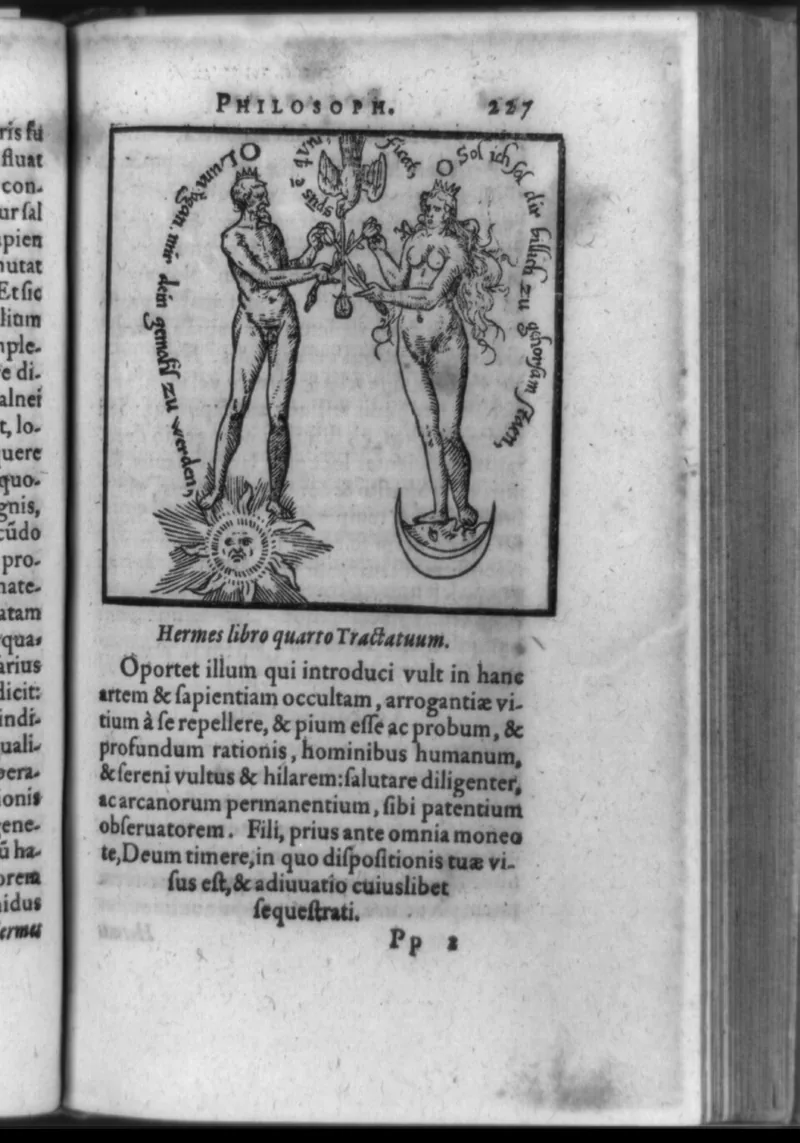
What made the book distinctive was its visual material. Jung reproduced more than two hundred images from manuscripts and printed books, including the woodcuts of the Rosarium philosophorum, Michael Maier's emblems and the illuminations of the Splendor Solis, alongside religious art from many cultures. For many readers this was their first encounter with alchemical iconography, and the book did much to make images such as the ouroboros, the hermaphrodite and the green lion familiar. A guide to these images is given in Alchemical Symbols.
The dream series and the symbolism of the mandala§
The second part draws on a series of several hundred dreams and visual impressions recorded by a young man of high scientific education. Jung explained that for most of the period the dreamer had worked either with one of Jung's pupils or alone, so that the material was little influenced by Jung himself. The dreamer was later identified as Wolfgang Pauli, the Nobel Prize-winning physicist, who corresponded with Jung for decades.
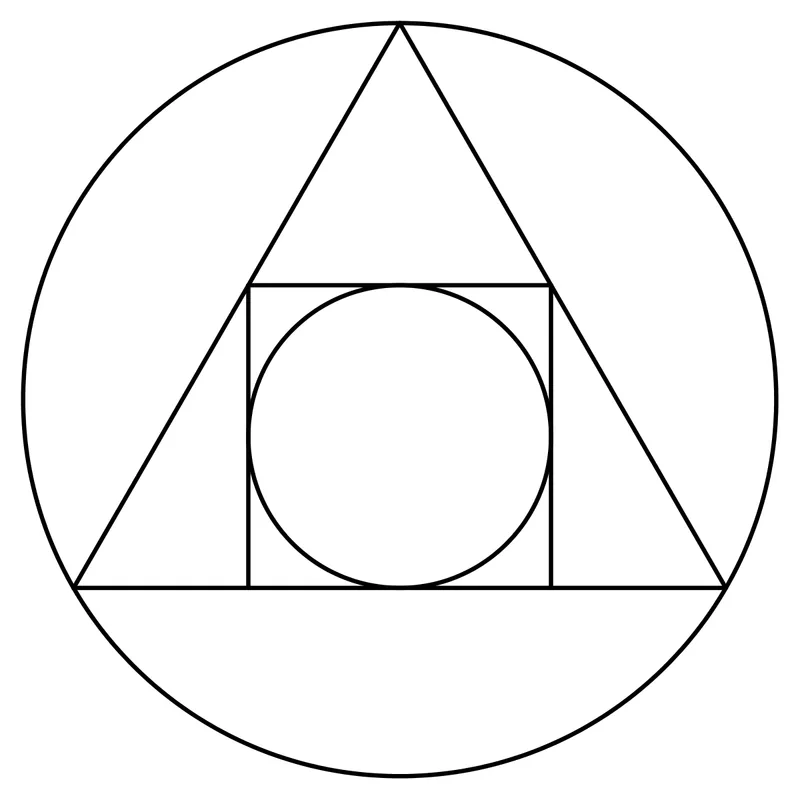
From this series Jung selected dreams in which circular and quaternary forms appeared: rotating circles, squares, central points, a clock and, at the climax, a vision of a "world clock" combining several rotating systems. He interpreted these as mandalas, symbols of the self, the totality of the conscious and unconscious psyche. He compared them with the alchemical motif of squaring the circle, with the round vessel of the Work and with the Stone as a unifying centre, arguing that the same symbolic tendency toward wholeness appeared spontaneously in a modern scientist and in early modern alchemists.
Alchemy as projection: the opus and individuation§
The third part develops Jung's most famous thesis. Alchemists, he argued, worked with substances whose real chemistry they did not understand. Faced with the dark and mysterious behaviour of matter in the vessel, they projected unconscious contents onto it, much as one sees figures in clouds. What they described as the dissolution, purification and union of materials was therefore also a record of their own inner transformation.
On this reading, the stages of the Great Work correspond to phases of psychological development. The blackening of the nigredo is the confrontation with the shadow; the union of king and queen is the integration of opposites such as conscious and unconscious, masculine and feminine; and the Philosopher's Stone is an image of the self. Jung did not claim that alchemists consciously practised psychology; he claimed that their symbols could be understood psychologically because they arose from the same source as dreams.
Christ and the lapis: religious ideas in alchemy§
Jung devoted a long section to the parallel between the Stone and Christ, a theme genuinely present in alchemical texts from Petrus Bonus in the fourteenth century to seventeenth-century writers. Alchemists compared the death and revival of the matter to the passion and resurrection, and the Stone's power to redeem imperfect metals to Christ's redemption of humanity.
For Jung this showed alchemy as a complement to Christian doctrine. Where the Church taught the redemption of humanity by God, alchemy, he suggested, pursued the redemption of the spirit imprisoned in matter by human effort. He linked this to Gnostic ideas of a divine light hidden in the material world, a connection explored further in What Is Gnosticism?. Critics have argued that he overstated the heterodoxy of alchemists, many of whom were conventional believers.
Influence on spiritual alchemy and the arts§
Psychology and Alchemy became volume 12 of Jung's Collected Works, translated by R. F. C. Hull, and was followed by Alchemical Studies and Mysterium Coniunctionis (1955–56), whose third volume, edited by Marie-Louise von Franz, presented the medieval Aurora consurgens. Von Franz and later Jungian analysts produced a substantial literature applying alchemical images to therapy.
Beyond psychology, the book shaped twentieth-century art, literature and religious studies. Writers and artists of the post-war decades, and much New Age literature, absorbed Jung's view that alchemy was "really" about inner transformation, and his ideas entered dialogue with scholars of religion such as Mircea Eliade, a fellow participant at Eranos. The broader story of this reception is told in the guide to spiritual alchemy.
Historians' criticism of Jung's alchemy§
From the late twentieth century, historians of science challenged Jung's interpretation. In an influential essay published in 2001, Lawrence Principe and William Newman argued that Jung relied heavily on nineteenth-century spiritual readings, selected a narrow range of mostly late and allegorical texts, and ignored the many sources that are plainly practical recipes. They showed that some passages Jung took as psychological projections describe real, reproducible chemical processes. On this view the claim that alchemists were unconsciously projecting cannot be tested and tells us more about Jung than about alchemy.
Defenders reply that Jung was offering a psychological hermeneutic, not a history of chemistry, and that alchemical texts do contain religious and contemplative dimensions. Most scholars now read Psychology and Alchemy as an important document of twentieth-century thought and of the modern esoteric imagination, valuable for its images and its ideas about symbolism, but not as a reliable guide to what alchemy meant to its practitioners.
Frequently asked questions§
What is the main argument of Psychology and Alchemy?§
Jung argued that the symbols of alchemy express unconscious psychological processes, especially individuation, the movement toward psychic wholeness. He believed alchemists projected these processes onto the substances in their vessels.
Whose dreams are analysed in Psychology and Alchemy?§
The dreams are presented anonymously in the book, but they were recorded by the physicist Wolfgang Pauli. Pauli and Jung later corresponded extensively about physics, psychology and symbolism.
Do historians accept Jung's interpretation of alchemy?§
Most historians of science do not. They argue that much alchemy was practical chemistry and that Jung drew on a selective set of texts. They nonetheless recognise the book's great influence on modern ideas of spiritual alchemy.
Sources and further reading§
- Psychology and Alchemy — C. G. Jung, 1944
- Mysterium Coniunctionis — C. G. Jung, 1956
- Problems of Mysticism and Its Symbolism — Herbert Silberer, 1917
- Alchemy: An Introduction to the Symbolism and the Psychology — Marie-Louise von Franz, 1980
- Atom and Archetype: The Pauli/Jung Letters, 1932–1958 — C. A. Meier, 2001
- Secrets of Nature: Astrology and Alchemy in Early Modern Europe — William R. Newman & Anthony Grafton, 2001
- The Secrets of Alchemy — Lawrence M. Principe, 2013