Liber I · Alchemy · Chapter I: Alchemical Symbols
The Green Lion in Alchemy: Meaning of the Sun-Devouring Lion
The green lion devouring the sun: meaning of the alchemical symbol, its chemical readings from vitriol to Ripley's sericon, and its spiritual interpretations.

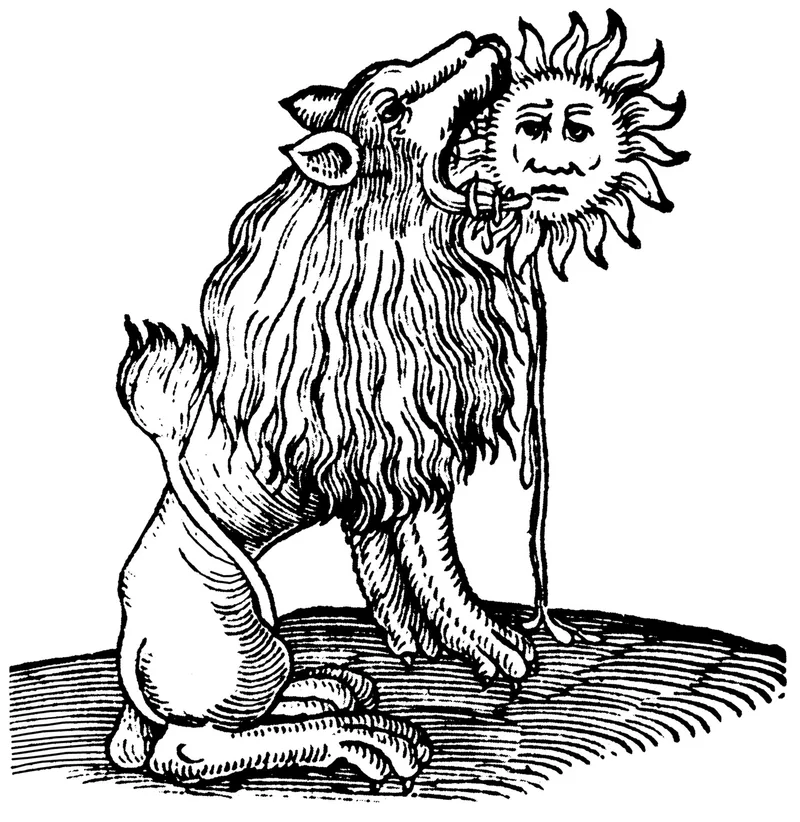
The green lion is one of the most famous emblems of alchemy: a green-coloured lion devouring the sun, with blood streaming from the sun's face. In alchemical language it usually stands for a powerful, "unripe" solvent able to dissolve gold, the solar metal, and so to release its hidden virtue for the making of the Philosopher's Stone. Because alchemists used the same name for different substances, the green lion has been identified with vitriol, with acid solvents, with antimony and, in the English tradition of George Ripley, with preparations of lead, while spiritual and Jungian readers have seen in it the raw, devouring energy of nature and of the psyche.
The green lion devouring the sun§
The best-known depiction comes from the Rosarium philosophorum ("Rosary of the Philosophers"), a compilation of earlier alchemical sayings printed at Frankfurt in 1550 with a celebrated cycle of woodcuts. In one of them a green lion bites into a radiant sun, and the sun's blood pours down. Related images appear in later manuscripts and emblem books, sometimes with the lion swallowing the sun whole, sometimes with a red lion or a pair of lions.
The image is shocking by design. The sun is the king of the heavens and the symbol of gold, the most perfect of metals; for an animal to eat it reverses the natural order. Alchemists used such violent paradoxes to describe operations in which a stronger agent overcame and dissolved a substance normally thought indestructible. The blood flowing from the sun is not destruction but release: the "blood of the green lion" was itself a prized product of the Work. The wider family of such images is surveyed in the guide to alchemical symbols.
Why a lion, and why green?§
The lion was a natural emblem of power, royalty and fire. In astrology Leo is the house of the sun, and the lion had long been associated with solar and kingly qualities. In alchemy lions often represent fixed, fiery and active substances, in contrast to eagles or birds, which signify volatile substances that fly up in the vessel. A lion could also be predatory and consuming, a fitting image for a corrosive agent.
Green, in alchemical usage, meant unripe, raw and young, like green fruit or green wood. A "green" substance was one not yet brought to maturity, still full of crude vital force. Some texts speak of "green gold" or of the greenness of a matter that is alive and capable of growth. The phrase "O blessed greenness" (O benedicta viriditas) in the Rosarium celebrates this generative quality. The green lion is therefore a raw and vigorous power, strong enough to overcome the sun, but itself in need of purification before it can become part of the finished Stone, described in the article on the Philosopher's Stone.
Chemical interpretations of the green lion§
Because alchemists deliberately concealed their materials, the green lion had no single fixed meaning. Several identifications appear in the sources and in modern scholarship.
Vitriol and acid solvents§
Green vitriol (iron sulphate) forms green crystals and, when distilled, yields a strongly corrosive "oil of vitriol" (sulphuric acid). Many readers have therefore linked the green lion with vitriol, whose importance is captured in the later acronym VITRIOL, "visit the interior of the earth, and by rectifying you will find the hidden stone", associated with works attributed to Basil Valentine. Modern popular accounts also often interpret the lion devouring the sun as aqua regia, the mixture of acids that dissolves gold, which was known in Europe from the late Middle Ages.
Antimony and other ores§
Some seventeenth-century authors used "green lion" in their own private codes for other materials, including ores of antimony, and Isaac Newton's alchemical manuscripts also use the term. Historians stress that the meaning must be established text by text: the same name could denote different substances in different schools.
George Ripley and the green lion in English alchemy§
In England, the green lion became closely tied to the writings attributed to George Ripley (d. c. 1490), the Augustinian canon of Bridlington whose Compound of Alchymy (1471) was among the most-read alchemical poems in English. Ripley's works, together with texts later circulated under his name, describe a practice based on "sericon", generally understood as a lead compound such as red lead. In this tradition, sericon dissolved in distilled vinegar produced a gummy salt (lead acetate), which some writers called the green lion. When this was distilled, it yielded a "white fume", a burning spirit and a red oil, the "blood of the lion".
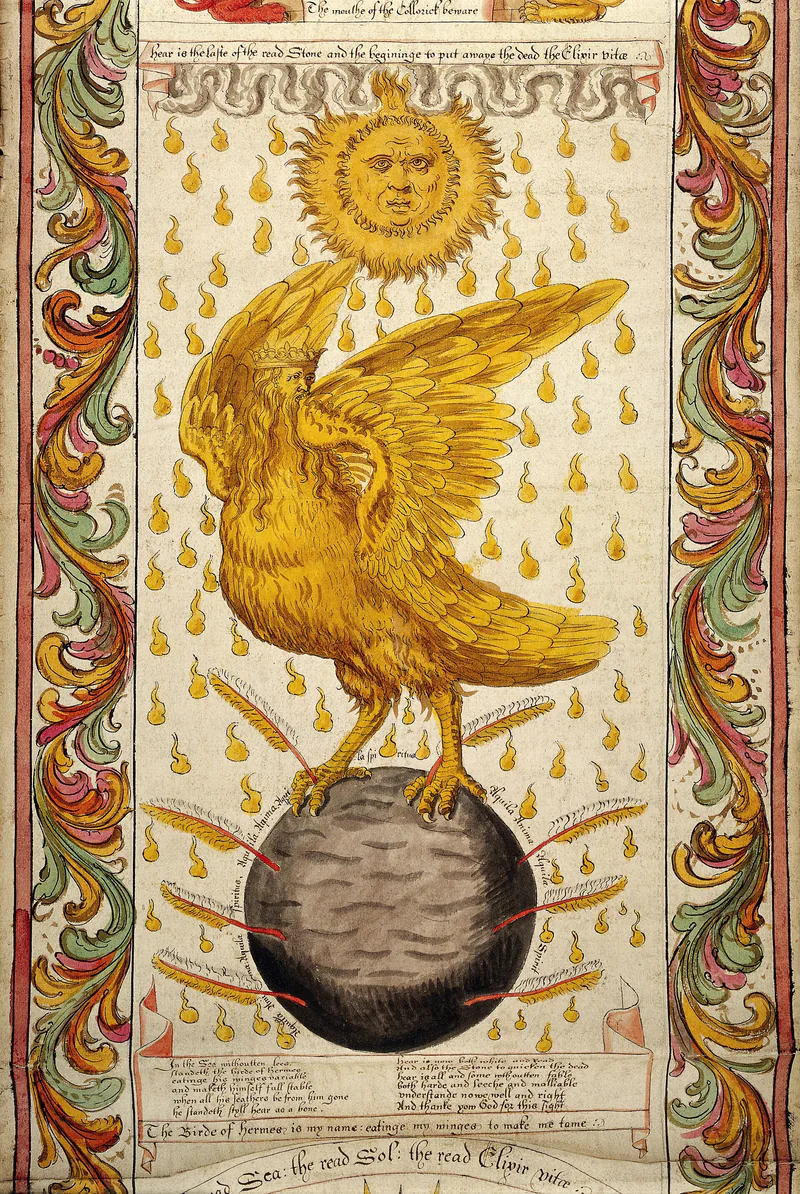
The historian Jennifer Rampling has traced how Ripley's readers in the sixteenth and seventeenth centuries interpreted and argued over this "sericonian" practice, and Lawrence Principe has shown that such recipes describe real chemical changes: the dry distillation of lead acetate does give a flammable spirit (now known as acetone) and coloured oily products. Here the green lion is not a vague allegory but a coded name for a specific, repeatable laboratory procedure. The famous illustrated rolls known as Ripley scrolls, produced long after his death, carry the same mix of practical and symbolic imagery. Ripley's scheme of twelve gates is outlined in the guide to the Great Work.
Spiritual and psychological readings§
From the seventeenth century onward, writers who read alchemy as a spiritual discipline treated the green lion as an image of untamed life force, desire or passion that had to be subdued and converted. The lion's ferocity suggested the instinctual energies of the soul, which could either devour reason or, once transformed, become a source of strength.
C. G. Jung developed this interpretation in his works on alchemy, notably Mysterium Coniunctionis. He associated the lion with passion and with the raw, instinctive side of the psyche, and the green colour with the creative, life-giving activity of the spirit. The devouring of the sun suggested the eclipse of consciousness by unconscious forces, a theme related to the darkness of the nigredo. Jung's general method is discussed in the article on his book Psychology and Alchemy. Historians caution that such psychological meanings are modern overlays rather than what most alchemists intended, but they explain much of the symbol's popularity today.
Older Christian symbolism also coloured the image. In the Physiologus and medieval bestiaries, the lion's cubs were said to be born lifeless and revived by their father on the third day, a figure of the resurrection, and Christ was called the Lion of the tribe of Judah (Revelation 5:5). Such associations made the lion a natural vehicle for themes of death and renewal.
The green lion among the alchemical beasts§
The green lion belongs to a whole menagerie of devouring and transforming animals. The red lion usually signified a mature, fixed substance, sometimes the finished red Stone or the "sulphur" of the philosophers. A wolf devouring the king appears in the first of the Twelve Keys attributed to Basil Valentine and in Michael Maier's Atalanta fugiens (1617), where it is generally read as antimony purifying gold. Dragons and serpents represent mercury and the volatile principle, while the eagle stands for sublimation. Paired lions or a lion fighting an eagle express the struggle between fixed and volatile.
Seen together, these animals form a visual grammar in which consumption, combat and marriage describe stages of chemical change. The green lion stands out because it unites the two great themes of the art: the dissolution of gold and the paradoxical power of what is raw and unripe to overcome what is perfect.
Frequently asked questions§
What does the green lion symbolise in alchemy?§
It generally symbolises a powerful raw solvent capable of dissolving gold, represented by the sun. Different alchemists used the name for different substances, including vitriol, acid solvents, antimony and lead compounds.
Why does the green lion eat the sun?§
The sun stands for gold. The lion devouring it represents the dissolution of gold by a strong agent, which was thought to release its essence. The blood flowing from the sun symbolises a precious tincture obtained in the process.
What is the difference between the green lion and the red lion?§
The green lion is raw, unripe and active, usually a solvent at the beginning of the Work. The red lion represents a mature, fixed substance, often associated with the finished red Stone or philosophical sulphur.
Sources and further reading§
- The Rosary of the Philosophers — Adam McLean, 1980
- The Compound of Alchymy — George Ripley, 1471
- The Experimental Fire: Inventing English Alchemy, 1300–1700 — Jennifer M. Rampling, 2020
- The Secrets of Alchemy — Lawrence M. Principe, 2013
- A Dictionary of Alchemical Imagery — Lyndy Abraham, 1998
- Mysterium Coniunctionis — C. G. Jung, 1956
- Alchemy & Mysticism — Alexander Roob, 1997