Liber I · Alchemy · Chapter I: Alchemical Symbols
The Pelican in Her Piety: Christian and Alchemical Symbol
The pelican in her piety: the bestiary legend of the bird feeding its young with blood, a symbol of Christ, the alchemists' pelican vessel and the red Stone.

The "pelican in her piety" is the image of a pelican wounding her own breast to feed her young with her blood. Born of an ancient legend recorded in the Physiologus and the medieval bestiaries, it became one of the most widespread symbols of Christ's self-sacrifice and of the Eucharist, and it passed from there into heraldry, alchemy and Rosicrucian and Masonic symbolism. In alchemy the pelican named both a distilling vessel whose arms fed its contents back into itself and the perfected red Stone that "nourished" other metals with its tincture.
The legend of the pelican in ancient and medieval lore§
The story of the self-wounding pelican is first clearly told in the Physiologus, a Greek collection of animal lore with Christian interpretations, probably compiled in Egypt between the second and fourth centuries CE. According to its account, young pelicans strike their parents in the face; the parents strike back and kill them. On the third day the mother pierces her own side and lets her blood flow over the dead chicks, which come back to life. The Physiologus draws the moral directly: humanity struck at its Creator and fell into death, and Christ, pierced on the cross, restored it with his blood.
Translated into Latin and many vernaculars, the Physiologus fed the illustrated bestiaries of the twelfth and thirteenth centuries, where the pelican regularly appears with its nest of chicks and its bleeding breast. Later versions often simplified the story, so that the pelican feeds rather than resurrects her young, and the image of a mother nourishing her brood with her blood became standard. Naturalists have suggested that the legend may have grown from the way pelicans press their bills against their chests to empty their pouches, or from the reddish colour some species show, but the origin of the story is uncertain.
The bird also has a biblical foothold. The Psalmist laments, "I am like a pelican of the wilderness" (Psalm 102:6), a verse that medieval commentators connected with the suffering Christ, although the Hebrew word may refer to a different bird.
The pelican as a symbol of Christ and the Eucharist§
By the high Middle Ages the pelican was a familiar figure of Christ. The eucharistic hymn Adoro te devote, traditionally attributed to Thomas Aquinas, addresses Christ as pie pelicane, "loving pelican", and asks him to cleanse the sinner with his blood. Dante, in the twenty-fifth canto of the Paradiso, describes the apostle John as the one who lay on the breast of "our Pelican". In both cases the image unites sacrifice, love and the sacrament: as the pelican gives her blood to her young, so Christ gives his body and blood to the faithful in the Eucharist.
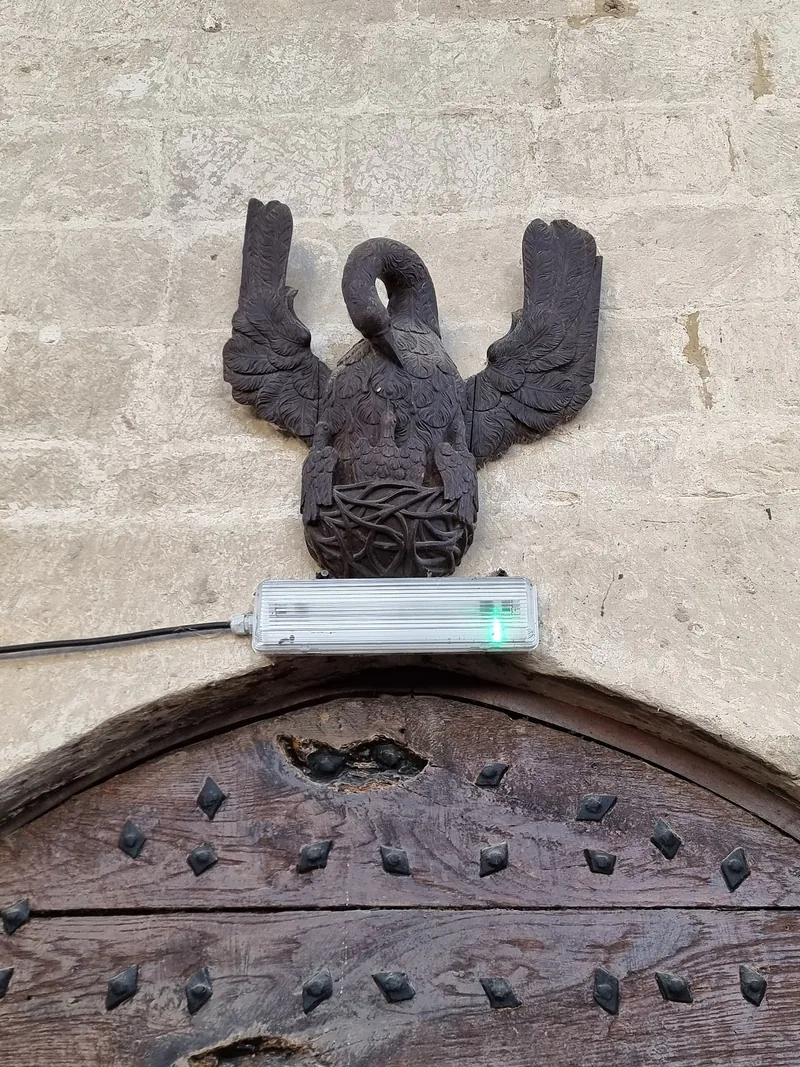
The image spread through church art. Pelicans appear on the tops of crucifixes, on tabernacles and altar frontals, on lecterns and in stained glass, and on liturgical vessels used in the Mass, as described in the article on Christian sacraments and liturgy. The bird's popularity survived the Reformation in Protestant England: Shakespeare has Laertes in Hamlet speak of "the kind life-rendering pelican" that feeds its young with its blood, and King Lear calls his ungrateful children "pelican daughters". The pelican is one of the clearest examples of a creature turned entirely into a moral and religious sign, a process surveyed in the guide to religious symbols.
The pelican in heraldry and royal imagery§
Heraldry took over the symbol with its own vocabulary. A pelican shown standing over her nest and feeding her young with blood is "in her piety", using "piety" in its older sense of dutiful love; a pelican striking her breast is said to be "vulning" herself, from the Latin for wounding. The arms of Corpus Christi College, Cambridge, include the pelican in her piety, and at Corpus Christi College, Oxford, founded by Bishop Richard Foxe, whose emblem was the pelican, a pelican crowns the sundial erected in the main quadrangle in 1581.
The image could also be political. Elizabeth I was painted in the so-called "Pelican Portrait" (c. 1573–75), attributed to Nicholas Hilliard, wearing a pelican jewel on her breast. The badge presented the queen as a mother who would sacrifice herself for her people, combining royal propaganda with the familiar religious symbolism. Such uses show how widely the pelican was understood in the very period when alchemical imagery was at its richest.
The pelican vessel of the distillers§
Alchemists and distillers borrowed the name for a piece of apparatus. A "pelican" was a glass vessel with a rounded body and a head from which one or two curved arms ran back down into the body. When the vessel was heated, vapours rose into the head, condensed in the arms and flowed back into the body, so that the contents were distilled and returned to themselves again and again. This process was called circulation, and it could continue for days or weeks.
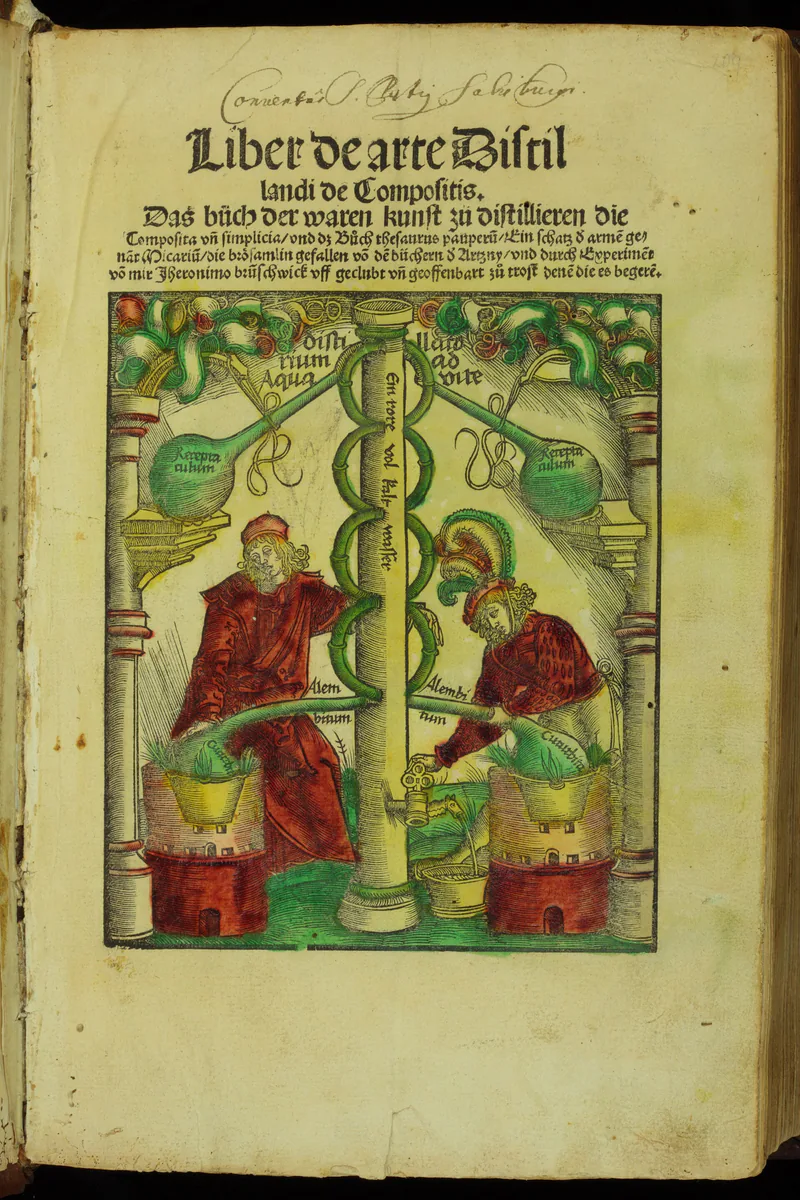
The name came from the vessel's shape: the arms curving back into the belly resembled a bird's neck bending to strike its own breast, and the returning liquid recalled the pelican's blood flowing back to nourish its young. Early printed distillation manuals, such as those of the Strasbourg surgeon Hieronymus Brunschwig (1500 and 1512), illustrate the pelican among other stills and vessels. In alchemical literature, circulation in the pelican was one of the gentle, long-continued operations that slowly matured the matter. The vessel is shown here as part of the history of laboratory equipment; it belongs with the other apparatus of the Great Work, from the alembic to the athanor.
The pelican in alchemical symbolism: the red Stone§
As a symbolic animal, the pelican usually stands at the end of the alchemical sequence. Many texts and diagrams place it with the rubedo, the reddening, after the black of the nigredo and the white of the albedo. The red Stone was imagined as giving itself away: thrown on to molten base metal in the act of projection, it imparted its own perfection, much as the pelican gives her blood. Lyndy Abraham's Dictionary of Alchemical Imagery notes that the pelican could signify both the Stone in this state and the process of multiplication, by which the Stone increased its own power.
The parallel with Christ was deliberate. Late medieval and early modern alchemists often compared the Philosopher's Stone with Christ, the "cornerstone" whose death and resurrection redeemed the world, and the red tincture with his redeeming blood. The pelican made this comparison visible. In emblem sequences it often appears alongside the phoenix, which rises from its own ashes, as the culminating images of the work. Together with animals such as the raven, the swan and the green lion, it forms part of the alchemical bestiary described in the guide to alchemical symbols.
The pelican in Rosicrucian and Masonic symbolism§
From alchemy and Christian iconography the pelican passed into the symbolism of eighteenth-century esoteric Freemasonry. The Rose Croix degree, which became the eighteenth degree of the Ancient and Accepted Scottish Rite and is also worked in other rites, carries the title "Knight of the Eagle and Pelican" in some versions. Its jewel shows a pelican feeding her young beneath a cross with a rose, sometimes with an eagle above. In the degree's teaching, the pelican stands for self-sacrificing love and charity, and in its Christian forms for Christ. The background is set out in the articles on the Scottish Rite and on Rosicrucianism.
Later writers on the degree drew freely on alchemical symbolism, and Albert Pike's Morals and Dogma (1871) offered a broad, often idiosyncratic interpretation of its emblems. Modern Rosicrucian orders and esoteric Christian groups have also used the pelican, sometimes combined with the rose and the cross. Throughout these adaptations the core meaning of the image has remained remarkably stable: the gift of one's own life to give life to others, whether that gift is understood as Christ's passion, a charitable virtue or the generous tincture of the alchemical Stone.
Frequently asked questions§
What does "the pelican in her piety" mean?§
It is the heraldic and religious name for the image of a pelican wounding her breast to feed her young with her blood. "Piety" is used in the old sense of dutiful, self-giving love, and the image symbolises self-sacrifice and, in Christian use, Christ.
Why is the pelican a symbol of Christ?§
The Physiologus and medieval bestiaries told how the pelican revived her dead young with her own blood, which Christian writers read as a figure of Christ's death and the Eucharist. Hymns such as Adoro te devote and Dante's Paradiso call Christ the pelican.
What is a pelican in alchemy?§
It is both a vessel and a symbol. The pelican vessel was a still whose arms led condensed vapours back into its body for repeated circulation, and the pelican as an emblem stood for the red Stone that gave its own perfection to other metals.
Sources and further reading§
- Physiologus — Michael J. Curley, 1979
- The Book of Beasts — T. H. White, 1954
- Medieval Bestiaries: Text, Image, Ideology — Debra Hassig, 1995
- A Dictionary of Alchemical Imagery — Lyndy Abraham, 1998
- Alchemy & Mysticism — Alexander Roob, 1997
- Morals and Dogma — Albert Pike, 1871
- The Secrets of Alchemy — Lawrence M. Principe, 2013