Liber XXX · Symbols · Chapter IV: Religious Symbols
Religious Symbols: Origins and Meanings of Sacred Signs
A guide to religious symbols and their history: the cross and chi-rho, Star of David, crescent, Om, swastika, dharma wheel, taijitu, ankh and more.

Religious symbols are visual signs that express a tradition's beliefs, sacred stories and identity: the cross of Christianity, the Star of David of Judaism, the Om of Hinduism, the wheel of Buddhism and many more. Most have long and surprising histories. Several of today's best-known emblems became official markers of a religion only in recent centuries, while some ancient signs, like the swastika and the ankh, have passed between cultures and acquired entirely new meanings.
What Makes a Symbol Religious§
A symbol becomes religious when a community uses it to point to the sacred. Some symbols are drawn from scripture or ritual, such as the cross or the menorah; others are adopted from older cultures, such as the halo or the lotus; others again are chosen by modern institutions to represent a faith, as with the Red Crescent or the Bahá'í nine-pointed star. Scholars distinguish between symbols that are devotional, used in prayer and worship, and those that are emblematic, marking identity, though many do both. The broader theory is introduced in What Is Sacred Symbolism?.
Symbols of the Abrahamic Traditions§
Judaism§
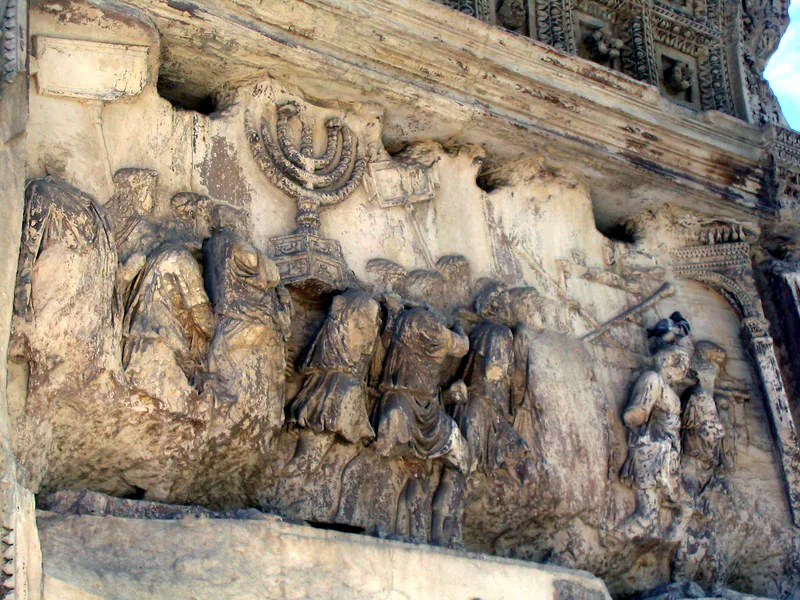
The oldest and most central Jewish symbol is the menorah, the seven-branched lampstand of the Tabernacle and Temple, depicted on the Arch of Titus in Rome among the spoils of Jerusalem (AD 70) and on ancient synagogue mosaics; it is now the emblem of the State of Israel. The Star of David (Magen David, "Shield of David") appears on Jewish objects from antiquity onward but was used equally by Christians and Muslims, often as the magical Seal of Solomon. Gershom Scholem showed that it became a general emblem of Judaism only gradually, beginning in Prague in the later Middle Ages and becoming widespread in the nineteenth century, before its adoption by the Zionist movement in 1897. Other symbols include the hamsa hand, the Tablets of the Law and the lion of Judah.
Christianity§
The earliest Christian art, in the Roman catacombs, used the fish (ichthys), the anchor, the dove and the Good Shepherd. The chi-rho, the first two Greek letters of Christos, became prominent after Constantine adopted it, according to ancient accounts, before the battle of the Milvian Bridge in 312. Public depictions of the cross, and especially the crucifix showing Christ's body, became common only from the fifth century, after crucifixion had ceased as a Roman punishment; one of the earliest surviving crucifixion scenes is carved on the wooden doors of Santa Sabina in Rome (c. 430). Other symbols include the lamb, the alpha and omega, the IHS monogram and the triangle of the Trinity, which developed into the Eye of Providence in seventeenth-century art.
Islam§
Islam prohibits images of God and discourages figurative art in religious settings, so its sacred visual culture centres on calligraphy of the Qur'an and the divine names, and on geometric and vegetal pattern (see Sacred Geometry). The crescent and star were used in the ancient Near East and by Byzantine Constantinople, and became associated with Islam mainly through their use on Ottoman flags, especially from the late eighteenth and nineteenth centuries. Many Muslims do not regard it as a religious symbol at all. The colour green, the Kaaba and the words of the shahada are more widely meaningful. Sufi orders developed their own emblems and diagrams; see Sufism.
Symbols of the Indian Religions: Om, Swastika, Wheel and Lotus§
Om (Aum) is the sacred syllable of Hinduism, discussed in the Upanishads; the Mandukya Upanishad interprets its three sounds and the silence after them as the states of waking, dreaming, deep sleep and the transcendent fourth. Its written form in Devanagari is one of the most recognisable religious signs in the world and is also used in Buddhism, Jainism and Sikhism (as Ik Onkar, a distinct Sikh symbol).
The swastika, from the Sanskrit svastika ("conducive to well-being"), is an ancient sign of good fortune found on Indus Valley seals, on Hindu doorways and account books, in Jain and Buddhist art, and in many other cultures from Greece to China. Its appropriation by the Nazi party in the 1920s has made it deeply offensive in the West, while it remains sacred across Asia.
The dharma wheel (dharmachakra) represents the Buddha's teaching, "set in motion" in his first sermon; its eight spokes are often linked to the Eightfold Path. Emperor Ashoka's lion capital at Sarnath (third century BCE) bears wheels, and the Ashoka chakra appears on the flag of India. The lotus, rising unstained from muddy water, symbolises purity and awakening in Hinduism and Buddhism. Jain communities agreed on a composite emblem in the mid-1970s, for the 2,500th anniversary of Mahavira's liberation, combining a raised hand, a swastika and the outline of the universe.
East Asian Symbols: The Taijitu, Torii and Ensō§
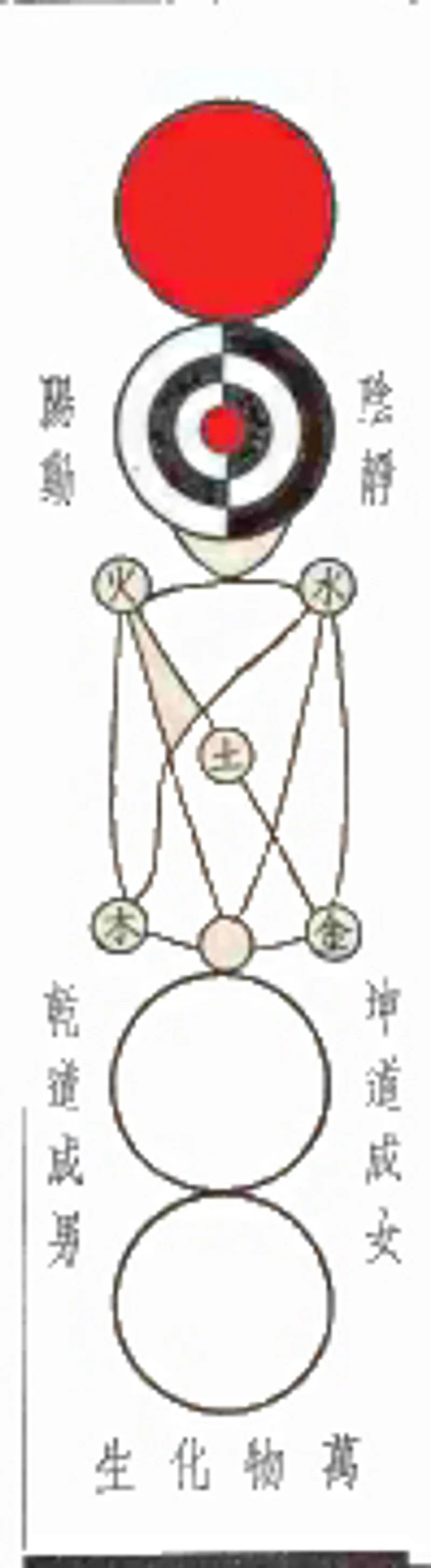
The taijitu, the familiar black-and-white "yin-yang" diagram, expresses the complementary forces of Chinese cosmology. The term comes from the eleventh-century Neo-Confucian Zhou Dunyi's "Explanation of the Diagram of the Supreme Ultimate", though his diagram looked different; the swirling form now known worldwide became standard in the Ming period. In Japan the torii gate marks the boundary of a Shinto shrine, and the ensō, a circle drawn in one brushstroke, expresses enlightenment and the moment in Zen art. Taoist practices behind such symbolism are explored in Taoist Internal Alchemy.
Ancient Egyptian Symbols in Later Use: Ankh and Eye of Horus§
Some symbols outlived the religions that created them. The ankh, the Egyptian hieroglyph for "life", is held by gods in countless temple scenes; Coptic Christians later adapted it as the crux ansata, and in modern times it has become an emblem of Kemetic religion, esotericism and popular culture. The Eye of Horus (wedjat), the healed eye of the god, served as a protective amulet for thousands of years. Its form is sometimes linked, without firm evidence, to the later Eye of Providence, which developed in Christian art from the triangle of the Trinity and appears on the reverse of the Great Seal of the United States (1782). Such afterlives are a recurring theme of Occult Symbols.
Aniconism, Calligraphy and the Limits of the Image§
Not all religions express the sacred chiefly through pictures. Judaism's prohibition of graven images, Islam's avoidance of figurative depiction of the divine, the early Buddhist representation of the Buddha by symbols such as footprints and empty thrones, and Protestant iconoclasm in the sixteenth century all show a deep suspicion of images. Yet these "aniconic" traditions developed rich alternatives: Hebrew micrography, Arabic calligraphy, geometric ornament, sacred architecture and the symbolic use of light and space. Even the refusal to depict is a kind of symbolic statement about the transcendence of the divine.
Frequently asked questions§
What is the oldest Christian symbol?§
The fish (ichthys) and the anchor are among the earliest Christian symbols, found in second- and third-century catacombs. The chi-rho became prominent in the fourth century, and the cross as a public emblem spread from the fourth and fifth centuries.
Is the crescent moon a symbol of Islam?§
It is widely used as one, especially on the flags of Muslim-majority countries, but its association with Islam developed mainly through Ottoman usage. Islam has no official symbol, and many Muslims prefer calligraphy or no emblem at all.
What does the Om symbol mean?§
Om is the sacred sound of Hinduism, regarded as the primordial vibration and an expression of ultimate reality, Brahman. The Mandukya Upanishad relates its parts to the states of consciousness.
When did the Star of David become a Jewish symbol?§
The hexagram appears on Jewish objects from antiquity, but it became a general emblem of Judaism only gradually from the late Middle Ages, spreading widely in the nineteenth century and adopted by Zionism in 1897.
Sources and further reading§
- The Migration of Symbols — Count Goblet d'Alviella, 1894
- The Messianic Idea in Judaism — Gershom Scholem, 1971
- The Cross: History, Art, and Controversy — Robin M. Jensen, 2017
- Reading Egyptian Art — Richard H. Wilkinson, 1992
- The Swastika: Symbol Beyond Redemption? — Steven Heller, 2000
- Images and Symbols — Mircea Eliade, 1952
- Islamic Art and Spirituality — Seyyed Hossein Nasr, 1987