Liber XXX · Symbols · Chapter V: Sacred Geometry
Sacred Geometry: History, Shapes and Meaning Explained
Sacred geometry explained: Pythagoras and Plato, the Platonic solids, the golden ratio and its myths, the vesica piscis, Gothic cathedrals and Islamic art.

Sacred geometry is the belief that certain shapes, proportions and patterns express the order of the cosmos and the divine, and the use of them in art, architecture and contemplation. Its roots lie in the Pythagorean and Platonic conviction that the universe is built on number and form; it shaped temples, cathedrals, mosques and mandalas; and in the twentieth century it became a popular spiritual movement centred on figures such as the Flower of Life. Separating the well-documented history from modern myth, especially about the golden ratio, is essential to understanding it.
What "Sacred Geometry" Means§
The phrase "sacred geometry" is modern, popularised in the twentieth century by writers such as Robert Lawlor, whose Sacred Geometry: Philosophy and Practice (1982) became a classic of the genre. The ideas it describes are old. Many cultures have built sacred spaces on carefully chosen geometric plans, oriented to the cardinal directions or the sun, and many philosophers have treated mathematics as a path to the divine. Sacred geometry thus covers three overlapping things:
- a philosophy, holding that geometric forms reveal the structure of reality;
- a craft, the practical geometry used to design temples and works of art with compass and straight-edge;
- a contemplative practice, in which drawing or meditating on figures is a spiritual exercise.
It is closely related to Number Symbolism, since ancient thinkers saw number and shape as two expressions of the same order.
Pythagoras, Plato and the Geometry of the Cosmos§
The followers of Pythagoras (sixth century BCE) held, according to later sources, that "all things are number". They discovered that musical harmonies correspond to simple ratios of string lengths, 2:1 for the octave, 3:2 for the fifth and 4:3 for the fourth, and saw in this a key to cosmic harmony. Their sacred figure, the tetractys, a triangle of ten points in rows of one, two, three and four, contained these ratios. The discovery of irrational magnitudes, such as the diagonal of a square, troubled their system and became legendary.
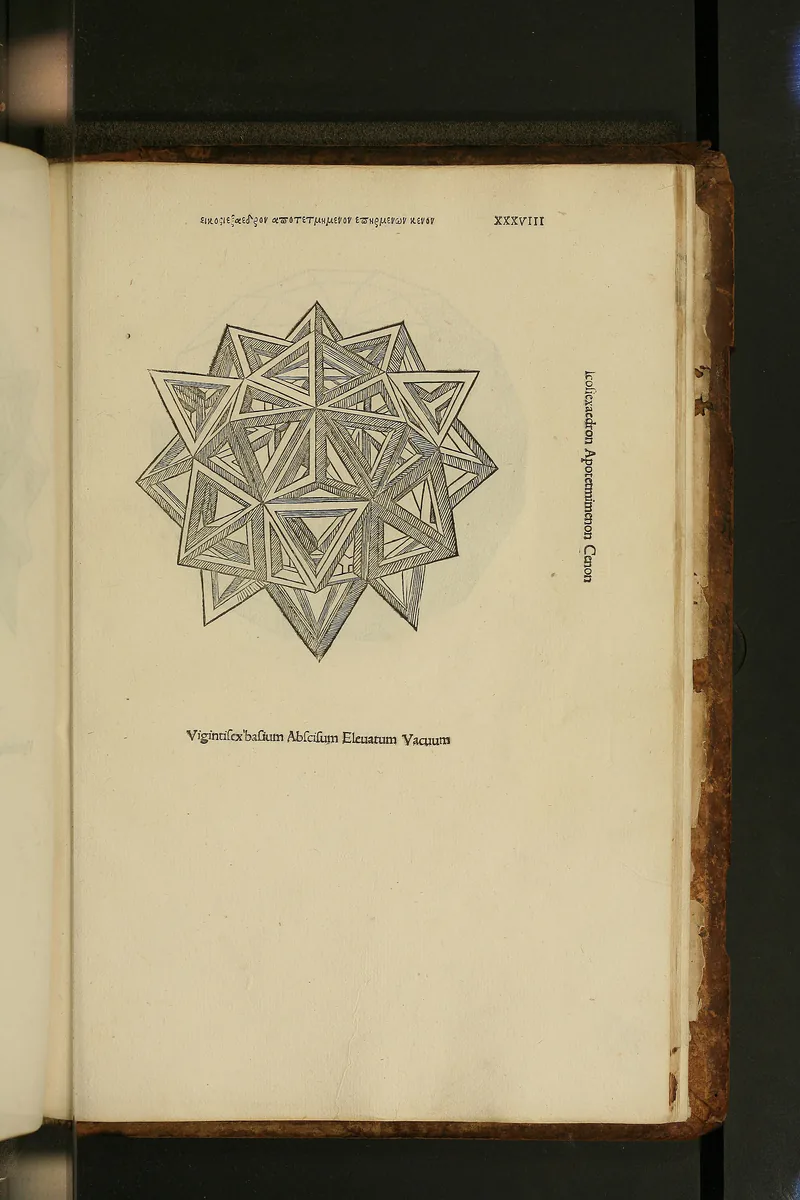
Plato's Timaeus (c. 360 BCE) gave sacred geometry its foundational myth. A divine craftsman, the Demiurge, orders the world according to mathematical proportions, building the four elements from triangles: fire from the tetrahedron, air from the octahedron, water from the icosahedron and earth from the cube, while a fifth figure, the dodecahedron, is used for the whole cosmos. These five regular convex polyhedra, the Platonic solids, were proved by Euclid in the final book of his Elements (c. 300 BCE) to be the only ones possible. The Neoplatonists who followed treated geometry as a ladder from the senses to the intelligible world, an idea echoed in the Hermetic tradition (see Corpus Hermeticum).
The vesica piscis§
One of the simplest constructions in geometry, two circles of equal radius each passing through the other's centre, produces an almond-shaped overlap later called the vesica piscis ("fish's bladder"). It is the first construction of Euclid's Elements, used to draw an equilateral triangle. In Christian art the same shape frames Christ in Majesty as the mandorla, and in modern sacred geometry it is treated as a symbol of creation and the meeting of worlds.
The Golden Ratio: History and Exaggeration§
The golden ratio, approximately 1.618 and written φ (phi), is the proportion in which a line is divided so that the whole is to the longer part as the longer part is to the shorter. Euclid called it "extreme and mean ratio" and used it to construct the pentagon and the dodecahedron. In 1509 the Franciscan mathematician Luca Pacioli published De divina proportione, illustrated by Leonardo da Vinci, celebrating its theological significance. The name "golden section" appears only in the nineteenth century, and the symbol φ was introduced in the early twentieth.
The ratio appears in pentagrams, in the Fibonacci sequence and in some patterns of plant growth. However, many popular claims are exaggerated or false. Studies such as George Markowsky's "Misconceptions about the Golden Ratio" (1992) have shown that the Parthenon, the Great Pyramid and many Renaissance paintings do not clearly embody it, that measurements are often chosen selectively to fit, and that the nautilus shell's spiral is not a golden spiral. Psychological experiments have not confirmed that the golden rectangle is universally preferred.
Building the Sacred: Temples, Cathedrals and Masons§
Sacred buildings across the world were laid out with geometric care. The Roman architect Vitruvius, writing in the first century BCE, taught that temples should reflect the proportions of the human body, which could be inscribed in a circle and square, an idea Leonardo illustrated in his Vitruvian Man (c. 1490). Hindu temple plans are based on the vastu-purusha mandala, a square grid on which a cosmic being is laid, and the Sri Yantra of interlocking triangles is a geometric image of the goddess and the cosmos.
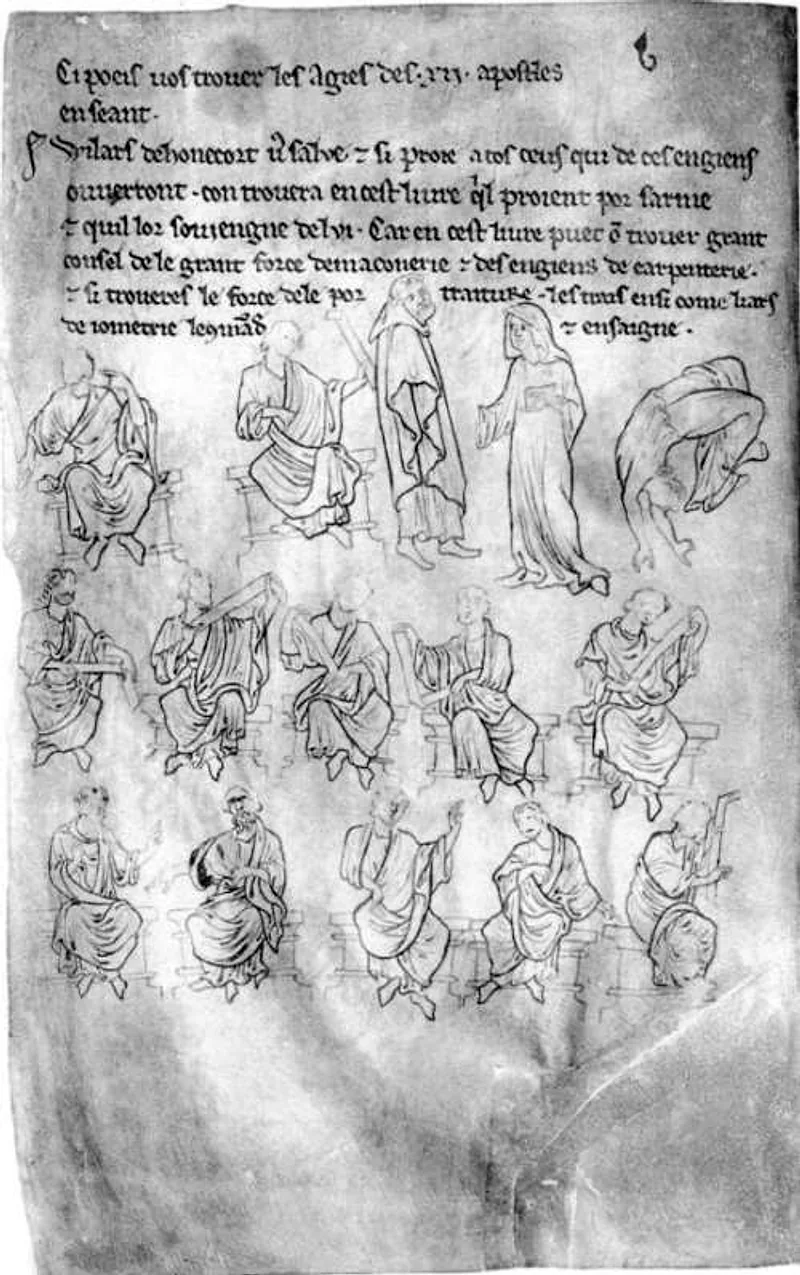
Medieval master masons used practical geometry, not arithmetic, to generate the plans and elevations of Gothic cathedrals. The thirteenth-century portfolio of Villard de Honnecourt shows figures drawn with geometric frameworks, and late Gothic booklets by masons such as Mathes Roriczer (1486) explain how to derive a pinnacle from a rotated square, the method ad quadratum. The construction of Milan Cathedral in the 1390s led to a recorded debate between local and foreign experts over whether to build ad quadratum or ad triangulum. Whether such geometry carried conscious theological symbolism, beyond structural and aesthetic sense, is debated; historians are cautious about modern claims of secret codes.
Pattern and Infinity in Islamic Geometric Art§
Islamic art developed one of the world's most sophisticated geometric traditions. Because figurative images were avoided in religious settings, mosques, madrasas and Qur'an manuscripts were adorned with interlacing star-and-polygon patterns, generated from the circle by compass and straight-edge. Many writers, including Keith Critchlow in Islamic Patterns (1976), have interpreted these designs as images of divine unity unfolding into multiplicity, though historians note that period sources rarely state such meanings explicitly.
The tradition reached extraordinary complexity in buildings such as the Alhambra in Granada and in Iranian and Central Asian architecture. In 2007 the physicists Peter Lu and Paul Steinhardt showed that some medieval Islamic designs, notably at the Darb-i Imam shrine in Isfahan (1453), were constructed with a set of "girih tiles" and approach the properties of quasicrystalline patterns that Western mathematics described only in the 1970s. See also Religious Symbols.
Kepler, the Renaissance and the Modern Revival§
Renaissance thinkers revived Pythagorean and Platonic cosmology. Johannes Kepler, in his Mysterium Cosmographicum (1596), proposed that the orbits of the six known planets were spaced by the five Platonic solids nested inside one another; in Harmonices Mundi (1619) he sought the music of the spheres in planetary motion and discovered his third law in the process. His theory of nested solids proved wrong, but his conviction that God created by geometry drove real discovery.
In the twentieth century sacred geometry became a movement in its own right. Matila Ghyka's books on the golden number, the Traditionalist writings of René Guénon, the work of Keith Critchlow and Robert Lawlor, and the New Age teachings of the 1990s popularised figures such as the Flower of Life, a lattice of overlapping circles, and Metatron's Cube, a figure joining the centres of thirteen circles. Both names are modern. Overlapping-circle patterns occur in ancient and medieval decoration, but the claim that the Flower of Life was a secret symbol of ancient Egypt rests largely on drawings at the temple of Osiris at Abydos whose date is uncertain and probably late. Kabbalistic diagrams such as the Tree of Life are often included in modern sacred-geometry books, too.
Frequently asked questions§
What is the most important shape in sacred geometry?§
There is no single one, but the circle is fundamental, since most traditional constructions begin with compass-drawn circles. From them derive the vesica piscis, the equilateral triangle, the hexagon and the Platonic solids.
Is the golden ratio really found everywhere in nature?§
No. It appears in some patterns of plant growth related to the Fibonacci sequence, but many popular claims, including those about the nautilus shell, the human face, the Parthenon and the Great Pyramid, are exaggerated or unsupported.
What are the Platonic solids?§
They are the five regular convex polyhedra: tetrahedron, cube, octahedron, dodecahedron and icosahedron. Plato associated four of them with the elements and the fifth with the cosmos, and Euclid proved no others exist.
Is the Flower of Life ancient?§
Patterns of overlapping circles are ancient and widespread, but the name "Flower of Life" and its role as a sacred symbol come from late twentieth-century New Age writers.
Sources and further reading§
- Sacred Geometry: Philosophy and Practice — Robert Lawlor, 1982
- A Beginner's Guide to Constructing the Universe — Michael S. Schneider, 1994
- Islamic Patterns: An Analytical and Cosmological Approach — Keith Critchlow, 1976
- The Geometry of Art and Life — Matila Ghyka, 1946
- Timaeus — Plato, c. 360 BCE
- The Elements — Euclid, c. 300 BCE
- The Golden Ratio: The Story of Phi, the World's Most Astonishing Number — Mario Livio, 2002
- Gothic Architecture and Scholasticism — Erwin Panofsky, 1951