Liber XXX · Symbols · Chapter V: Sacred Geometry
Vesica Piscis: Meaning and History of the Sacred Mandorla
The vesica piscis explained: the geometry of two overlapping circles, Euclid and the number 153, the Christian mandorla, Gothic arches and modern myths.

The vesica piscis is the almond-shaped figure formed where two circles of equal size overlap, each passing through the centre of the other. Its Latin name means "bladder of a fish". Geometrically it is the first step in the construction of an equilateral triangle in Euclid's Elements, and its proportions involve the square root of three. In Christian art the same shape, called the mandorla, surrounds Christ and the Virgin in glory, and it shaped medieval seals and pointed arches. Since the nineteenth century esoteric writers and the modern sacred geometry movement have treated it as a primal symbol of creation, a reading that goes well beyond the historical evidence.
The Geometry of the Vesica Piscis§
To draw a vesica piscis, take two points and draw a circle around each with a radius equal to the distance between them. Each circle passes through the centre of the other, and the area they share is a pointed oval. The two points where the circles cross, together with either centre, form an equilateral triangle; joining both crossing points and both centres gives two such triangles base to base, a rhombus. If the circles have a radius of one unit, the vesica is one unit wide and √3 units long (about 1.732), and this irrational proportion is the reason the figure was associated with the hidden "measures" of sacred design.
The name vesica piscis is a Latin term used by later medieval and early modern writers, and mandorla is the Italian word for "almond". Other names include the "pointed oval" in architecture and ichthys or fish shape in some modern writing, because two arcs crossing at one end produce the simple outline of the Christian fish sign. The figure is also the basic form of the diagram that John Venn introduced in 1880 to show logical relations between classes, which is why the overlapping-circles shape is now familiar from Venn diagrams.
Euclid, Archimedes and the Number 153§
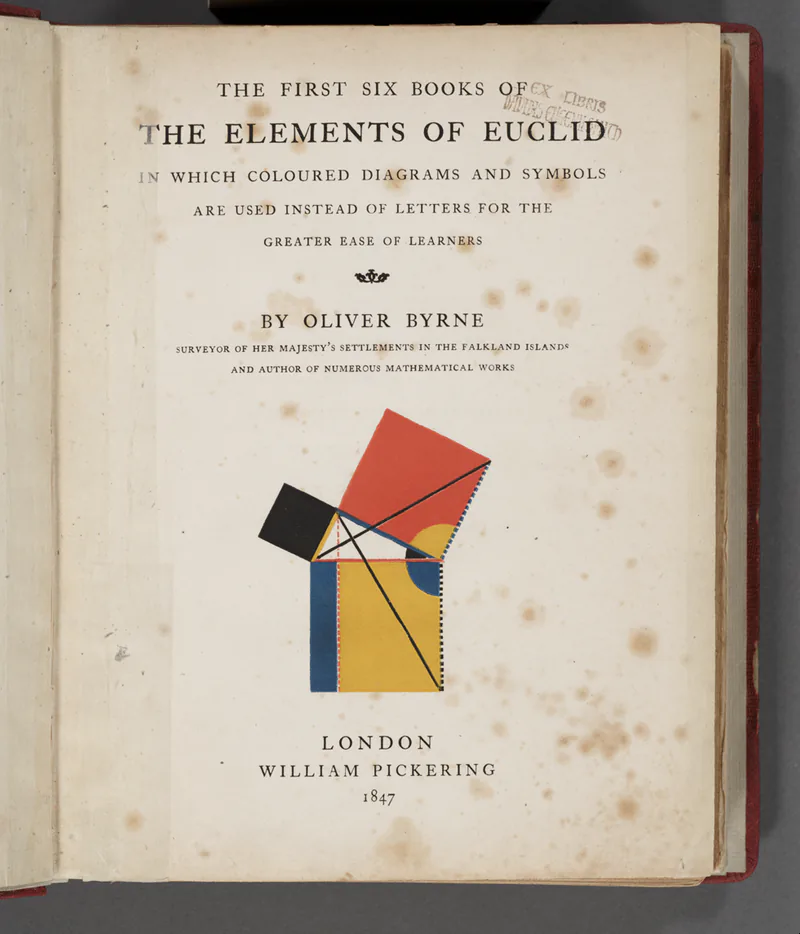
The vesica stands at the very beginning of Greek geometry. Proposition 1 of Book I of Euclid's Elements (about 300 BCE) shows how to construct an equilateral triangle on a given straight line: draw a circle around each end of the line through the other end, and join the ends to a point where the circles meet. Every reader of Euclid for two thousand years began with this construction, and the same pair of circles underlies the construction of hexagons, the division of lines and many other procedures with compass and straightedge. The broader tradition is surveyed in sacred geometry.
Because √3 cannot be expressed as a ratio of whole numbers, ancient mathematicians used approximations. In his Measurement of a Circle Archimedes (third century BCE) used the fraction 265/153 as a lower bound for √3, without explaining where he found it. Modern esoteric writers, notably John Michell in City of Revelation (1972), connected this 153 with the 153 fish caught in the net in John 21, proposing that the Gospel writer encoded the "measure of the fish" in the story. The suggestion is ingenious but speculative; there is no ancient text that makes the connection. Augustine, in his Tractates on the Gospel of John, explained 153 differently, as the sum of the numbers from 1 to 17, where seventeen joins the ten commandments of the law to the seven gifts of the Spirit. Such readings belong to the tradition described in biblical numerology.
The Mandorla: The Vesica in Christian Art§
In Christian art, a body of light enclosing a holy person is called an aureole, and when it takes the pointed oval shape it is a mandorla. It appears in Byzantine art by the sixth century: the apse mosaic of the Transfiguration at the Monastery of St Catherine on Mount Sinai shows Christ in a mandorla of concentric bands of blue, with rays striking the apostles below. Icons of the Transfiguration, the Ascension and the Dormition of the Virgin continued to use it, often with graded colours that darken towards the centre to express the paradox of divine light that is also unapproachable darkness.
In the West, the mandorla became central to Romanesque sculpture and painting. On the Royal Portal of Chartres Cathedral (around 1145–1155), Christ in Majesty sits enthroned in a mandorla surrounded by the four living creatures of the evangelists, a composition repeated on church portals and in manuscript illumination across Europe. The Virgin of the Assumption and visions of the Apocalypse also use it. The mandorla is the full-body counterpart of the halo or nimbus: it signals that the figure is seen in heavenly glory rather than in ordinary space.
Whether medieval artists thought of the mandorla as the geometric vesica, constructed with compasses, is a separate question. Many mandorlas are true vesicas; others are freely drawn ovals or even circles. The symbolic meanings later attached to the shape, such as the meeting of heaven and earth or of divine and human nature in Christ, are plausible theological readings but are rarely stated in medieval texts.
Pointed Arches, Seals and Gothic Masons§
The pointed oval was also a practical form. From the twelfth century many seals of bishops, abbots, cathedral chapters, religious houses and women of rank were made in this shape, while kings and lay lords usually used round seals. The pointed oval suited a standing figure and became a mark of ecclesiastical and female identity in the documents of medieval Europe.

In Gothic architecture, the equilateral pointed arch is drawn from two centres placed on the springing line, each at the opposite side of the opening; its outline is the upper half of a vesica. Medieval masons designed with compass and straightedge rather than numbers, and constructions with intersecting circles, squares and triangles appear in the portfolio of Villard de Honnecourt (about 1230) and in late Gothic booklets on design such as Mathes Roriczer's treatise on pinnacles (1486). Historians such as Lon Shelby and Charles Radding have shown how this "constructive geometry" worked in the lodges. Claims that particular cathedral plans were laid out from a single great vesica, however, mostly come from nineteenth- and twentieth-century analysts, whose diagrams can often be made to fit many buildings equally well. The later symbolic interest of Freemasons in geometry is discussed in Freemasonry.
Victorian Esotericism and the Glastonbury Vesica§
The modern esoteric career of the vesica began in Victorian Britain. In The Canon (1897), published anonymously and later attributed to William Stirling, the author argued that ancient temples and Gothic cathedrals were designed according to a secret canon of number and geometry inherited from pagan mysteries, and he gave the vesica a central place in it. The book influenced occultists, architects and later earth-mysteries writers.
The architect and psychical researcher Frederick Bligh Bond, who excavated Glastonbury Abbey from 1908, believed that the abbey's medieval builders used sacred geometry and claimed that some of his findings were guided by automatic writing, as described in his book The Gate of Remembrance (1918). In 1919 he designed the wrought-iron cover of the Chalice Well at Glastonbury with two interlocking circles forming a vesica, pierced by a lance or sword. The cover made the vesica a recognisable emblem of Glastonbury's spiritual tourism and of the wider British interest in sacred landscapes.
The Vesica in Modern Sacred Geometry§
From the 1970s, writers such as John Michell, Keith Critchlow and Robert Lawlor presented the vesica as a cosmological symbol. In Lawlor's Sacred Geometry: Philosophy and Practice (1982), the two circles represent unity dividing into polarity, and the vesica becomes the "womb" from which the regular polygons and proportions are generated, including the roots of two, three and five that lead to the golden ratio and the Platonic solids. Goddess-spirituality writers read the shape as a vulva or yonic sign and the mandorla as a feminine gateway of birth, an interpretation without clear support in the medieval sources.
New Age teachers of the 1990s, especially Drunvalo Melchizedek, made the vesica the first step of a sequence of overlapping circles called the Seed of Life and the Flower of Life, which they described as the blueprint of creation. The Flower of Life pattern does have a long history as ornament, appearing on Assyrian and Roman objects and in medieval and Renaissance designs, and one example drawn on a granite pillar of the Osireion at Abydos in Egypt is often cited, though it is probably much later than the building itself. In this modern setting the vesica functions as a meditation symbol and design motif. Its historical meaning is more modest: the first figure of Euclidean geometry, a convenient shape for arches and seals, and in Christian art a frame for divine glory. The ancient philosophical background of number and shape is described in Pythagoras and Pythagorean number mysticism.
Frequently asked questions§
What does the vesica piscis symbolise?§
Geometrically it is the overlap of two equal circles and the basis of the equilateral triangle. In Christian art, as the mandorla, it frames Christ or the Virgin in heavenly glory. Modern sacred geometry treats it as a symbol of creation, of unity dividing into two, or of the feminine, which are modern interpretations.
Why is it called the "fish bladder"?§
Vesica piscis is Latin for "bladder of a fish", a descriptive name for the pointed oval shape. The resemblance of the figure to a fish outline also connects it in modern writing with the early Christian fish sign.
Is the vesica piscis connected with the 153 fish in the Gospel of John?§
Some modern writers argue that it is, because Archimedes used 265/153 as an approximation of √3, the ratio of the vesica's length to its width. No ancient source makes this connection, and Augustine explained 153 instead as the triangular number of seventeen.
Sources and further reading§
- The Elements — Euclid, c. 300 BCE
- The Works of Archimedes — T. L. Heath, 1897
- Tractates on the Gospel of John — Augustine of Hippo, c. 420
- The Gothic Cathedral — Otto von Simson, 1956
- Medieval Architecture, Medieval Learning: Builders and Masters in the Age of Romanesque and Gothic — Charles M. Radding and William W. Clark, 1992
- The Canon: An Exposition of the Pagan Mystery Perpetuated in the Cabala as the Rule of All the Arts — William Stirling, 1897
- The Gate of Remembrance — Frederick Bligh Bond, 1918
- City of Revelation — John Michell, 1972
- Sacred Geometry: Philosophy and Practice — Robert Lawlor, 1982