Liber XXX · Symbols · Chapter V: Sacred Geometry
The Platonic Solids: Meaning and History of the Five Forms
The five Platonic solids explained: Plato's Timaeus and the elements, Euclid's proof, Leonardo's drawings, Kepler's cosmic model and modern sacred geometry.

The Platonic solids are the five regular convex polyhedra: the tetrahedron, cube, octahedron, dodecahedron and icosahedron. Each has identical regular faces and the same number of faces meeting at every corner, and no other solids share these properties. They take their name from Plato's Timaeus (c. 360 BCE), which made four of them the building blocks of the elements and the fifth the shape of the cosmos; Euclid proved that only five exist; and from Renaissance artists to Johannes Kepler and modern sacred geometry they have stood for the hidden mathematical order of creation.
What Are the Platonic Solids?§
A polyhedron is regular when all its faces are identical regular polygons and the same number meet at every vertex. In three dimensions there are exactly five convex examples:
- Tetrahedron: 4 equilateral triangles, 4 vertices, 6 edges.
- Cube (hexahedron): 6 squares, 8 vertices, 12 edges.
- Octahedron: 8 equilateral triangles, 6 vertices, 12 edges.
- Dodecahedron: 12 regular pentagons, 20 vertices, 30 edges.
- Icosahedron: 20 equilateral triangles, 12 vertices, 30 edges.
The reason there are only five is simple. At least three faces must meet at a corner, and their angles must total less than 360 degrees, or the surface would lie flat. Equilateral triangles (60 degrees) can meet in threes, fours or fives; squares (90 degrees) only in threes; regular pentagons (108 degrees) only in threes. Hexagons, at 120 degrees, already fill a flat plane when three meet.
The solids are also linked in pairs. Joining the centres of a cube's faces produces an octahedron, and vice versa; the dodecahedron and icosahedron are related in the same way, while the tetrahedron is its own partner. The pentagons of the dodecahedron, and the proportions of the icosahedron, are governed by the golden ratio, which is one reason those two solids attracted special mystical attention.
Plato's Timaeus and the Geometry of the Elements§
The philosophical history of the solids begins with Plato's Timaeus. In this dialogue a divine craftsman, the Demiurge, shapes a pre-existing chaos into an ordered cosmos according to mathematical proportions (see the Demiurge). Plato accepts the four elements of Empedocles, earth, water, air and fire, but argues that they are not ultimate: they are made of tiny invisible bodies with geometric shapes, and those shapes are built from two kinds of right-angled triangle, the half-square and the half-equilateral.

Plato assigns each element the solid that suits its properties. Fire, the sharpest and most mobile, is the tetrahedron, with the fewest faces and the most pointed corners. Air is the octahedron and water the icosahedron, progressively rounder and heavier. Earth, the most stable, is the cube, which sits firmly on its square faces. Because fire, air and water are all built from the same triangles, they can break up and recombine into one another, explaining how water boils into vapour or air fuels fire; earth, made from a different triangle, cannot change into the others. Of the fifth solid, the dodecahedron, Plato says only that the god used it "for the whole", decorating it with figures, which most readers took to mean the twelve signs of the zodiac.
This theory is the first attempt in Western thought to explain matter through mathematical structure, and historians of science have often compared it, in spirit if not in detail, to modern atomic and molecular physics. Later Platonists, when Aristotle had added a fifth element, the aether or "quintessence" of the heavens, came to associate the dodecahedron with that element.
Pythagoreans, Theaetetus and Euclid's Proof§
Who first discovered the five solids is uncertain. Later tradition credited the Pythagoreans with knowledge of the dodecahedron, and the Neoplatonist Iamblichus tells of a Pythagorean, often identified as Hippasus, who died at sea as punishment for revealing the construction of the "sphere of twelve pentagons" to outsiders. A small carved dodecahedron from northern Italy, attributed to the Etruscans of around 500 BCE, has been cited as early evidence of interest in the shape, though its dating and meaning have been debated. Scholars such as Walter Burkert caution that much of the "Pythagorean" mathematics described by later writers may be projected back from Plato's time (see Pythagoras and Pythagorean number mysticism).
A later scholion to Euclid credits Theaetetus of Athens (c. 417–369 BCE), Plato's friend and the subject of a dialogue, with the theory of the octahedron and icosahedron and with the first rigorous treatment of all five. The mathematical tradition culminated in Euclid's Elements (c. 300 BCE), whose thirteenth and final book shows how to inscribe each of the five solids in a sphere, compares their edges, and ends with the proof that no sixth regular solid exists. Some ancient commentators, notably Proclus, argued that the whole of the Elements was composed with the cosmic figures as its goal.
Hundreds of hollow bronze dodecahedra from Roman Gaul, Britain and the Rhineland, dating from roughly the second to fourth centuries CE, add a puzzle of their own: their purpose is unknown, and proposals range from measuring instruments to calendrical or religious objects.
Renaissance Perspectives: Pacioli, Leonardo and Jamnitzer§
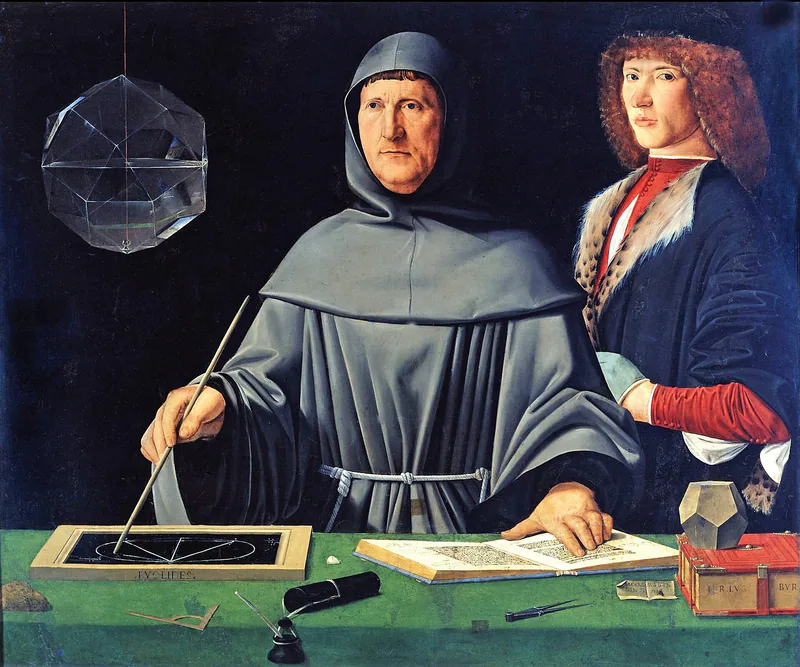
The Renaissance rediscovered the solids as objects of art as well as mathematics. The painter Piero della Francesca wrote a short treatise on the five regular bodies in the 1480s, and the Franciscan mathematician Luca Pacioli drew on it in De divina proportione (printed at Venice in 1509), which links the solids with the golden ratio and with theology. Its illustrations were designed by Leonardo da Vinci, who drew each solid both solid and "skeletal", showing only its edges as if made from wooden struts, a striking new way of making three-dimensional structure visible. A famous portrait of Pacioli of 1495, attributed to Jacopo de' Barbari, shows him demonstrating a theorem of Euclid beside a model dodecahedron and a glass polyhedron half filled with water.
Artists treated the solids as tests of perspective. Albrecht Dürer's Underweysung der Messung (1525) printed some of the first fold-out "nets" from which polyhedra can be built, and the Nuremberg goldsmith Wenzel Jamnitzer published Perspectiva corporum regularium (1568), a book of engravings in which the five solids, each linked by Jamnitzer to one of Plato's elements, are elaborated into dozens of fantastic variations. Polyhedra also appear in intarsia woodwork, in Dürer's engraving Melencolia I (1514), whose large stone is a truncated rhombohedron rather than a Platonic solid, and in the decorative programmes of humanist courts. In this setting the solids belonged to the wider occult philosophy of the Renaissance, which saw mathematics as a key to divine order.
Kepler's Cosmic Mystery§
The most ambitious use of the solids came from Johannes Kepler (1571–1630). In Mysterium cosmographicum ("The Cosmographic Mystery", 1596) he asked why God had made exactly six planets (as then known) and why their distances from the Sun were as they were. His answer was that the five Platonic solids, nested one inside another with spheres between them, fixed the spacing of the six planetary orbits: the cube between Saturn and Jupiter, the tetrahedron between Jupiter and Mars, the dodecahedron between Mars and Earth, the icosahedron between Earth and Venus, and the octahedron between Venus and Mercury. A large engraved plate showed the nested model, and Kepler even hoped to have it made as a silver drinking vessel for his patron.
The match with observed distances was only approximate, and Kepler spent years trying to improve it with better data from the astronomer Tycho Brahe. That work led him to discover that planetary orbits are ellipses, which undermined his scheme of perfect spheres. In Harmonices mundi (1619) he returned to the solids, illustrating each with an emblem of its element, and to the music of the spheres, while also stating his third law of planetary motion. His geometrical cosmology was mistaken, but the conviction that God created according to geometry drove real discoveries.
The Platonic Solids in Nature and Modern Sacred Geometry§
Some natural forms do approximate the solids. Common salt crystallises in cubes, fluorite often in octahedra and cubes, and pyrite in cubes and twelve-sided "pyritohedra" (whose pentagons are not regular). Methane molecules have tetrahedral geometry, and many viruses build their protein shells with icosahedral symmetry. The biologist Ernst Haeckel's Kunstformen der Natur (1899–1904) popularised drawings of microscopic radiolarians with polyhedral skeletons, though Haeckel tended to idealise their regularity.
In twentieth-century sacred geometry, the solids became central symbols. Keith Critchlow's Order in Space (1969) and Robert Lawlor's Sacred Geometry (1982) treated them as archetypal forms, and New Age writers related them to the elements, the chakras and figures such as "Metatron's Cube", a modern name for a pattern of thirteen circles from whose lines two-dimensional outlines of the solids can be drawn. These are modern interpretations, not ancient doctrines. The solids also live on in the dice of tabletop games, where the four-, six-, eight-, twelve- and twenty-sided dice are simply Plato's five bodies. For the broader tradition see Sacred Geometry.
Frequently asked questions§
Why are there only five Platonic solids?§
Because at least three regular faces must meet at each corner with angles totalling less than 360 degrees. Only triangles (in threes, fours or fives), squares (in threes) and pentagons (in threes) meet this condition, giving exactly five solids.
Which element goes with each Platonic solid?§
In Plato's Timaeus, fire is the tetrahedron, air the octahedron, water the icosahedron and earth the cube. The dodecahedron represents the whole cosmos, and later writers linked it with the fifth element, aether.
Did Plato discover the Platonic solids?§
No. They were known before him, and the mathematician Theaetetus is credited with important work on them. They are named after Plato because his Timaeus gave them their famous cosmological meaning.
Sources and further reading§
- Timaeus — Plato, c. 360 BCE
- The Elements — Euclid, c. 300 BCE
- Plato's Cosmology: The Timaeus of Plato — Francis M. Cornford, 1937
- Polyhedra — Peter R. Cromwell, 1997
- Kepler's Geometrical Cosmology — J. V. Field, 1988
- Mysterium Cosmographicum: The Secret of the Universe — Johannes Kepler, 1596
- Order in Space: A Design Source Book — Keith Critchlow, 1969
- Sacred Geometry: Philosophy and Practice — Robert Lawlor, 1982