Liber IX · Gnosticism · Chapter V: Gnostic Cosmology
The Demiurge: From Plato's Craftsman to Gnostic Yaldabaoth
The demiurge explained: Plato's divine craftsman in the Timaeus, the Gnostic Yaldabaoth, Marcion's creator, Plotinus's critique and modern literary echoes.

The demiurge is the maker of the physical universe in Greek philosophy and in several early Christian movements. In Plato's Timaeus the demiurge is a good divine craftsman who shapes the cosmos as a likeness of eternal forms; in many Gnostic texts he becomes an ignorant or arrogant lower god, often called Yaldabaoth, who creates the material world and is distinct from the true, transcendent God. The story of this figure, from Athens to Nag Hammadi and beyond, is one of the most influential reinterpretations in the history of religious thought.
The Word Demiurge and Its Origins§
The Greek noun dēmiourgos combines dēmos, "people", and ergon, "work". In Homer and in everyday Greek it referred to anyone who worked for the public: a carpenter, a potter, a healer, a herald. In some Greek cities it also named a class of magistrates. By the fifth century BCE it was used for skilled artisans generally, people who produced things according to a plan.
Philosophers applied the image of the craftsman to the order of the universe. Xenophon's Socrates argues that the purposeful design of the human body points to an intelligent maker. It was Plato, however, who made the craftsman a central figure of cosmology and gave the word its lasting religious meaning.
Plato's Demiurge in the Timaeus§
In the Timaeus, written around 360 BCE, the astronomer Timaeus of Locri gives a "likely account" of how the world came to be. A divine maker, whom he calls the craftsman and father of the universe, looks to an eternal, unchanging model, the realm of intelligible forms, and fashions the visible world as its image. The craftsman is good, and because he is without envy he wishes everything to be as much like himself as possible. He takes a pre-existing chaos moving without order and brings it into order, because order is better.

The demiurge does not create from nothing. He works with a resistant medium that Plato calls the "receptacle" or "nurse of becoming", and he is constrained by "necessity". He first forms the world soul, mixing Sameness, Difference and Being according to musical ratios, then the heavenly bodies as instruments of time. He creates the immortal part of the human soul himself, but delegates the making of mortal bodies to the "young gods", the lesser divinities he has generated, so that he will not be responsible for mortal evils.
Several features of this account proved decisive for later readers: the distinction between a model and its copy, the idea that the maker is not the highest principle but looks to something above him, the use of subordinate agents for the body, and the claim that he is free of envy. Later Gnostic writers would invert almost every one of these points.
The Demiurge in Middle Platonism and Hellenistic Judaism§
Between Plato and the second century CE, philosophers debated how to read the Timaeus. Was the world created in time, or eternally? Was the demiurge identical with the supreme God, or a second principle? Middle Platonists such as Numenius of Apamea (second century CE) distinguished a first God, pure intellect at rest, from a second God who is the demiurge, active and turned toward matter, and even a third, the cosmos. Numenius described the second god as becoming "divided" by his attention to the material world.
Jewish thinkers in Alexandria brought Genesis and the Timaeus together. Philo of Alexandria (c. 20 BCE–c. 50 CE) presented the God of Moses as the maker who first conceived the intelligible world in his Logos and then shaped the visible world. To protect God from responsibility for human sin, Philo reads the plural "Let us make" in Genesis 1:26 as indicating that God used helpers to create the lower, mortal parts of the human being, an idea that echoes Plato's young gods. In this way the ground was prepared for the separation of the creator from the highest God.
The Gnostic Demiurge: Yaldabaoth, Saklas and Samael§
In the second century several Christian and possibly Jewish groups took the decisive step of treating the creator as not merely subordinate but deficient. In the myth preserved in the Apocryphon of John, the central text of Sethian Gnosticism, the aeon Sophia produces an offspring without her partner. He is lion-faced and serpentine, and she names him Yaldabaoth. Other names in the texts include Saklas, Aramaic for "fool", and Samael, "blind god", a name associated in Jewish tradition with the angel of death.
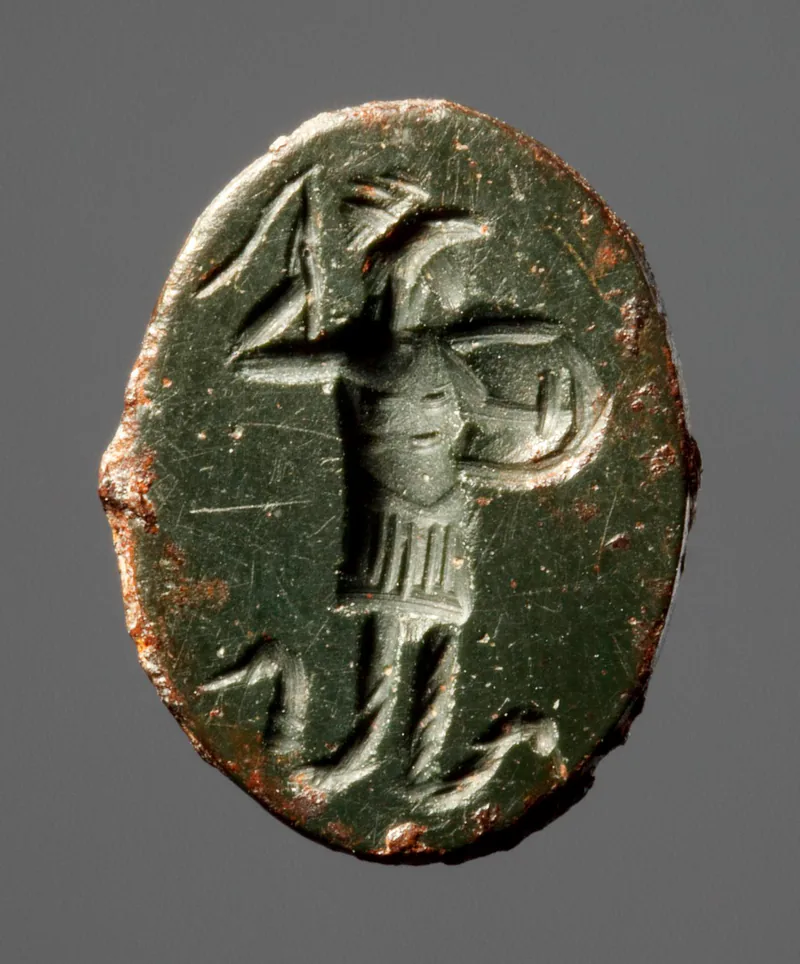
The Gnostic demiurge takes power from his mother and uses it to make archons, the planetary and zodiacal rulers. He creates the world as a defective imitation of the higher aeons, which he has glimpsed without understanding. When he declares, in words taken from Isaiah, that he is God and there is no other, the texts treat the claim as a revealing error. In the Hypostasis of the Archons and On the Origin of the World, a voice from above rebukes him as mistaken, and his son Sabaoth repents and is enthroned in a higher heaven, an intriguing detail that shows the myth could allow some powers to be redeemed.
The Gnostic reading turns Plato's account inside out. Plato's craftsman lacks envy; Yaldabaoth is jealous. Plato's craftsman looks to the eternal model with understanding; Yaldabaoth does not know what lies above him. Plato's world is a beautiful image; the Gnostic world is a prison guarded by the archons. Yet the structure, a maker below the highest principle who copies a higher model and uses subordinate powers to form the body, is clearly borrowed from the Platonic tradition.
The Valentinian Demiurge§
Not every Gnostic group was so negative. In Valentinian Gnosticism, the demiurge is formed from soulish substance by the lower Wisdom, Achamoth. He creates in ignorance but is guided from above without knowing it, and Ptolemy's Letter to Flora calls him "just", intermediate between perfect goodness and evil. Some Valentinian sources expect him to be granted rest at the end of time. This variety is one reason scholars like Michael Williams prefer the descriptive phrase "biblical demiurgical traditions" to a single doctrine of "Gnosticism", as discussed in our overview of Gnosticism.
Marcion and the Two Gods§
Marcion of Sinope, a wealthy shipowner from Pontus who came to Rome around 140 CE and was expelled from the Roman church in about 144, held a related but distinct view. In his Antitheses, now lost, he set out contrasts between the God of the Jewish scriptures and the God revealed by Jesus. The creator, in his view, was a just but harsh lawgiver, responsible for the world and its suffering; the good God was a stranger, previously unknown, who sent Christ out of pure mercy to rescue humanity from the creator's domain.
Marcion did not develop aeons, Sophia or archons, and he seems to have taught salvation by faith in the good God rather than by gnosis. He compiled a scriptural collection consisting of an edited Gospel of Luke and ten letters of Paul, and his churches spread widely and survived for centuries. Adolf von Harnack's monograph Marcion: The Gospel of the Alien God (1921) made him a sympathetic figure to modern theologians. Although Marcion is usually distinguished from the Gnostics, his opponents grouped them together, and his separation of the creator from the God of Jesus became one of the defining Christian heresies.
Plotinus Against the Gnostics§
The most serious ancient philosophical critique of the Gnostic demiurge came not from a Christian but from the Platonist Plotinus (c. 204–270). Porphyry reports that Christian Gnostics attended Plotinus's seminars in Rome and used revelations attributed to Zostrianos and others. Plotinus responded with a treatise that Porphyry placed in the Enneads as II.9 and titled Against the Gnostics; modern scholars, following Richard Harder, recognise it as the last part of a longer work split by Porphyry into four treatises.
Plotinus's objections are revealing. He argues that the Gnostics multiply intermediate principles unnecessarily; that their story of a fallen Wisdom producing the world implies a change and decline in the divine that is impossible; and that it is impious to despise the cosmos, which is the best possible image of the intelligible realm. He contrasts their contempt for the heavenly bodies, which he considers ensouled and divine, with their arrogant claim that they themselves are children of God superior to the stars. For Plotinus, the cosmos and its soul are not a prison but a beautiful work that leads the mind upward. His defence of the craftsman's goodness is essentially a defence of Plato's original vision.
Medieval Dualism and the Evil Creator§
The idea of a world-maker distinct from the good God reappeared in the Middle Ages. Bogomil and Cathar teachers, discussed in our article on the Cathars and Bogomils, taught that the visible world was made by Satan or an evil principle, sometimes identified with the God of the Old Testament. The historical connection between these movements and ancient Gnosticism is doubtful, since there is no clear chain of transmission and the Manichaean and Paulician links once proposed are now treated cautiously. Their cosmology also overlaps with the separate history of the devil traced in our article on the history of Satan and the Devil.
The Demiurge in Modern Literature and Thought§
In the nineteenth and twentieth centuries the demiurge became a figure of literary and philosophical imagination. William Blake's mythology features Urizen, a cold law-giving creator who binds the world in measure, often compared with the Gnostic demiurge, although Blake drew on many sources including Jacob Boehme. Carl Jung's Seven Sermons to the Dead (1916) speaks of Abraxas, a god above the conventional creator. Hans Jonas's The Gnostic Religion (1958) read the Gnostic rejection of the cosmos as an ancient analogue of modern existential alienation.
Twentieth-century fiction made frequent use of the theme. Philip K. Dick's novels VALIS (1981) and The Divine Invasion (1981) explore a deceiving lower creator and a hidden true God. Harold Bloom described American religion as Gnostic in The American Religion (1992) and wrote a Gnostic novel, The Flight to Lucifer (1979), inspired by David Lindsay's A Voyage to Arcturus. Philip Pullman's His Dark Materials trilogy (1995–2000) features an aged angel, the Authority, who falsely claims to be the creator. Critics frequently compare films such as The Matrix (1999) and The Truman Show (1998) to the Gnostic myth of a counterfeit world, though the filmmakers drew on many sources.
Frequently asked questions§
Is the demiurge evil?§
It depends on the source. In Plato's Timaeus the demiurge is entirely good. In Sethian texts Yaldabaoth is ignorant, arrogant and hostile to the spiritual seed, while Valentinian texts describe a creator who is ignorant but just. Medieval dualists sometimes identified the world-maker with Satan.
What is the difference between the demiurge and God?§
In Platonic philosophy the demiurge is often seen as subordinate to the eternal forms or to a higher first principle. In Gnostic myths the distinction is sharper: the demiurge is a lower being who creates the material world, while the true God is transcendent, unknown and the source of the divine spark in humanity.
Why is the demiurge called Yaldabaoth?§
The name appears in Sethian texts such as the Apocryphon of John. Its meaning is uncertain; suggested Aramaic etymologies include "child of chaos" or "begetter of Sabaoth", but none is agreed. The texts also give him the names Saklas and Samael.
Did Plato believe in an evil creator?§
No. Plato's demiurge is explicitly good and free of envy, and makes the world as beautiful as possible. The negative evaluation of the creator is a later development, shaped by second-century readers who combined Plato with Genesis and Christian revelation.
Sources and further reading§
- Timaeus — Plato, c. 360 BCE
- On the Creation of the World (De opificio mundi) — Philo of Alexandria, early 1st century CE
- Enneads II.9, Against the Gnostics — Plotinus, c. 265 CE
- Marcion: Das Evangelium vom fremden Gott — Adolf von Harnack, 1921
- The Gnostic Religion — Hans Jonas, 1958
- Rethinking "Gnosticism" — Michael Allen Williams, 1996
- The Middle Platonists — John Dillon, 1977
- Marcion and the Dating of the Synoptic Gospels — Markus Vinzent, 2014