Liber XXX · Symbols · Chapter V: Sacred Geometry
Labyrinth Symbol: From Knossos to Chartres and the Modern Walk
The labyrinth symbol explained: the classical seven-circuit design, Knossos and the Minotaur, Roman mosaics, the Chartres pavement and the modern revival.

A labyrinth is a single winding path that leads, by many turns, from an entrance to a centre, and it is one of the oldest designs in human culture. The classical form, with seven concentric circuits, appears on a Mycenaean clay tablet of about 1200 BCE, on the coins of Knossos and on rock carvings in Europe, and Greek myth made it the prison of the Minotaur. Christians set labyrinths in the floors of churches, most famously in Chartres Cathedral around 1200, and since the 1990s walking a labyrinth has become a widespread form of meditation and prayer.
Labyrinth and Maze: Defining the Symbol§
Scholars of the subject, following the German historian Hermann Kern, generally reserve the word labyrinth for a figure with a single path that winds back and forth, filling the whole space, before arriving at the centre. The walker cannot get lost, only turned around: the path repeatedly approaches the centre and swings away again. A maze, by contrast, offers choices, junctions and dead ends, and is a puzzle to be solved. Puzzle mazes became popular as garden features in the Renaissance; the hedge maze at Hampton Court, planted around 1690, is a famous example. Older English often used "maze" for both kinds, and some languages have only one word.
The classical labyrinth, also called the Cretan labyrinth, has seven circuits around a central space. It can be drawn quickly from a "seed": a cross, four right angles in the quarters between its arms, and four dots. Joining the ends of the seed in sequence, from the top of the cross to the nearest angle, then the next pair, and so on, generates the whole figure. Variants with three, eleven or more circuits follow similar principles. The geometric logic of such figures places them alongside other forms in sacred geometry, and its seven circuits have invited comparison with the sacred meanings of the number seven, though no early source makes that link.
Knossos, the Minotaur and the Earliest Labyrinths§
The earliest securely dated classical labyrinth is scratched on the back of a Linear B clay tablet from the Mycenaean palace at Pylos in Greece, preserved when the palace burned around 1200 BCE. Rock carvings of the same design at sites in Galicia in north-west Spain and in the Val Camonica in northern Italy may be as old or older, but rock art is notoriously difficult to date. Linear B tablets from Knossos on Crete record an offering of honey to the "Mistress of the labyrinth", showing that a place or sanctuary called labyrinthos existed there. The word's origin is uncertain; a popular derivation from labrys, the Minoan double axe, has been questioned by linguists.

Greek myth made the labyrinth the work of the craftsman Daedalus, built for King Minos to contain the Minotaur, the bull-headed son of his queen. Every ninth year (or every year, in some versions) Athens sent seven youths and seven maidens to be devoured, until the hero Theseus, given a thread by Minos's daughter Ariadne, killed the monster and found his way out. From the fourth century BCE the coins of Knossos carried a labyrinth, sometimes square, sometimes the classical round form. Greek writers also applied the name to other complex buildings: Herodotus calls a vast temple and mortuary complex in Egypt, usually identified with the pyramid complex of Amenemhat III at Hawara, "the labyrinth" and claims it surpassed the pyramids. The religious world of the myth is described in Greek religion and the mysteries.
Roman Mosaics and the First Church Labyrinths§
The Romans loved the labyrinth as a decorative and protective design. A graffito on a column at Pompeii shows a labyrinth with the words Labyrinthus hic habitat Minotaurus, "Labyrinth: here lives the Minotaur". Dozens of Roman mosaic floors, from Britain and Portugal to North Africa and Syria, depict a labyrinth with walls drawn as city fortifications, often with Theseus fighting the Minotaur at the centre. The Roman type divides the circuit into four quarters, each completed before the path moves to the next. Some scholars suggest that labyrinths at house entrances served an apotropaic purpose, confusing or trapping harmful influences, though Roman texts say little about this.
Christians adopted the motif early. The oldest known church labyrinth is in the Basilica of Reparatus at Orléansville (modern Chlef, Algeria), usually dated to the fourth century. At its centre is a square of letters that can be read in many directions as Sancta Eclesia, "Holy Church". The labyrinth here seems to have become an image of the world, or of the Church set within it, a theme the medieval interpreters of the design developed further.
Chartres and the Medieval Cathedral Labyrinth§
In the early Middle Ages, scholars copying computistical and astronomical manuscripts drew labyrinths, and in about the ninth and tenth centuries a new eleven-circuit Christian labyrinth appeared, divided into four quarters by a cross formed from the turns of the path. This is the design laid in the nave floor of Chartres Cathedral, usually dated to around 1200–1220. About thirteen metres across, it is made of pale stone set in dark bands, with a six-petalled rosette at its centre and a border of small lunations around the edge. A metal plaque once at its centre, reportedly showing Theseus and the Minotaur, was removed during the French Revolution.
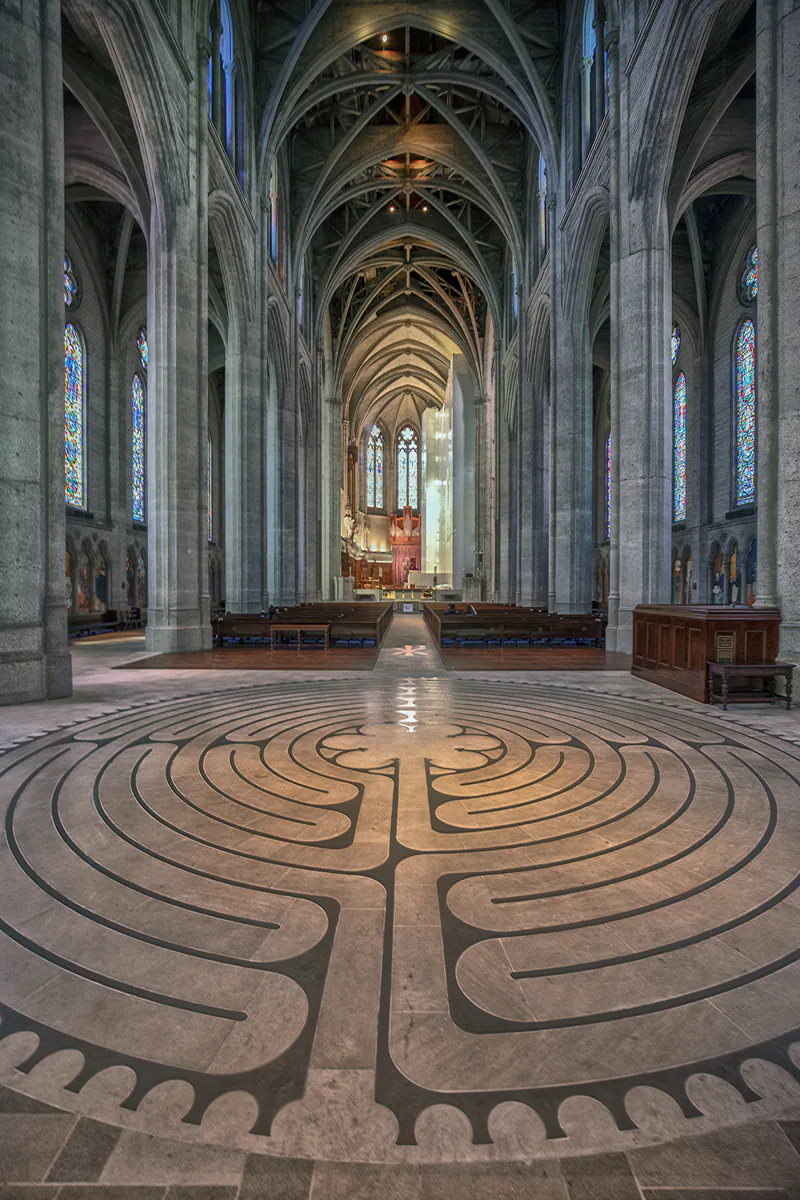
Other cathedrals in northern France had large pavement labyrinths. That of Amiens (1288) is octagonal, and its central stone named the bishop and the three master masons who built the cathedral, linking the labyrinth's maker Daedalus with the architects of the church. The labyrinth of Reims, which also honoured the cathedral's architects, was destroyed in the eighteenth century, as were others, reportedly because children playing on them disturbed services. At Auxerre, records describe the canons performing a ball dance on the labyrinth at Easter, a ritual that the musicologist Craig Wright has connected with Christ's harrowing of hell, imagined as a new Theseus defeating the devil.
Later writers called pavement labyrinths chemins de Jérusalem and claimed they were walked on the knees as a substitute for pilgrimage to the Holy Land. These names and practices are attested mostly from the early modern period onward, and medieval evidence for penitential walking is thin. What medieval sources do show, as Penelope Reed Doob has argued, is a rich theological idea of the labyrinth as an image of the fallen world, the difficult path of the soul and the divine art that orders apparent confusion.
Turf Mazes, Troy Towns and Folk Labyrinths§
Outside churches, labyrinths were cut in turf on village greens and laid out with stones on coasts. England preserves several historic turf mazes, such as those at Saffron Walden in Essex and Alkborough in Lincolnshire ("Julian's Bower"), whose dates are uncertain but which were used for games and festivities in the early modern period. Around the Baltic and in northern Scandinavia, hundreds of stone labyrinths survive, many near fishing grounds; local names such as Trojaborg ("Troy town") recall the old association of labyrinths with the walls of Troy. Folklore connects some of them with fishermen's rituals for good winds or catches, though most are probably medieval or later.
In the American Southwest, the "Man in the Maze" design of the Tohono O'odham, showing the figure of I'itoi at the entrance to a labyrinth, has become an emblem of that nation and appears in basketry; its age and relation to similar Hopi designs are debated. In India, labyrinth designs are linked with the Chakravyuha, the spiral battle formation of the Mahabharata, showing how widely the form appealed.
The Modern Labyrinth Revival§
Interest in labyrinths grew in the twentieth century, first among historians such as W. H. Matthews, whose Mazes and Labyrinths (1922) remains a classic, and then among writers on earth mysteries and sacred geometry. Jungian psychologists read the labyrinth as an image of the journey to the psychological centre, the self.
The great revival came in the 1990s. The Episcopal priest Lauren Artress, after walking the Chartres labyrinth, introduced a copy at Grace Cathedral in San Francisco in 1991 and promoted labyrinth walking as a form of contemplative prayer in her book Walking a Sacred Path (1995). Since then thousands of labyrinths, most copied from Chartres or the classical form, have been built in churches, hospitals, schools, parks and retreat centres. Practitioners describe walking them as a moving meditation of release, reflection and return, and they are used by people of many faiths and none; see meditation and the New Age. The practice is modern, though inspired by a symbol with a three-thousand-year history.
Frequently asked questions§
What is the difference between a labyrinth and a maze?§
A labyrinth has a single path that always leads to the centre, with no choices to make. A maze has branching paths and dead ends and is designed to puzzle the walker. Historically the words have often been used interchangeably.
What does the labyrinth symbolise?§
Its meanings have varied: the lair of the Minotaur in Greek myth, a protective or decorative figure in Roman houses, an image of the world, of the soul's difficult path and of Christ's victory over death in medieval Christianity, and a path of meditation today.
Did medieval pilgrims walk the Chartres labyrinth on their knees?§
This is often said, but the evidence is late. Names such as "road to Jerusalem" and accounts of penitential walking come mainly from the early modern period, and medieval sources say little about how the pavement was used.
Sources and further reading§
- Through the Labyrinth: Designs and Meanings over 5,000 Years — Hermann Kern, 2000
- The Idea of the Labyrinth from Classical Antiquity through the Middle Ages — Penelope Reed Doob, 1990
- The Maze and the Warrior: Symbols in Architecture, Theology, and Music — Craig Wright, 2001
- Mazes and Labyrinths: A General Account of Their History and Developments — W. H. Matthews, 1922
- Labyrinths and Mazes: A Complete Guide to Magical Paths of the World — Jeff Saward, 2003
- Walking a Sacred Path: Rediscovering the Labyrinth as a Spiritual Practice — Lauren Artress, 1995
- The Histories — Herodotus, c. 430 BCE