Liber X · Greek Mythology · Chapter VI: Religion, Mysteries & Oracles
Greek Religion and the Mysteries: Gods, Sacrifice and Eleusis
Ancient Greek religion and the mysteries explained: Olympian gods, sacrifice and festivals, oracles, hero cult, and the Eleusinian and Orphic mysteries.

Ancient Greek religion was the worship of the Olympian gods, heroes and local powers by the city-states of Greece and the Greek world from the Bronze Age to late antiquity. It had no single scripture, creed or church: religion was woven into civic life through sacrifice, festivals, sanctuaries and oracles, and priests were usually citizens who held office for a time. Alongside this public cult stood the mysteries, secret initiations such as those of Demeter at Eleusis, which promised initiates a closer bond with the gods and a better lot after death.
The Olympian Gods and Their Myths§
The Greeks worshipped many gods, of whom the twelve Olympians formed the best-known group: Zeus, father of gods and men; Hera, his wife and patron of marriage; Poseidon of the sea and earthquakes; Demeter of grain; Athena of wisdom, crafts and war; Apollo of prophecy, music and healing; Artemis of the hunt and wild places; Ares of war; Aphrodite of love; Hephaestus of fire and metalwork; Hermes, messenger and guide of souls; and Dionysus or Hestia, depending on the list. Beneath and around them stood Hades of the underworld, nymphs of springs and trees, river gods and countless local powers.
Greek knowledge of the gods came largely from poetry. Homer's Iliad and Odyssey (probably composed in the eighth or seventh century BCE) portrayed gods with human passions; Hesiod's Theogony (c. 700 BCE) told how the cosmos arose from Chaos and how Zeus overthrew his father Kronos. The historian Herodotus wrote that Homer and Hesiod had "given the gods their names and forms" for the Greeks. Yet these poems were not sacred law, and philosophers from Xenophanes onwards criticised their immoral gods. A god was also not the same everywhere: Athena Polias of Athens, Artemis of Ephesus and Zeus of Dodona each had distinct cults and epithets.
Sacrifice, Festivals and Sanctuaries§
The central act of Greek worship was thysia, animal sacrifice at an outdoor altar before the temple. A procession led the animal, usually a sheep, goat, pig or ox, to the altar; participants washed their hands and threw barley grains; a prayer was spoken; and the animal was killed, its thigh bones wrapped in fat and burned for the gods while the meat was cooked and shared among the worshippers. Hesiod explained this unequal division through the myth of Prometheus tricking Zeus at Mekone. Libations of wine, offerings of cakes, fruits and incense, and votive gifts such as statues and inscribed plaques were also common.
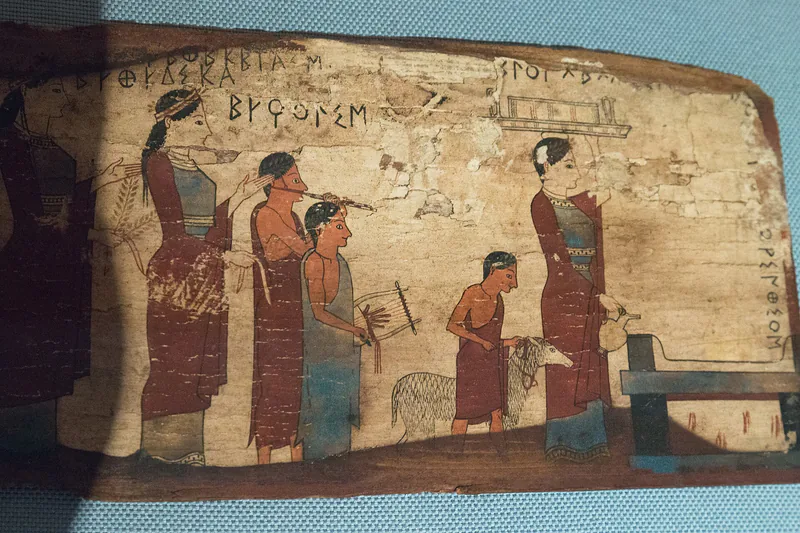
The temple itself housed the cult image and treasures; worship happened outside it. Every city had its religious calendar. At Athens the Panathenaia honoured Athena with a procession bringing a new robe to her ancient image; the City Dionysia presented tragedies and comedies in honour of Dionysus; and the Thesmophoria was a festival of Demeter kept by married women alone. The great Panhellenic sanctuaries, among them Olympia, Delphi, Isthmia and Nemea, drew Greeks from everywhere to games and festivals, which created a shared identity across rival cities. Scholars such as Christiane Sourvinou-Inwood have called this system "polis religion".
Oracles, Heroes and the Dead§
Greeks sought the will of the gods through divination: the examination of sacrificial entrails, the flight of birds, dreams and above all oracles. At Delphi the Pythia, a priestess of Apollo, gave responses to cities and individuals; at Dodona the rustling of Zeus's sacred oak and later lots were consulted. Cities would not found a colony or start a war without consulting Delphi. These practices are placed in a wider context in What Is Divination?.
Heroes, mighty dead men and women such as Heracles, Theseus or local founders, received cult at their tombs, often with offerings poured into the earth, and were believed to protect the land. Ordinary dead received offerings from their families. Popular ideas of the afterlife in Homer were gloomy: shades lingering in the house of Hades. Against this background the hopes offered by the mysteries were especially attractive.
The Eleusinian Mysteries§
The most famous mysteries were celebrated at Eleusis, about twenty kilometres west of Athens, in honour of Demeter and her daughter Persephone (Kore). Their foundation myth is told in the Homeric Hymn to Demeter, probably of the seventh or sixth century BCE: Hades carries off Persephone; Demeter, grieving, withholds the growth of grain until Zeus allows her daughter to return for part of each year; and the goddess, before leaving Eleusis, teaches its rulers her rites. The hymn declares the initiate blessed and the uninitiated without share in such good things after death.
Initiation was open to men and women, free and slave, provided they spoke Greek and were free of blood guilt. Candidates first attended the Lesser Mysteries at Agrai in spring. The Greater Mysteries, in the autumn month of Boedromion, began in Athens with purification in the sea, followed by a great procession along the Sacred Way to Eleusis, where initiates broke their fast with the kykeon, a drink of barley and pennyroyal. The climax took place at night in the Telesterion, a great hall, under the direction of the hierophant, who "showed the sacred things". Ancient writers distinguished "things done, things said and things shown", but the core secret was never revealed. Modern theories range from a dramatic re-enactment of the myth to the display of an ear of grain; a hypothesis that the kykeon contained a psychoactive substance remains speculative and unproven. The mysteries continued under Roman rule, with emperors such as Hadrian among the initiates, and ended around the time of Theodosius I's anti-pagan laws and the Gothic invasion of 396 CE.
Dionysus, Orpheus and Other Mystery Cults§
Bacchic or Dionysian mysteries were organised in private groups (thiasoi) rather than at one sanctuary. Euripides' Bacchae (405 BCE) dramatises the god's ecstatic female worshippers, the maenads. Gold leaves found in graves from southern Italy, Crete and Thessaly, dating from the fourth century BCE onwards, instruct the dead initiate how to answer the guardians of the underworld, claiming kinship with the gods: "I am a child of Earth and starry Sky."
These texts are linked with Orphism, a movement claiming the authority of the mythical singer Orpheus. Orphic poems told of Dionysus torn apart by the Titans and of humans born from the Titans' ashes, carrying both divine and Titanic elements. The Derveni papyrus, a charred roll found near Thessaloniki in 1962 and dated to the late fourth century BCE, contains an allegorical commentary on an Orphic theogony and is often called Europe's oldest surviving book. Orphics and Pythagoreans taught purification, vegetarianism and the transmigration of souls.
Other mysteries included those of the Great Gods (Kabeiroi) on Samothrace and, in the Hellenistic and Roman periods, the cults of Isis, Cybele and Mithras, discussed in Roman Religion. The ritual and theurgic philosophy of late antiquity, which drew on these traditions, is covered in Neoplatonism and Theurgy, and Greek spells and curse tablets in Greco-Roman Magic.
Frequently asked questions§
Did the ancient Greeks believe in their myths?§
Many Greeks accepted the gods and much of the myth as true in a broad sense, but belief was not defined by creed. Practice mattered more than doctrine, and educated Greeks often read myths as allegory or criticised them, while still taking part in sacrifice and festivals.
What happened at the Eleusinian Mysteries?§
Initiates purified themselves, walked in procession from Athens to Eleusis and, at night in the Telesterion, saw and heard sacred things shown by the hierophant. The central secret was kept so well that historians still do not know exactly what it was.
What is the difference between Greek religion and the mysteries?§
Civic religion was public, involved the whole community and aimed at the city's welfare. Mysteries were optional initiations, chosen by individuals, which created a personal relationship with particular gods and promised a better fate after death.
When did ancient Greek religion end?§
There was no single moment. Christian emperors restricted sacrifice in the fourth century, Theodosius I's laws of 391–392 banned pagan cult, and sanctuaries closed or were destroyed over the following decades, though traditional practices lingered in places into the sixth century.
Sources and further reading§
- Theogony — Hesiod, c. 700 BCE
- The Homeric Hymns — Apostolos N. Athanassakis (trans.), 1976
- Greek Religion — Walter Burkert, 1985
- Ancient Mystery Cults — Walter Burkert, 1987
- Ancient Greek Religion — Jon D. Mikalson, 2005
- Mystery Cults of the Ancient World — Hugh Bowden, 2010
- Ritual Texts for the Afterlife: Orpheus and the Bacchic Gold Tablets — Fritz Graf and Sarah Iles Johnston, 2007
- Eleusis and the Eleusinian Mysteries — George E. Mylonas, 1961