Liber X · Greek Mythology · Chapter VI: Religion, Mysteries & Oracles
Orphism and the Orphic Gold Tablets: Greek Mystery and Afterlife
Orphism explained: Orpheus, the Orphic poems and Derveni papyrus, Dionysus and the Titans, the gold tablets for the dead and the Orphic way of life.

Orphism is the name modern scholars give to a set of ancient Greek religious ideas, poems and rites attributed to the legendary singer Orpheus, which promised purification and a better fate after death. Its sources include theogonies that told of the gods' origins, a myth of Dionysus torn apart by the Titans, a way of life that avoided meat, and thin gold tablets buried with the dead that told the soul which path to take in the underworld. Whether Orphism was ever an organised religion, or rather a label attached to many freelance practitioners and texts, is one of the long-running debates of classical scholarship.
Orpheus the Singer in Greek Myth§
In Greek myth Orpheus was a poet from Thrace, usually the son of the Muse Calliope, whose song could charm animals, trees and stones. He sailed with the Argonauts, drowning out the Sirens with his music, and he descended to the underworld to bring back his wife Eurydice, only to lose her when he looked back too soon. His death was as famous as his song: he was torn apart by Thracian women, the maenads of Dionysus, and his severed head floated to the island of Lesbos, still singing, where it was said to have given oracles.
From an early date this figure was treated as a founder of rites. Greek writers called him the one who first taught people mysteries and initiations, and poems circulated under his name, much as hymns and oracles were attributed to the legendary seers Musaeus and Linus. An Orpheus who had gone down to Hades and returned was an obvious authority on what awaited the dead.
Orphic Poems and the Derveni Papyrus§
Classical authors speak of a body of Orphic writings and of those who used them. Herodotus, in the fifth century BCE, mentions rites called "Orphic and Bacchic" that forbade burial in woollen garments. Plato, in the Republic, describes begging priests and seers who went to the doors of the rich with a noisy heap of books by Musaeus and Orpheus, offering sacrifices and spells that would release the living and the dead from the penalties of wrongdoing. Euripides has Theseus sneer at his son Hippolytus for living on a meatless diet and revering the vapour of many writings with Orpheus as his master. The picture is of texts, private rites and ritual specialists rather than of a public temple cult.
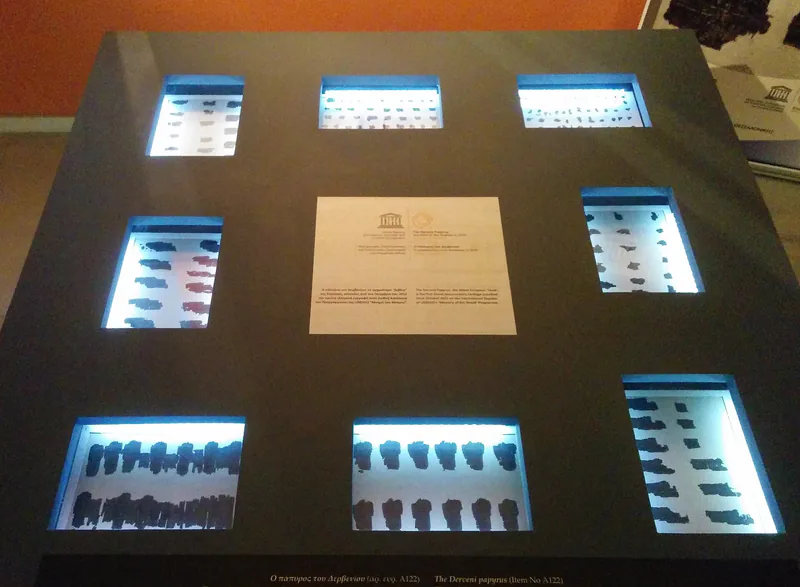
The most important find is the Derveni papyrus, discovered in 1962 among the charred remains of a funeral pyre at Derveni near Thessaloniki. The roll was burnt around 340–320 BCE, and it is generally reckoned the oldest surviving Greek book. Its author, whose identity is unknown, quotes and interprets an Orphic poem about the birth of the gods, reading it allegorically in terms of the natural philosophy of his day. The poem told how Zeus swallowed a primordial being and so contained the whole world within himself before creating it anew. The papyrus shows that an Orphic theogony existed by the fifth century BCE and that educated readers already treated it as sacred text requiring interpretation.
The Orphic Theogony and the Myth of Dionysus§
Later theogonies attributed to Orpheus survive mostly in quotations by Neoplatonist philosophers such as Proclus and Damascius. The best known, the Rhapsodies or Sacred Discourses in twenty-four books, began with Time and a cosmic egg from which hatched Phanes, a shining, double-sexed first-born god, followed by a succession of rulers ending with Zeus and then with Zeus's son Dionysus.
The episode that made Orphism famous is the death of the child Dionysus, sometimes called Zagreus. The Titans lured him with toys, killed and ate him; Zeus struck them with his thunderbolt, and Dionysus was restored, in some versions from his heart, which Athena had saved. In the sixth-century CE commentator Olympiodorus, human beings arise from the soot of the blasted Titans, so that they carry both a Titanic and a Dionysian element.
Nineteenth- and early twentieth-century scholars took this as the core Orphic doctrine: an "original sin" inherited from the Titans and a divine spark to be purified. Recent scholars, notably Radcliffe Edmonds, argue that this neat synthesis was assembled by modern writers from scattered and late sources, and that no early text clearly connects human guilt with the Titans' crime. Others still see allusions to it in Plato and in the gold tablets. The debate matters because it decides whether Orphism had a distinctive theology of the soul or only shared themes with wider Greek religion.
The Gold Tablets: Passports for the Dead§
Since the nineteenth century archaeologists have found small sheets of gold foil, inscribed in Greek and folded or placed by the body, in graves from southern Italy, Sicily, Thessaly, the Peloponnese, Crete and Rome. They date from about 400 BCE to the second century CE. The earliest, from Hipponion (Vibo Valentia) in Calabria, belongs to around 400 BCE; others come from Thurii, Petelia and Pelinna; one of the latest was buried with a Roman woman named Caecilia Secundina.
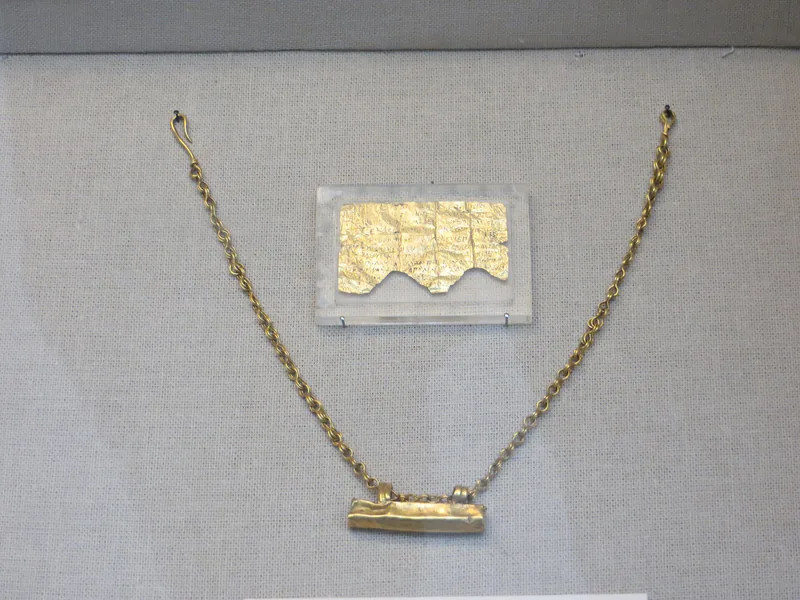
The longer tablets give the soul directions. It will find a spring by a white cypress, which it should avoid, and then the lake of Memory, guarded by watchmen. To them it must say, in substance, that it is a child of Earth and starry Heaven, that its race is heavenly, and that it is parched with thirst, and ask to drink. Other tablets address Persephone, queen of the dead, claiming purity and declaring that the soul has paid the penalty for unjust deeds; some promise that the dead will become a god instead of a mortal. Two ivy-leaf tablets from Pelinna tell the deceased to say to Persephone that Bacchus himself has released them.
Scholars call these texts "Orphic" or "Bacchic" gold tablets. They are ritual texts rather than private notes, and they presuppose initiation in Dionysian mysteries and a belief that the initiated dead could escape forgetfulness. Comparisons with the Egyptian Book of the Dead, which also furnishes the dead with words for underworld guardians, are often drawn, although direct borrowing is uncertain. Bone plaques from Olbia on the Black Sea, of the fifth century BCE, bear the words "life, death, life", "truth" and the name of Dionysus together with the word Orphikoi, the earliest known use of the term.
The Orphic Life: Purity, Vegetarianism and the Soul§
Plato refers to an "Orphic life" in which people abstained from animal flesh and offered only cakes and fruits to the gods. Avoiding the bloody sacrifice that stood at the centre of Greek civic religion, described in Greek religion and the mysteries, set its followers apart. Some ancient writers also attribute to "those around Orpheus" the idea that the body (soma) is a tomb or prison (sema) for the soul, which is being punished until it has paid its debt.
These ideas overlap strongly with those of the Pythagoreans, who also taught the transmigration of souls and dietary purity; the poet Ion of Chios even claimed that Pythagoras had written poems under Orpheus's name. Separating Orphic from Pythagorean, Bacchic and Eleusinian elements is often impossible, and many scholars now speak of a shared current of concern with purification and the afterlife rather than of distinct sects. The links with Pythagoras were important for later philosophy.
Ancient Critics, Modern Debates and Later Influence§
Ancient opinion of the Orphic specialists was mixed. Plato mocked the itinerant purifiers who sold release from guilt, while taking seriously myths of judgement and rebirth in his own dialogues. In late antiquity the Neoplatonists treated Orpheus as a theologian in the line that ran through Pythagoras to Plato, and Proclus read the Orphic theogonies as a symbolic account of the levels of reality, part of the wider project traced in Neoplatonism and theurgy. The eighty-seven Orphic Hymns, addressed to many deities, probably come from a cultic association in Asia Minor in the Roman imperial period.
Modern scholarship has swung between extremes. Around 1900 some writers saw an Orphic church behind much of Greek religion and even Christianity; in 1941 Ivan Linforth's The Arts of Orpheus argued that almost nothing could be securely called Orphic. The finds at Derveni and of new gold tablets have since restored confidence that Orphic texts and rites were real, while Walter Burkert's model of competing freelance "craftsmen" of ritual, and Edmonds's view of "Orphic" as a label for claims of extraordinary purity and divine authority, explain why no single Orphic community appears in the sources.
Renaissance Platonists revived Orpheus as an ancient sage. Marsilio Ficino sang the Orphic hymns to the lyre as part of his astrological and musical therapy, and Orpheus took his place in the chain of ancient theologians alongside Hermes Trismegistus and Zoroaster. Through these channels the singer who went to the underworld became a symbol of poetry, initiation and the soul's return in European art and esotericism.
Frequently asked questions§
Was Orphism a religion?§
It was not a religion in the sense of a church with membership and a single creed. It was a set of poems attributed to Orpheus, initiation rites and practices of purity, carried by private ritual specialists and small groups. Scholars disagree about how coherent it was.
What do the Orphic gold tablets say?§
They give the dead instructions for the underworld: avoid one spring, drink from the lake of Memory, and tell its guardians that they are children of Earth and starry Heaven. Some tablets address Persephone and claim the soul has been purified and released by Dionysus.
What is the Derveni papyrus?§
It is a carbonised papyrus roll found in 1962 at Derveni in northern Greece, burnt in a funeral pyre in the later fourth century BCE. It contains an allegorical commentary on an Orphic poem about the gods' origins and is often called the oldest surviving Greek book.
Sources and further reading§
- Orpheus and Greek Religion — W. K. C. Guthrie, 1935
- The Arts of Orpheus — Ivan M. Linforth, 1941
- The Orphic Poems — M. L. West, 1983
- Ritual Texts for the Afterlife: Orpheus and the Bacchic Gold Tablets — Fritz Graf and Sarah Iles Johnston, 2007
- The Derveni Papyrus: Cosmology, Theology and Interpretation — Gábor Betegh, 2004
- Redefining Ancient Orphism: A Study in Greek Religion — Radcliffe G. Edmonds III, 2013
- Ancient Mystery Cults — Walter Burkert, 1987