Liber VII · Divination · Chapter IX: Numerology
Pythagoras and Pythagorean Number Mysticism: The Real History
Pythagoras and Pythagorean number mysticism: the tetractys, the meanings of one to ten, Philolaus, Nicomachus and how the legend shaped modern numerology.

Pythagorean number mysticism is the ancient Greek belief, traced to Pythagoras of Samos (sixth century BC) and his followers, that number is the underlying principle of the cosmos and that each of the first ten numbers has a moral, physical and divine character. It did not include the personal "life path" calculations of modern numerology, which were invented around 1900, but it supplied the philosophy, the prestige and the name that modern numerologists claim.
Pythagoras of Samos: Man and Legend§
Pythagoras was born on the island of Samos around 570 BC and, around 530 BC, settled at Croton in southern Italy, where he founded a community bound by shared rules of life. After political upheaval the Pythagoreans were attacked and dispersed, and Pythagoras is said to have died at Metapontum. These are about the only facts that most historians accept.
Pythagoras wrote nothing, and his followers were said to attribute their own discoveries to "the master". The fullest accounts of his life, by Diogenes Laertius, Porphyry and Iamblichus, date from the third century AD, some eight hundred years after his death, and they are coloured by legend: a golden thigh, the ability to be seen in two cities at once, memories of previous incarnations. Aristotle, writing in the fourth century BC, already speaks cautiously of "the so-called Pythagoreans" and seldom of Pythagoras himself.
Modern scholarship has divided sharply on how much of a mathematician Pythagoras was. Walter Burkert's influential study argued that the historical Pythagoras was chiefly a religious teacher of the soul's transmigration and of ritual purity, and that the famous theorem and much of the mathematics were attributed to him later. Leonid Zhmud and others have defended a larger scientific role. What is not in doubt is that by Plato's time number had become the hallmark of the Pythagorean name.
Hearers and learners§
Later sources describe two groups within the school: the akousmatikoi ("hearers"), who kept the sayings and taboos (do not eat beans, do not stir a fire with a knife, put on the right shoe first), and the mathematikoi ("learners"), who pursued the study of number, geometry, music and astronomy. The division may reflect later disputes about which group was the true heir of Pythagoras, but it shows that number and religious discipline were bound together from early on.
"All Things Are Number": Philolaus and Aristotle's Account§
The first Pythagorean whose words survive is Philolaus of Croton (late fifth century BC). His fragments say that the world was fitted together from "limiters" and "unlimiteds", and that everything known has number, since without number nothing could be grasped or known. Number, for Philolaus, is what makes a structured cosmos possible.
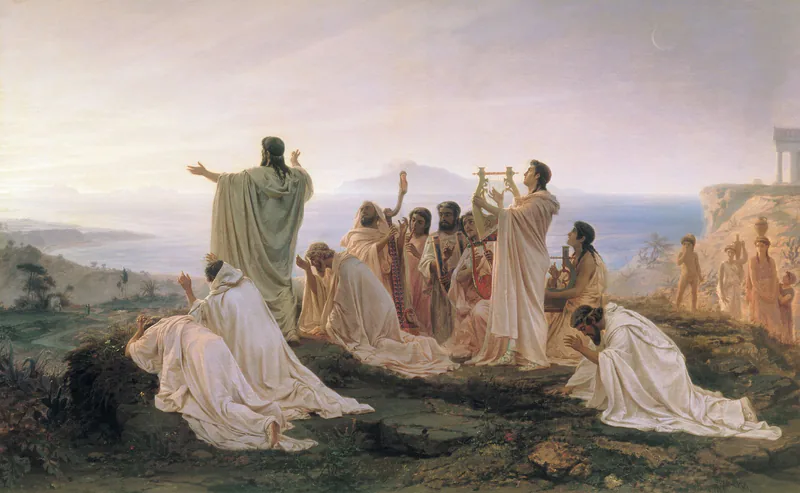
Aristotle reports the doctrine more starkly in his Metaphysics: the Pythagoreans, struck by the fact that musical harmonies could be expressed as ratios, supposed that the elements of numbers were the elements of all things and that the whole heaven was "harmony and number". He also preserves their table of ten opposites: limit and unlimited, odd and even, one and plurality, right and left, male and female, rest and motion, straight and curved, light and darkness, good and bad, square and oblong. The list shows how arithmetic categories (odd and even) were aligned with cosmic, moral and social ones.
Aristotle adds that the Pythagoreans identified abstract things with particular numbers: justice with a number that is "equal times equal" (a square number, usually taken as four), opportunity or the right moment with seven, and marriage with five, the union of the first female number (two) and the first male number (three). Such identifications are the direct ancestors of the number meanings found in modern numerology books.
The Tetractys and the Harmony of the Spheres§
The best-known Pythagorean symbol is the tetractys, ten points arranged in a triangle of four rows: one, two, three, four. Its sum, ten, was the perfect number that contains all numbers, and its rows yield the ratios 2:1, 3:2 and 4:3, which correspond to the octave, the fifth and the fourth on a string. Later sources say the Pythagoreans swore an oath by "him who gave to our generation the tetractys, source and root of ever-flowing nature".
The discovery that consonant musical intervals answer to simple whole-number ratios was, for the Pythagoreans, a revelation that the order of the world is numerical. From it grew the idea of the harmony of the spheres: the planets, moving at speeds in fixed proportions, produce a cosmic music that human ears do not notice because they have heard it from birth. Plato gave the idea classic form in the myth of Er in the Republic and in the Timaeus, where the world soul is built according to a series of musical proportions. The theme ran through Boethius, medieval cosmology and Johannes Kepler's Harmonices mundi (1619), and it underlies much of what is now called sacred geometry.
The Meaning of the Numbers One to Ten§
Under the Roman Empire a revival called Neopythagoreanism systematised Pythagorean number lore. Nicomachus of Gerasa (second century AD) wrote an Introduction to Arithmetic, which became a standard textbook through its Latin adaptation by Boethius, and a Theologoumena arithmeticae ("Theology of Arithmetic"). The latter is lost, but much of it survives in a compilation of the same name traditionally attributed to Iamblichus, which also draws on the Christian bishop Anatolius of Laodicea.
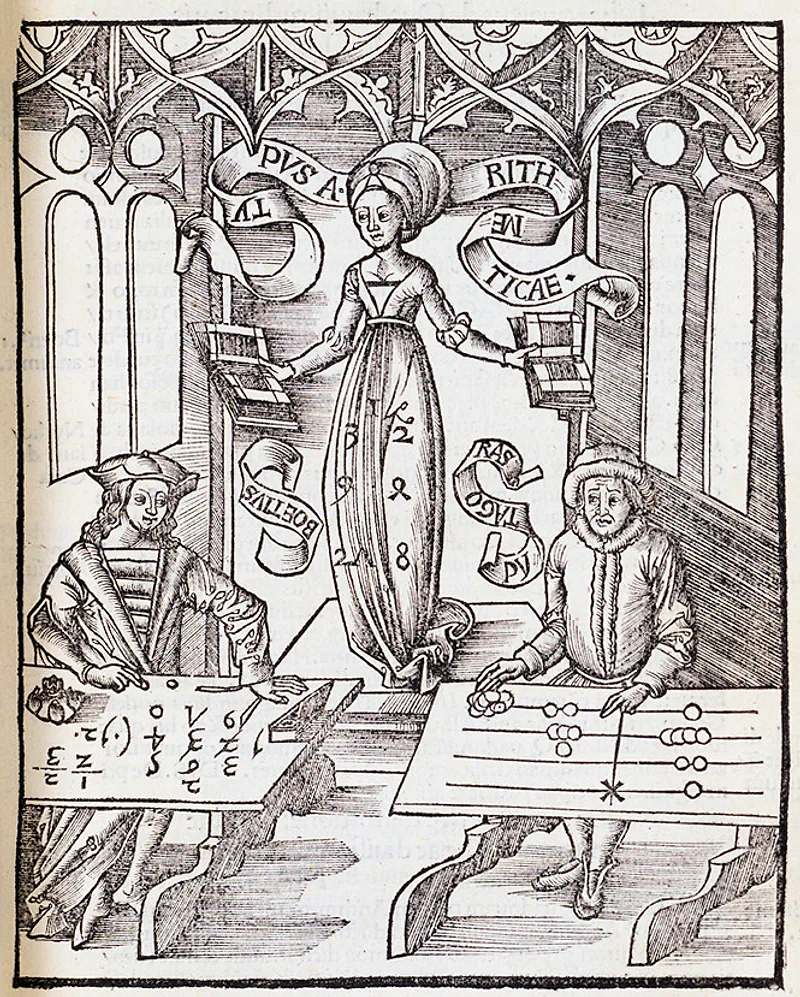
The Theology of Arithmetic treats each number of the decad as a divine principle with many names:
- The monad (1): not strictly a number but the source of number; identified with God, intellect, form and the sun.
- The dyad (2): the first departure from unity; matter, opinion, boldness, the source of difference and "the unlimited".
- The triad (3): the first number with beginning, middle and end, and so the first complete number; associated with harmony and friendship.
- The tetrad (4): the first square, justice, the four elements and seasons; the base of the tetractys.
- The pentad (5): marriage, as the sum of the first female and male numbers; also called "lack of strife" and linked to the five senses.
- The hexad (6): the first "perfect" number, equal to the sum of its divisors (1 + 2 + 3), and so a figure of health and wholeness.
- The heptad (7): called "motherless" and "virgin" because within the decad it neither generates nor is generated by another number, and therefore linked with Athena; it governs critical days in illness and the stages of life.
- The ogdoad (8): the first cube, safety and stability.
- The ennead (9): the horizon, the last single number before the return to unity.
- The decad (10): the all-embracing number, "the universe", which contains every ratio.
These portraits mix genuine arithmetic properties (squares, cubes, perfect numbers) with mythology and wordplay. They passed into Latin culture through Macrobius, Martianus Capella and Boethius, and Christian authors read them alongside the numbers of Scripture, as described in number symbolism.
From Neoplatonism to the Renaissance§
In late antiquity the Pythagorean heritage merged with Platonism. Iamblichus wrote a series of works on Pythagoreanism, including On the Pythagorean Life and On General Mathematical Science, as a curriculum leading the soul upward, and Proclus treated mathematics as a ladder between the sensible world and the gods; see Neoplatonism and theurgy. The so-called Golden Verses of Pythagoras, a short moral poem probably composed in the Hellenistic or Roman period, circulated widely with a commentary by Hierocles of Alexandria.
The Renaissance prized Pythagoras as one of the ancient theologians alongside Hermes and Orpheus. Marsilio Ficino and Giovanni Pico della Mirandola wrote of number as a path to divine things, Johann Reuchlin connected Pythagorean and Kabbalistic number, and Cornelius Agrippa's second book of occult philosophy (1533) set out the "scales" of numbers from one to twelve with their correspondences; see Agrippa's Three Books. By the nineteenth century, occultists in Britain, France and America regularly invoked Pythagoras as the founder of a secret science of numbers.
How the Legend Shaped Modern Numerology§
When L. Dow Balliett and her successors created modern numerology in the early twentieth century, they presented it as the system "taught by Pythagoras", and the alphabetical letter scheme (A = 1 to I = 9, then repeating) is still called Pythagorean. There is no ancient evidence that Pythagoras or any Pythagorean converted names into numbers by this method, or calculated a person's character from a birth date. Greek isopsephy, the summing of letter values, was real, but it used the Greek alphabet's numeral values (alpha 1, iota 10, rho 100) and was not specifically Pythagorean.
What modern numerology does inherit is a set of ideas: that numbers have qualities as well as quantities, that one to nine (or ten) form a complete cycle, that odd and even are complementary principles, and that the cosmos and human life are tuned like an instrument. The modern meanings of the numbers echo the ancient ones in places (one as origin, two as division and partnership, four as stability, seven as spiritual and set apart) but were largely rewritten in the language of personality psychology. The story of that transformation is told in the birth of modern numerology, and the system as a whole in Numerology: A Complete Guide. The site's numerology pages give the modern meaning of each number.
Frequently asked questions§
Did Pythagoras invent numerology?§
No. Pythagoras and his followers developed a philosophy in which number is the principle of the cosmos, but the system of personal numbers derived from names and birth dates was created around 1900. Modern numerologists adopted Pythagoras as a founding figure and named their letter system after him.
What is the tetractys?§
The tetractys is a triangle of ten points in rows of one, two, three and four. It represented the perfect number ten and contained the ratios of the octave, fifth and fourth, so it stood for the numerical harmony of the universe.
What did the Pythagoreans believe about the number seven?§
They called seven "motherless" and "virgin" because, among the numbers up to ten, it is neither a product nor a factor of another. It was associated with Athena, with the right moment, and with the critical days and stages of human life.
What is the Theology of Arithmetic?§
It is a Greek compilation, traditionally attributed to Iamblichus, that describes the divine and symbolic qualities of each number from one to ten. It draws heavily on a lost work by Nicomachus of Gerasa and is the main surviving source for Neopythagorean number theology.
Sources and further reading§
- Lore and Science in Ancient Pythagoreanism — Walter Burkert, 1972
- Pythagoras: His Life, Teaching, and Influence — Christoph Riedweg, 2005
- Pythagoras and the Pythagoreans: A Brief History — Charles H. Kahn, 2001
- Pythagoras and the Early Pythagoreans — Leonid Zhmud, 2012
- Philolaus of Croton: Pythagorean and Presocratic — Carl A. Huffman, 1993
- The Theology of Arithmetic — Iamblichus (attributed), trans. Robin Waterfield, 1988
- The Pythagorean Sourcebook and Library — Kenneth Sylvan Guthrie, ed. David Fideler, 1987