Liber VII · Divination · Chapter X: Other Oracles
Other Oracles: Scrying, Palmistry, Lots, Dreams and More
A guide to other kinds of divination: crystal and mirror scrying, palmistry, bibliomancy, dream interpretation, lots and dice, Ifá, Lenormand and tea leaves.

Beyond astrology, tarot, the I Ching, geomancy and runes, people have sought hidden knowledge through a great variety of other oracles: gazing into crystals, mirrors or water; reading the lines of the hand; opening a sacred book at random; interpreting dreams; casting lots, dice, shells or sticks; and laying out small fortune-telling cards. This guide surveys the most important of these methods and their histories.
Scrying: Crystals, Mirrors and Water§
Scrying means gazing into a reflective or translucent surface, such as a crystal, a polished stone, a mirror, a bowl of water, ink or oil, until images appear. In the ancient world, lecanomancy (divination with a bowl of liquid) is attested in Mesopotamia and in the Greek magical papyri from Roman Egypt, where a boy medium often looked into the vessel on the magician's behalf. Medieval and early modern magic texts describe calling spirits into a crystal or onto a child's fingernail; the Ghent manuscript on the seven aerial kings is a sixteenth-century example.
The most famous scrying sessions in history are those of the Elizabethan scholar John Dee and his scryer Edward Kelley in the 1580s, which produced the angelic language and system now called Enochian magic. Dee's obsidian mirror, of Aztec origin, is now in the British Museum. In the nineteenth century crystal-gazing became popular again in occult circles, as seen in the short treatise The Art of Drawing Spirits into Crystals, and attracted psychical researchers who studied it as a form of induced hallucination; Theodore Besterman's survey Crystal-Gazing (1924) summarises that literature.
Palmistry and the Reading of the Body§
Palmistry, or chiromancy, interprets the lines, mounts and shape of the hand. Its early history is obscure: Indian and Chinese traditions have their own forms of hand reading, and the European art appears in Latin manuscripts from the twelfth and thirteenth centuries. Late medieval texts named the principal lines (life, head, heart) and associated the mounts at the base of the fingers with the planets, so that palmistry became a branch of astrological thinking. Printed treatises spread it in the Renaissance; Bartolomeo della Rocca, known as Cocles, published his Chyromantie ac Physionomie Anastasis in Bologna in 1504, joining palmistry to physiognomy, the reading of character from the face and body.

Palmistry declined among the learned but survived in popular culture, notably among fortune-tellers, and enjoyed a fashionable revival around 1900. The Irish-born Cheiro (William John Warner) read the hands of many celebrities and wrote popular manuals. Related methods include metoposcopy (reading the lines of the forehead) and, in India, the sāmudrika śāstra, the science of bodily marks.
Bibliomancy and the Sortes§
Bibliomancy is the practice of opening a revered book at random and taking the first passage the eye falls on as an answer. In late antiquity the sortes Vergilianae used the poems of Virgil; the Historia Augusta tells stories of emperors who consulted them. Christians adopted the sortes biblicae, opening the Gospels or Psalms. Augustine's account in the Confessions of hearing a voice say "take up and read," opening Paul's letters and finding the passage that completed his conversion, became a famous model, although church councils from the fifth century onward repeatedly condemned the use of Scripture for fortune-telling.
Lot books, such as the Sortes Sanctorum and the Sortes Astrampsychi, offered numbered answers to standard questions selected by dice or other means. In the Persian-speaking world, the fāl-e Hāfez, opening the Divan of the poet Hafez at random, remains a popular custom, especially on the winter solstice night of Yalda. Muslims also practised divination by opening the Qur'an, though jurists debated its legitimacy.
Dreams, Incubation and Oneiromancy§
Dream interpretation is one of the oldest documented forms of divination. Mesopotamian scribes compiled dream-omen books; an Egyptian papyrus dream book from the Ramesside period lists dreams and their meanings as good or bad. In Greece, sufferers practised incubation, sleeping in a sanctuary such as those of Asclepius at Epidaurus in hope of a healing dream. The Oneirocritica of Artemidorus of Daldis (second century AD), the only complete ancient dream manual in Greek, distinguishes prophetic dreams from those caused by the day's concerns and interprets symbols in relation to the dreamer's circumstances.
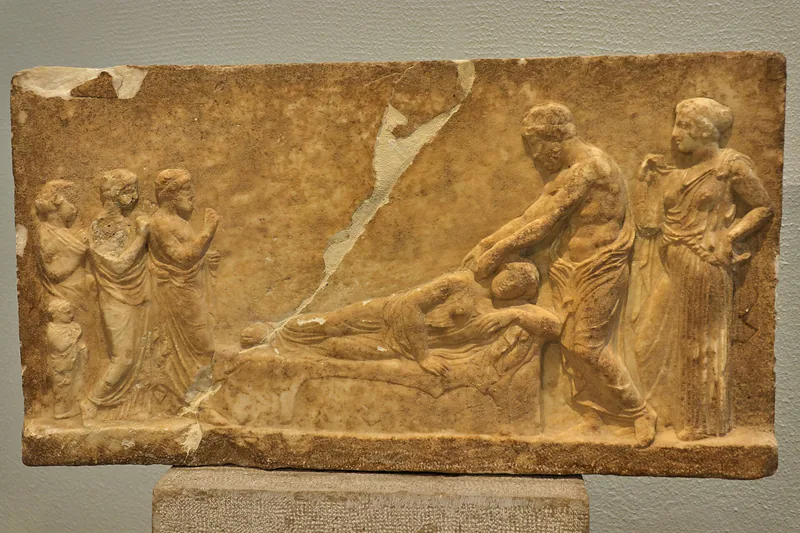
The Bible records dreams interpreted by Joseph and Daniel; Islamic tradition developed a large literature of dream interpretation (taʿbīr), much of it attributed to Ibn Sīrīn. Medieval Europe circulated alphabetical dream books such as the Somniale Danielis. In the twentieth century Freud and Jung transformed the interpretation of dreams into psychology, though popular dream dictionaries continue the older divinatory tradition.
Lots, Sticks, Dice and Shells§
Cleromancy, divination by casting lots, is found almost everywhere. The Hebrew Bible records lots used to divide the land and to identify a guilty party. In Roman Asia Minor, inscribed dice oracles set up in public places gave a verse response for each combination of astragali (knucklebones) or dice. Chinese temples today offer qiuqian, a cylinder of numbered bamboo sticks shaken until one falls out, matched with a printed verse, and the paired crescent "moon blocks" (jiaobei) that answer yes or no. Japanese shrines sell omikuji fortune slips.
In West Africa, the Yoruba system of Ifá is among the most complex divination traditions in the world. A priest (babaláwo) manipulates sixteen palm nuts or casts a divining chain (ọ̀pẹ̀lẹ̀) to generate one of 256 signs (odù), each associated with a large corpus of memorised verses. Ifá was recognised by UNESCO as part of the intangible cultural heritage of humanity in 2005, and it continues in the Americas within Lucumí and related traditions, alongside simpler cowrie-shell and coconut divination; see Santería and the Orishas. Its sixteen-based structure invites comparison with geomancy, though the historical relationship is debated.
Oracle Cards, Lenormand and Tea Leaves§
Cartomancy with ordinary playing cards is documented from the eighteenth century. The Lenormand deck of thirty-six small picture cards (Rider, Clover, Ship, House and so on) derives from a German parlour game, Das Spiel der Hoffnung ("The Game of Hope"), published around 1799 and designed by Johann Kaspar Hechtel. After the death in 1843 of the celebrated Parisian fortune-teller Marie Anne Lenormand, publishers attached her name to it, though she had no connection with the deck. Modern "oracle cards," freely designed decks with their own imagery and guidebooks, have become a large publishing category since the 1990s.
Tasseography, reading the patterns of tea leaves or coffee grounds left in a cup, became popular in Britain and Ireland after tea became an everyday drink in the eighteenth and nineteenth centuries; Turkish and Middle Eastern coffee-cup reading is an older tradition. Other methods include pendulum and dowsing practices, ceromancy with molten wax, and talking boards such as the Ouija board, which belong to the history of spiritualism. For the broader picture see What Is Divination?
Frequently asked questions§
What is scrying?§
Scrying is divination by gazing into a reflective or translucent surface, such as a crystal ball, mirror or bowl of water, to see images or receive messages. It is attested from antiquity and was famously practised by John Dee and Edward Kelley in the 1580s.
What is bibliomancy?§
Bibliomancy is opening a revered book at random and treating the passage found as an answer or sign. It has been practised with Virgil, the Bible, the Qur'an and the poetry of Hafez.
Who invented Lenormand cards?§
The deck derives from a German card game, Das Spiel der Hoffnung, designed by Johann Kaspar Hechtel and published around 1799. It was named after the famous fortune-teller Marie Anne Lenormand only after her death in 1843.
Is palmistry ancient?§
Hand reading has old roots in India, China and Europe, but the European system with named lines and planetary mounts is documented from the high Middle Ages and was codified in printed books of the Renaissance.
Sources and further reading§
- The Interpretation of Dreams (Oneirocritica) — Artemidorus, trans. Robert J. White, 1975
- Crystal-Gazing — Theodore Besterman, 1924
- Ifa Divination: Communication between Gods and Men in West Africa — William Bascom, 1969
- Divination and Oracles — Michael Loewe and Carmen Blacker (eds.), 1981
- Fortune-tellers and Philosophers: Divination in Traditional Chinese Society — Richard J. Smith, 1991
- Ancient Greek Divination — Sarah Iles Johnston, 2008
- A Wicked Pack of Cards: The Origins of the Occult Tarot — Ronald Decker, Thierry Depaulis and Michael Dummett, 1996