Liber VII · Divination · Chapter V: I Ching
I Ching: A Complete Guide to the Chinese Book of Changes
The I Ching explained: origins of the Zhouyi, the 64 hexagrams and eight trigrams, the Ten Wings, yarrow-stalk and coin divination, and its Western history.

The I Ching (Yijing), or Book of Changes, is an ancient Chinese divination manual built on sixty-four hexagrams, figures of six broken or unbroken lines, each with a short oracular text. Its core, the Zhouyi, took shape in the Western Zhou dynasty around the ninth century BC; with the philosophical commentaries called the Ten Wings it became one of the Confucian classics and one of the most influential books in East Asian thought.
Origins and Authorship of the Zhouyi§
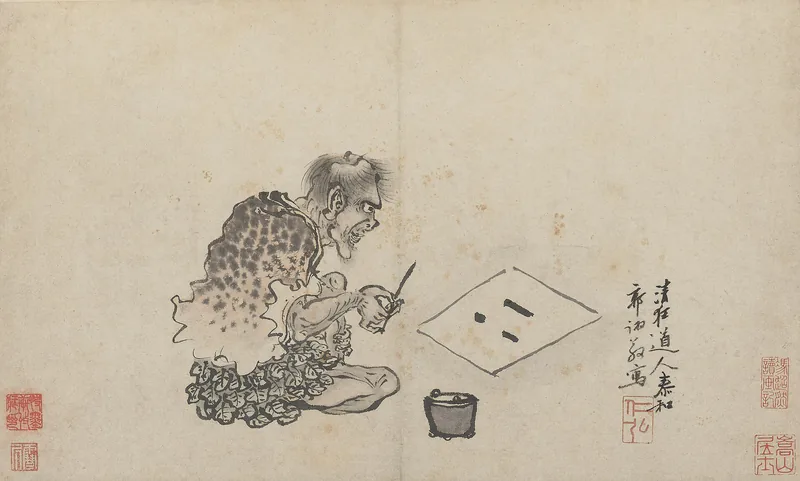
Chinese tradition tells a story of four sages. The mythical ruler Fu Xi discovered the eight trigrams by observing the patterns of heaven and earth; King Wen of Zhou, imprisoned by the last Shang king, doubled them into sixty-four hexagrams and wrote the judgements; his son, the Duke of Zhou, added the line statements; and Confucius wrote the commentaries. This account dominated Chinese scholarship for two millennia.
Modern scholarship sees the Zhouyi ("Changes of Zhou") as a compilation of divinatory formulae from the Western Zhou period (c. 1046–771 BC), probably edited towards the end of that era. Its language is archaic and its images refer to sacrifices, hunts, military campaigns, marriages and travels, much like the records of Shang and Zhou divination on bone and shell. Excavated manuscripts have transformed the field: a bamboo-slip text of about 300 BC in the Shanghai Museum, and the silk manuscript from the Mawangdui tomb (sealed 168 BC), which arranges the hexagrams in a different order and includes commentaries otherwise lost. Scholars such as Edward Shaughnessy and Richard Rutt have reconstructed the early meaning of the text as an oracle book rather than a philosophical treatise.
Hexagrams, Trigrams and Lines§
Each hexagram has six lines, read from the bottom upward. A solid line (⚊) is yang; a broken line (⚋) is yin. Each hexagram can be divided into a lower and upper trigram, and the eight trigrams carry names and images:
| Trigram | Name | Image | Trigram | Name | Image |
|---|---|---|---|---|---|
| ☰ | Qian | Heaven | ☷ | Kun | Earth |
| ☳ | Zhen | Thunder | ☴ | Xun | Wind, wood |
| ☵ | Kan | Water | ☲ | Li | Fire |
| ☶ | Gen | Mountain | ☱ | Dui | Lake |
The received order of the sixty-four begins with Qian (Hexagram 1, six yang lines, "the Creative" or "Force") and Kun (Hexagram 2, six yin lines, "the Receptive" or "Field"), and ends with Jiji (63, "After Completion") and Weiji (64, "Before Completion"), so that the book closes on an open, unfinished state. Every hexagram has a name, a judgement (guaci) using formulae such as "auspicious," "regret vanishes" or "favourable to cross the great river," and six line statements (yaoci), one for each line, which often develop a single image step by step.
The Ten Wings and the Confucian Classic§
The Ten Wings (Shiyi) are seven commentaries, some in two parts, attached to the Zhouyi. Most important is the Great Commentary (Xici zhuan), which presents the book as a model of the cosmos: the interplay of yin and yang produces all change, and the sage who understands the hexagrams understands the patterns of heaven and earth. Other Wings interpret the judgements and images, list the trigrams' associations, and explain the order of the hexagrams. Scholars date them to the Warring States and early Han periods (roughly the fourth to second centuries BC) and do not regard them as the work of Confucius.
With the Wings, the Changes became a Confucian classic, one of the Five Classics officially recognised under the Han emperor Wu. Interpreters divided broadly into a school of "images and numbers," which sought cosmological correspondences, and a school of "meanings and principles," represented by Wang Bi (226–249), who read the text philosophically. The Song Neo-Confucian Zhu Xi (1130–1200) insisted that the book was originally for divination and must be read with that in mind. Daoist authors used its symbols to describe inner cultivation, as in Daoist internal alchemy.
Consulting the I Ching: Yarrow Stalks and Coins§
The Great Commentary describes a procedure with fifty yarrow stalks, one of which is set aside. The remainder are repeatedly divided and counted off in fours, producing for each line one of four numbers: 6, 7, 8 or 9. Seven (young yang) and eight (young yin) are stable; nine (old yang) and six (old yin) are changing lines that turn into their opposites. The result is a primary hexagram and, if any lines change, a second hexagram showing the direction of change. The line statements of the changing lines receive special attention.
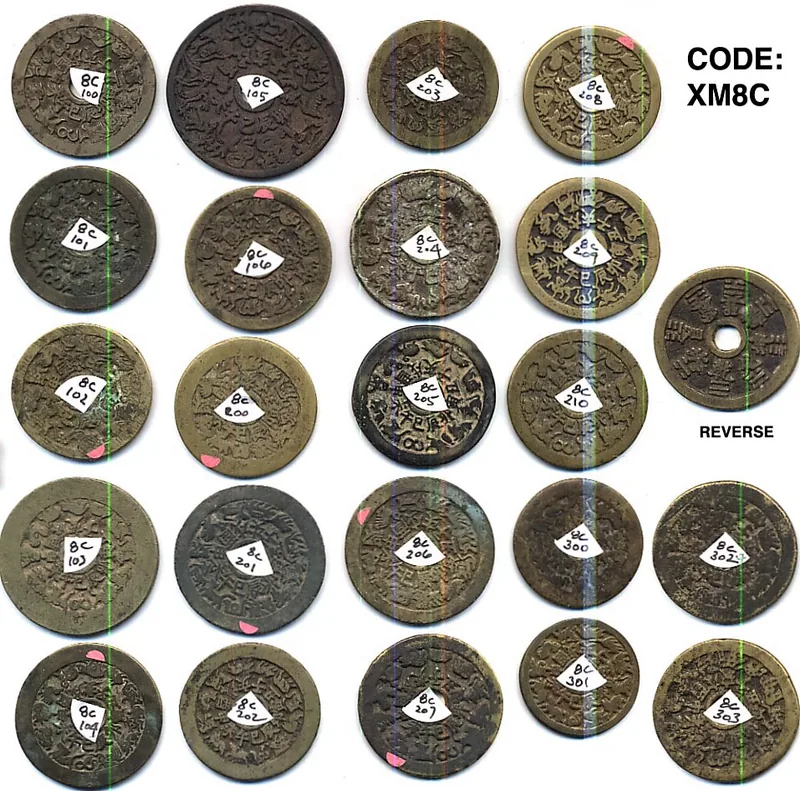
A quicker three-coin method, in which heads and tails are given values that sum to 6, 7, 8 or 9, was in use by about the Song dynasty and is the method most Western users know. The two methods do not give the same probabilities: with yarrow stalks old yang is three times as likely as old yin, whereas with coins the two are equally likely. For the place of the I Ching among other methods see What Is Divination?; its binary structure invites comparison with Arabic and European geomancy.
The I Ching in the West§
Jesuit missionaries in China studied the Changes in the seventeenth and eighteenth centuries, and some of them, the "Figurists," thought it preserved traces of a primordial revelation. In 1701 the Jesuit Joachim Bouvet sent Gottfried Wilhelm Leibniz a diagram of the hexagrams in the arrangement associated with the Song philosopher Shao Yong; Leibniz saw in it a confirmation of his binary arithmetic, published in 1703.
The first complete English translation was by the Scottish sinologist James Legge in 1882, in Max Müller's Sacred Books of the East. The German missionary Richard Wilhelm, working with the scholar Lao Naixuan, published his translation in 1924; Cary F. Baynes's English version of Wilhelm (1950) carried a foreword by Carl Jung, who used the book to illustrate his idea of synchronicity. The Wilhelm–Baynes translation became a fixture of the counterculture of the 1960s and influenced writers, artists and composers such as John Cage, who used coin tosses to compose. More recent translations aim to recover the Bronze Age text, while popular versions continue the reflective, psychological approach.
Interpreting the I Ching Today§
Contemporary users approach the book in several ways. In China and Taiwan it remains both a classic of philosophy studied in universities and a tool of professional fortune-tellers, who sometimes combine it with calendrical methods described in Chinese Astrology. In the West it is often used as a contemplative aid, the answer read as a commentary on the situation rather than a prediction. Scholars of religion study it as a rare case of a divination manual becoming a philosophical canon, its oracular formulas reread for over two thousand years as statements about the nature of change.
Frequently asked questions§
What does I Ching mean?§
Yi means "change" or "easy," and jing means "classic" or "canonical book," so Yijing is "the Classic of Changes." The core text is also called the Zhouyi, "the Changes of Zhou."
Who wrote the I Ching?§
Tradition attributes it to Fu Xi, King Wen, the Duke of Zhou and Confucius. Historians regard the core text as an anonymous compilation of the Western Zhou period and the Ten Wings as later commentaries from the Warring States and Han.
How many hexagrams are there in the I Ching?§
There are sixty-four, every possible combination of six yin or yang lines. Each is also made up of two of the eight trigrams.
What is a changing line?§
A changing line is one that comes out as old yang (nine) or old yin (six) in the casting. It changes into its opposite to form a second hexagram, and its line statement is given particular weight in the reading.
Sources and further reading§
- The Yî King (Sacred Books of the East, vol. 16) — James Legge, 1882
- The I Ching or Book of Changes — Richard Wilhelm, trans. Cary F. Baynes, 1950
- Zhouyi: The Book of Changes — Richard Rutt, 1996
- I Ching: The Classic of Changes — Edward L. Shaughnessy, 1996
- Unearthing the Changes — Edward L. Shaughnessy, 2014
- Fathoming the Cosmos and Ordering the World: The Yijing and Its Evolution in China — Richard J. Smith, 2008
- The Classic of Changes: A New Translation of the I Ching as Interpreted by Wang Bi — Richard John Lynn, 1994