Liber XXXI · Taoism & Chinese Religion · Chapter III: Confucianism
Neo-Confucianism: Zhu Xi, Wang Yangming and the Way of Principle
Neo-Confucianism explained: the Song masters, Zhu Xi's learning of principle and the Four Books, Lu Jiuyuan, Wang Yangming's innate knowing, East Asia.

Neo-Confucianism is the revival and reinterpretation of Confucian thought that began in Song-dynasty China (960–1279) and dominated the intellectual and political life of China, Korea, Japan and Vietnam until the twentieth century. Its thinkers, above all Zhu Xi (1130–1200) and Wang Yangming (1472–1529), answered the challenge of Buddhism and Taoism with a Confucian metaphysics of principle (li) and vital stuff (qi), and a path of self-cultivation whose goal was to become a sage.
What Is Neo-Confucianism?§
By the eighth century Confucianism was the ideology of the Chinese state and the curriculum of its scholars, but the most profound questions about the mind, death and ultimate reality were being answered by Buddhists and Taoists. Neo-Confucianism was the response: an effort to show that the classics of Confucius and Mencius contained a complete account of the cosmos and of human nature, and a path of spiritual transformation as demanding as any monastery.
The Western name, which became standard in the twentieth century, groups together a family of movements that disagreed sharply with each other. Peter Bol has emphasised that the "Learning of the Way" was also a social movement of literati who built private academies, compiled family rituals and community compacts, and sought to reform local society as well as the self. Scholars such as Wm. Theodore de Bary and Rodney Taylor have drawn attention to its religious dimension: its reverence for Heaven, its meditative practices and its aspiration to sagehood.
Origins: Han Yu and the Challenge of Buddhism§
The movement looked back to the Tang essayist Han Yu (768–824). In his essay "On the Origin of the Way" he attacked Buddhism and Taoism for drawing people away from family and state, and he described a "transmission of the Way" from the ancient sage-kings through Confucius to Mencius, after which, he claimed, it had been lost. In 819 he was exiled for a memorial protesting the emperor's veneration of a relic of the Buddha. His friend Li Ao (772–841) wrote on "returning to one's nature", using a vocabulary that already owed much to Buddhism.
Buddhism, especially the Huayan and Chan schools, offered powerful ideas: that every particular thing reflects the whole, that the mind's original nature is pure, and that enlightenment can be realised in this life. Neo-Confucians rejected the Buddhist teaching that the world is empty and its attachments illusory, and they condemned monastic withdrawal from family duties. Yet they developed their own metaphysics, meditation and ideal of sudden insight in conversation with the traditions they criticised.
The Northern Song Masters§
Later tradition honoured five thinkers of the eleventh century as the founders of the Learning of the Way:
- Zhou Dunyi (1017–1073), whose Explanation of the Diagram of the Supreme Ultimate described how the Supreme Ultimate generates yin and yang and the Five Phases; see the Taijitu.
- Shao Yong (1011–1077), who developed a numerological cosmology based on the Book of Changes.
- Zhang Zai (1020–1077), who held that everything is made of qi, condensing into things and dispersing into the Great Void. His short Western Inscription opens by calling Heaven his father and Earth his mother and all people his brothers and sisters.
- Cheng Hao (1032–1085), who taught that the humane person forms one body with heaven, earth and all things.
- Cheng Yi (1033–1107), his younger brother, who made li, principle, the centre of his philosophy and stressed the "investigation of things".
Zhu Xi and the Learning of Principle§
Zhu Xi (1130–1200), born in Fujian, passed the highest examination at eighteen but spent most of his life as a teacher, writer and holder of minor posts. He gathered the ideas of the Northern Song masters into a comprehensive system that became the orthodoxy of later imperial China.
At its centre is the distinction between principle (li) and vital stuff (qi). Principle is the pattern or reason by which each thing is what it is and ought to be; qi is the energetic matter of which things are made. Principle is one, but its manifestations are many, as the moon is reflected in countless streams. Human nature is principle, and therefore good, as Mencius had taught; but each person's endowment of qi is more or less clear or turbid, which explains differences of character and the presence of selfish desires.
Self-cultivation therefore has two sides. One is the investigation of things (gewu), the patient study of principle in the classics, history, human affairs and the natural world, until one day understanding becomes comprehensive. The other is reverent attentiveness (jing), a steady, collected state of mind sustained through daily conduct and periods of quiet sitting.
Zhu Xi's most enduring achievement was to group four short texts, the Analects, the Mencius, the Great Learning and the Doctrine of the Mean, as the Four Books and to write commentaries on them, published together in 1190. With Lü Zuqian he compiled Reflections on Things at Hand (1175), an anthology of the Northern Song masters, and his Family Rituals shaped weddings, funerals and ancestral rites across East Asia. His school was briefly banned as "false learning" in the 1190s, but in 1313 the Yuan court made his commentaries the standard for the civil service examinations, which they remained until the examinations were abolished in 1905.
Lu Jiuyuan and the Goose Lake Debate§
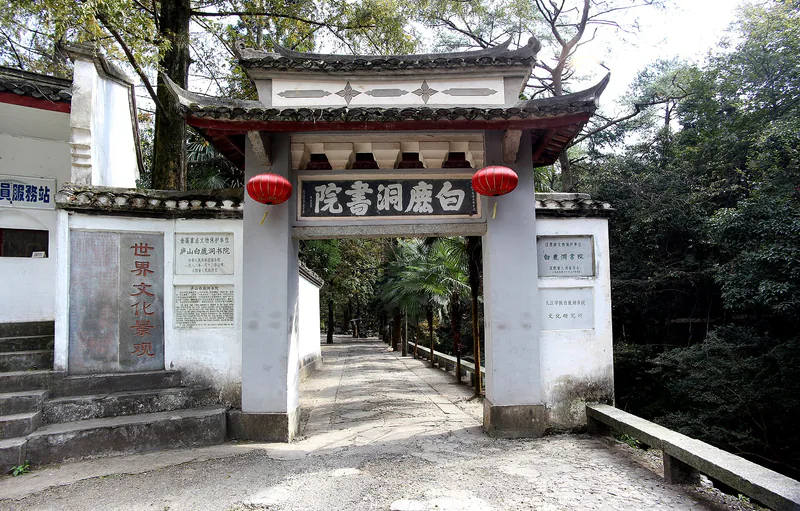
Zhu Xi's approach had critics in his own lifetime. In 1175 the scholar Lü Zuqian arranged a meeting at the Goose Lake Temple between Zhu Xi and Lu Jiuyuan (1139–1193), also known as Lu Xiangshan. Lu taught that "the mind is principle": the moral mind each person possesses is identical with the principle of the universe, so that the essential task is to recognise and preserve it, not to accumulate external knowledge. He regarded Zhu's method as fragmented; Zhu thought Lu's approach too simple and suspiciously close to Chan Buddhism. The two men parted unreconciled but respectful, and their disagreement defined the two main currents of later Neo-Confucianism, the Cheng-Zhu School of Principle and the Lu-Wang School of Mind.
Wang Yangming and the Learning of the Mind§
The greatest representative of the School of Mind was Wang Shouren (1472–1529), known as Wang Yangming. As a young man, according to his own account, he and a friend tried to follow Zhu Xi's advice by investigating the principle of the bamboo in a garden; after days of contemplation both fell ill, and Wang concluded that principle could not be found in this way. In 1506 he protested against a powerful eunuch, was flogged and banished to a remote post in Guizhou. There, in 1508, he experienced a sudden realisation that the principle of things is complete in one's own mind.
From this insight came his two best-known teachings. The unity of knowledge and action (zhixing heyi) holds that true knowledge already includes action: someone who claims to know filial piety but does not practise it does not really know it. Extending innate knowing (zhi liangzhi) holds that every person possesses an innate, intuitive knowledge of good and evil, and that cultivation means acting on it fully in every situation. Wang was also an able official and general who suppressed several rebellions, including that of the Prince of Ning in 1519. His teachings were collected by his students as Instructions for Practical Living (Chuanxi lu).
Wang's followers, especially the radical Taizhou school, carried his ideas in individualistic directions. In the Qing dynasty, scholars of "evidential learning" criticised both Zhu Xi and Wang Yangming for speculative metaphysics and turned to philology and textual criticism.
Neo-Confucianism in Korea, Japan and the Modern World§
Neo-Confucianism became the state ideology of Korea's Joseon dynasty (1392–1910). Its greatest Korean thinkers, Yi Hwang (Toegye, 1501–1570) and Yi I (Yulgok, 1536–1584), debated the relation of principle and vital stuff in the "Four-Seven Debate" over the moral feelings, a discussion of great subtlety. In Tokugawa Japan (1603–1868) the Zhu Xi school enjoyed official patronage, while Wang Yangming's teaching, known as Yōmeigaku, inspired reformers and activists, among them figures of the Meiji Restoration.
In the twentieth century Neo-Confucianism was attacked as a pillar of the old order, but "New Confucian" philosophers such as Xiong Shili, Mou Zongsan and Tu Weiming reinterpreted it as a living spiritual tradition. Its relationship with Taoism remains a subject of study: the Song masters borrowed Taoist cosmology even as they rejected Taoist withdrawal, as the article on what Taoism is explains.
Frequently asked questions§
What is the difference between Confucianism and Neo-Confucianism?§
Neo-Confucianism is a later development of Confucianism that began in the Song dynasty. It kept the ethics of Confucius and Mencius but added a systematic metaphysics of principle and vital stuff, a theory of human nature and a path of self-cultivation, partly in response to Buddhism and Taoism.
What did Zhu Xi mean by principle (li)?§
For Zhu Xi, principle is the inherent pattern that makes each thing what it is and what it ought to be. It is one in its source but appears in countless particular things, and human nature is principle in its moral form.
What is Wang Yangming's unity of knowledge and action?§
It is the teaching that genuine knowledge and action cannot be separated: to know the good truly is already to be moved to do it. Failure to act shows that the knowledge was never complete.
Sources and further reading§
- Neo-Confucianism in History — Peter K. Bol, 2008
- Reflections on Things at Hand: The Neo-Confucian Anthology — Wing-tsit Chan, 1967
- Learning to Be a Sage: Selections from the Conversations of Master Chu, Arranged Topically — Daniel K. Gardner, 1990
- Instructions for Practical Living and Other Neo-Confucian Writings by Wang Yang-ming — Wing-tsit Chan, 1963
- Readings from the Lu-Wang School of Neo-Confucianism — Philip J. Ivanhoe, 2009
- Neo-Confucian Orthodoxy and the Learning of the Mind-and-Heart — Wm. Theodore de Bary, 1981
- To Acquire Wisdom: The Way of Wang Yang-ming — Julia Ching, 1976
- A Source Book in Chinese Philosophy — Wing-tsit Chan, 1963