Liber XXXI · Taoism & Chinese Religion · Chapter IX: Yin-Yang & the Five Phases
The Taijitu: A History of the Yin-Yang Symbol and Its Meaning
The taijitu or yin-yang symbol: taiji in the Book of Changes, Zhou Dunyi's diagram, the Daoist origins debate, Ming swirling diagrams and modern uses.

The taijitu (taiji tu, "diagram of the Supreme Ultimate") is the Chinese symbol now known worldwide as the yin-yang: a circle divided by an S-shaped curve into interlocking black and white halves, each containing a dot of the other colour. It represents the Supreme Ultimate (taiji) giving rise to yin and yang, but the familiar swirling design is relatively late; the most famous "Taiji diagram" of Chinese philosophy, drawn by Zhou Dunyi in the eleventh century, looked quite different.
What Is the Taijitu?§
The modern taijitu shows two teardrop shapes, one dark and one light, curling around each other within a circle. The dark half is yin (shade, receptivity, the feminine, the moon, stillness); the light half is yang (sunlight, activity, the masculine, movement). The curving line suggests that each grows as the other declines, as day turns into night and summer into winter, and the small dot of the opposite colour within each half shows that each contains the seed of the other. The whole circle stands for the undivided unity from which both arise. These ideas are explained more fully in the article on yin and yang and the Five Phases.
In Chinese the swirling design is often called the "yin-yang fish" (yinyang yu) from the shape of the two halves, or simply the "Taiji diagram". Its history, however, is the history of several different diagrams that shared one name.
Taiji: The Supreme Ultimate in the Book of Changes§
The word taiji originally meant something like "great ridgepole" or "supreme pole", the highest point from which everything else hangs. Its classic philosophical use is in the Great Commentary (Xici zhuan) attached to the Book of Changes, probably compiled in the late Warring States or early Han period. There it is said that in change there is the Supreme Ultimate, which produces the "two modes" (yin and yang), which produce the four images, which produce the eight trigrams.
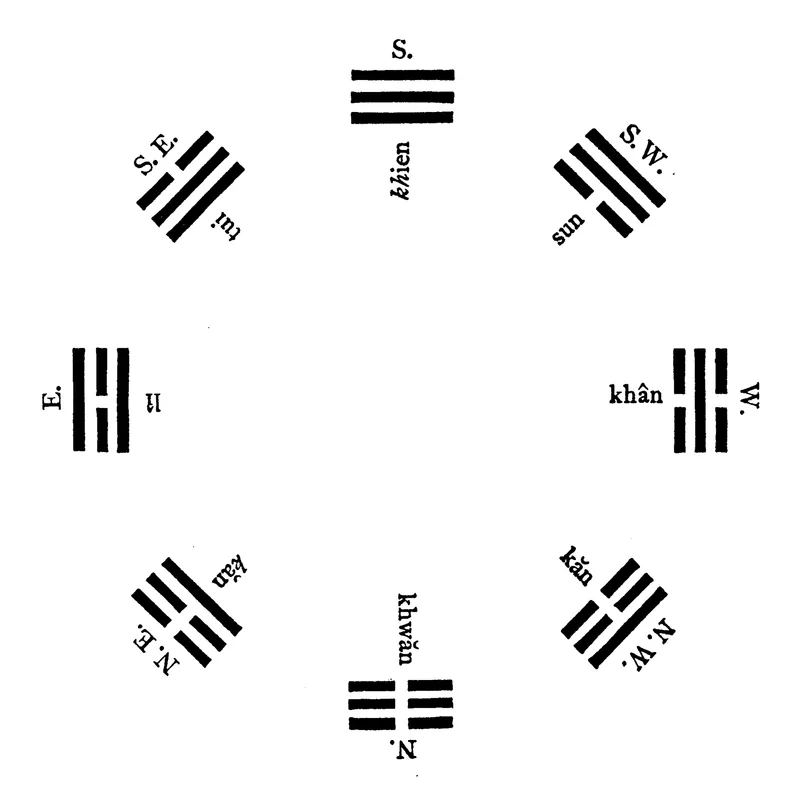
This sequence of doubling, from one to two to four to eight and on to the sixty-four hexagrams, became the basis of a long tradition of cosmological diagrams. The Zhuangzi also uses the word, describing the Tao as existing before the taiji. For centuries the term belonged to commentators on the Changes and to cosmologists rather than to any single school.
Zhou Dunyi's Diagram of the Supreme Ultimate§
The most influential Taiji diagram was published by the Song scholar Zhou Dunyi (1017–1073) with a short essay, the Explanation of the Diagram of the Supreme Ultimate (Taijitu shuo), of only some 250 characters. Zhou's diagram is a vertical column of figures:
- an empty circle at the top, representing the Supreme Ultimate, described in the essay's famous and much-debated opening as "Non-Ultimate, and yet Supreme Ultimate" (wuji er taiji);
- a circle of concentric black and white half-rings, showing yang in movement and yin in stillness, each rooted in the other;
- a network linking the Five Phases, water, fire, wood, metal and earth;
- a circle representing the way of Qian (heaven) forming the male and the way of Kun (earth) forming the female;
- a final circle for the production and transformation of the myriad things.
The essay explains how the Supreme Ultimate moves and generates yang, rests and generates yin, how yin and yang produce the Five Phases, and how human beings, receiving the finest of these forces, are the most intelligent of creatures, with the sage establishing the ultimate standard of humanity through centrality, correctness and stillness.
The great synthesiser Zhu Xi (1130–1200) wrote a commentary on the diagram and placed it at the start of his anthology Reflections on Things at Hand (1175), making Zhou Dunyi the founding figure of the "Learning of the Way". Through the examination system the diagram became part of the education of every Chinese scholar; see Neo-Confucianism.
The Debate over Daoist Origins: Chen Tuan and the Wuji Diagram§
Zhu Xi's championship of the diagram was controversial from the start. The brothers Lu Jiushao and Lu Jiuyuan objected in letters of the late 1180s that "Non-Ultimate" (wuji) was a Taoist term from the Tao Te Ching and had no place in Confucian teaching, and that the diagram could hardly be the work of a sage.

An earlier Song scholar, Zhu Zhen (1072–1138), had already traced the diagram through a chain of teachers back to Chen Tuan (d. 989), a famous Taoist recluse of Mount Hua. In the seventeenth century Qing critics such as Huang Zongyan and Zhu Yizun argued that Zhou had adapted a Taoist "Diagram of the Non-Ultimate" (Wuji tu), said to have been carved on Mount Hua, which, read from the bottom up, described the stages of internal alchemy: refining essence into breath, breath into spirit, and spirit back into emptiness. Zhou, they claimed, had simply turned it upside down to describe cosmic creation instead of return.
Modern scholars, including Joseph Adler and Isabelle Robinet, treat these claims with care. Similar diagrams survive in the Taoist Canon, but their dating is uncertain, and some may have been influenced by Zhou rather than the reverse. What is clear is that Song cosmology drew freely on Taoist, Buddhist and Confucian resources, and that the boundaries between them were more porous than later polemics suggested.
The Swirling Yin-Yang: Ming Diagrams and the "Fish"§
The swirling emblem familiar today emerged from the same Song interest in diagrams of the Book of Changes, in which scholars arranged the trigrams and hexagrams in circles to show the waxing and waning of yin and yang over the year. The art historian François Louis has traced how these schemes developed into a pictorial icon. A late fourteenth-century scholar, Zhao Huiqian, published a "Diagram of the Natural Order of Heaven and Earth" showing black and white halves curling around each other, surrounded by the eight trigrams, and claimed it came from earlier sources.
In the sixteenth century the scholar Lai Zhide (1525–1604) published his own Taiji diagram, and Zhang Huang's encyclopaedia Illustrated Compendium (Tushu bian) reproduced several versions. During the Ming and Qing the swirling design, often surrounded by the eight trigrams, spread to Taoist robes, temple ceilings, ritual implements, bagua mirrors hung over doorways and the compasses of feng shui masters. In the nineteenth century it gave its name to taijiquan, the martial art known in the West as tai chi.
Similar Designs Outside China§
Curving designs that resemble the taijitu appear in other cultures, though they are visual parallels rather than evidence of shared meaning. The late Roman Notitia Dignitatum, a register of offices from around 400 CE, illustrates the shield patterns of army units, some of which show a circle divided by a curved line into dark and light halves with contrasting dots. Celtic La Tène art of the Iron Age used swirling curvilinear motifs, and the Soyombo symbol devised by the Mongolian Buddhist leader Zanabazar in 1686, now on the flag of Mongolia, contains two interlocking fish.
The Taijitu in Modern Religion, Flags and Culture§
Today the taijitu is the most widely recognised symbol of Taoism, displayed in temples and on the robes of Taoist priests and monks. Korea adopted a red and blue version, the taegeuk, for the national flag in the 1880s, framed by four of the eight trigrams; the design remains the flag of South Korea. In 1947 the Danish physicist Niels Bohr chose the taijitu for his coat of arms as a knight of the Order of the Elephant, with the Latin motto "opposites are complementary", in reference to his principle of complementarity.
In the West the yin-yang became popular in the twentieth century through interest in Asian philosophy, martial arts and the counterculture, and it is often used in a general sense for balance. Scholars note common misunderstandings: that yin is evil and yang good, or that the two are static opposites rather than phases of a single process. In Chinese thought they are relative and changing, and the symbol is meant to show their unceasing alternation within the unity of the Supreme Ultimate.
Frequently asked questions§
What is the yin-yang symbol called in Chinese?§
It is usually called the taiji tu, "diagram of the Supreme Ultimate", or informally the "yin-yang fish" (yinyang yu). The name taijitu also refers to Zhou Dunyi's very different eleventh-century diagram.
How old is the yin-yang symbol?§
The ideas of yin, yang and the Supreme Ultimate are more than two thousand years old, but the familiar swirling emblem is documented mainly from the late fourteenth century onwards. Zhou Dunyi's earlier Taiji diagram dates from the eleventh century.
What do the dots in the yin-yang symbol mean?§
The small dot of the opposite colour in each half shows that yin contains the seed of yang and yang the seed of yin. Each turns into the other at its extreme, as midnight gives way to dawn and midsummer to the shortening days.
Sources and further reading§
- Yinyang: The Way of Heaven and Earth in Chinese Thought and Culture — Robin R. Wang, 2012
- Reconstructing the Confucian Dao: Zhu Xi's Appropriation of Zhou Dunyi — Joseph A. Adler, 2014
- A Source Book in Chinese Philosophy — Wing-tsit Chan, 1963
- Reflections on Things at Hand: The Neo-Confucian Anthology — Wing-tsit Chan, 1967
- Fathoming the Cosmos and Ordering the World: The Yijing (I Ching, or Classic of Changes) and Its Evolution in China — Richard J. Smith, 2008
- A History of Chinese Philosophy — Fung Yu-lan, 1952