Liber VIII · Eastern Mysticism · Chapter VI: Qigong & Internal Arts
Tai Chi (Taijiquan): History, Philosophy and the Taiji Classics
Tai chi (taijiquan) explained: the taiji cosmology, the Zhang Sanfeng legend, Chen village origins, the Taiji Classics, the great styles and tai chi today.

Tai chi, properly taijiquan ("supreme ultimate boxing"), is a Chinese internal martial art practised as slow, continuous, relaxed movement and named after the taiji, the cosmological principle from which yin and yang arise. Legend credits the Daoist immortal Zhang Sanfeng with its invention, but the documented history begins in the Chen family village of Henan in the seventeenth century and runs through the great nineteenth-century styles to the simplified forms practised by millions today.
Taiji: The Supreme Ultimate in Chinese Cosmology§
The term taiji is far older than the martial art. A commentary appended to the Book of Changes says that in change there is the taiji, which generates the "two modes", yin and yang, and from them the four images and the eight trigrams. The guide to the I Ching explains that system. Ji means a ridgepole or extreme point, so taiji is the ultimate pivot on which the polarities turn.
The Neo-Confucian philosopher Zhou Dunyi (1017–1073) gave the idea its classic form in his short Explanation of the Diagram of the Supreme Ultimate. It opens with the phrase wuji er taiji, usually rendered "non-polar, and yet the supreme ultimate". From that source, movement produces yang and stillness produces yin, and their interaction generates the five phases and the myriad things. The diagram, with its circles of alternating dark and light, is an ancestor of the familiar black-and-white taijitu.
When nineteenth-century boxers adopted the name, they claimed this cosmology for their art. Every movement in taijiquan is described as an interplay of yin and yang: emptiness and fullness, softness and hardness, opening and closing, advancing and retreating. The form is meant to embody the turning of the cosmos on a small scale, a theme shared with the Daoist arts of nourishing life described in the guide to qigong and the internal arts.
Zhang Sanfeng, Wudang and the Internal School Legend§
Zhang Sanfeng is a figure of Daoist hagiography, associated with the Wudang mountains in Hubei and variously placed in the Song, Yuan or early Ming dynasty. Ming emperors are said to have sought him without success, and he was venerated as an immortal. Stories that he invented an art of soft boxing after watching a fight between a bird and a snake, or after a dream in which a deity taught him, are late.
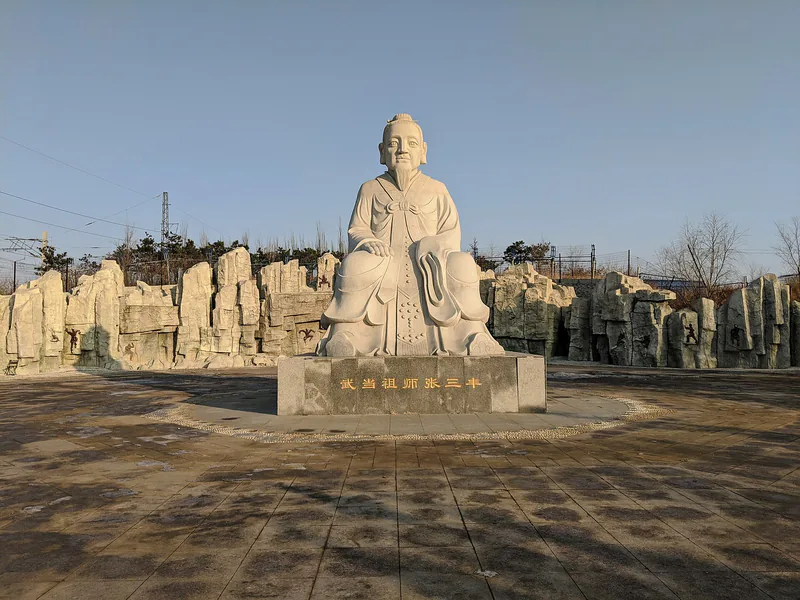
The decisive early text is an epitaph that the scholar Huang Zongxi wrote in 1669 for the boxer Wang Zhengnan. It distinguishes the "external" fighting methods associated with the Buddhist Shaolin monastery from an "internal school" (neijia) that overcomes force with stillness, and it traces that school to Zhang Sanfeng. Huang's son Huang Baijia later wrote a manual of the internal boxing. Neither text mentions taijiquan. Historians, beginning with Tang Hao in the 1930s, concluded that the link between Zhang Sanfeng and taiji was made only in the nineteenth century, when practitioners sought a Daoist pedigree for their art. For many practitioners, especially in the Wudang tradition, the legend remains a meaningful expression of the art's Daoist spirit rather than a historical claim.
Chen Village and the Documented Origins of Taijiquan§
The earliest securely traceable taiji boxing comes from Chenjiagou, the village of the Chen family in Wen county, Henan. Family records credit Chen Wangting (seventeenth century), a local militia officer, with creating sets of boxing routines, combining earlier martial techniques with ideas drawn from Daoist breathing and the Book of Changes. Tang Hao visited the village in the early 1930s and argued that this was the true origin, a view most historians accept, though the details of Chen Wangting's role are known only from later family sources.
The Chen art combines slow movements with sudden explosive strikes, stamps and jumps, and features spiralling "silk-reeling" movements of the whole body. In the early nineteenth century the Chen master Chen Changxing (1771–1853) accepted an outsider, Yang Luchan (1799–1872) of Yongnian in Hebei, as a student, an event that would carry the art far beyond the village.
The Taiji Classics and the Thirteen Postures§
The theory of taijiquan is preserved in a handful of short texts known collectively as the Taiji Classics. Tradition holds that around the 1850s Wu Chengqing, brother of the Yongnian scholar-boxer Wu Yuxiang (1812–1880), found a treatise attributed to one Wang Zongyue in a salt shop in Wuyang county. Wu Yuxiang and his nephew Li Yiyu (1832–1892) copied, edited and added to these writings, and Li's manuscript copies of the 1880s are among the earliest surviving versions. Douglas Wile's Lost T'ai-chi Classics from the Late Ch'ing Dynasty (1996) examines this literature and the questions of authorship it raises.
The classics are aphoristic. The treatise ascribed to Wang Zongyue begins by declaring that taiji is born of wuji and is the mother of yin and yang. Others teach that power is rooted in the feet, issued through the legs, directed by the waist and expressed in the fingers; that the body should be light and agile, every part connected; that one should sink the qi to the dantian and keep the head as if suspended from above; and that a small force correctly applied can deflect a great one, the proverbial "four ounces deflecting a thousand pounds". Stillness within movement and movement within stillness is a recurring ideal.
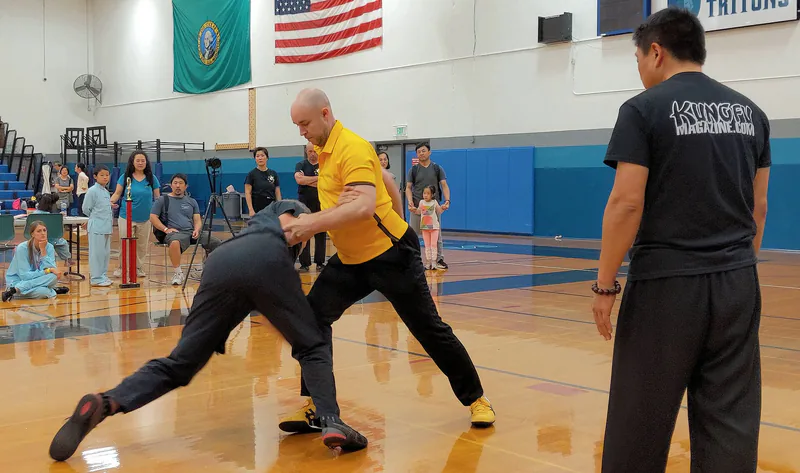
The classics also set out the "thirteen postures", the basic energies of the art. Eight are hand methods, usually translated ward-off, roll-back, press, push, pluck, split, elbow and shoulder strike, which the texts correlate with the eight trigrams. Five are directions of stepping, advance, retreat, look left, look right and central equilibrium, correlated with the five phases. These energies are trained in partner practice called "push hands" (tuishou), in which two people maintain contact and learn to sense, yield to and redirect each other's force. The emphasis on cultivated inner energy links taijiquan to Daoist internal alchemy and to practices such as the microcosmic orbit, though most styles do not teach explicit alchemical meditation.
The Great Styles: Yang, Wu, Sun and the Spread of Tai Chi§
Yang Luchan taught in Beijing, where his skill earned him a formidable reputation and students among Manchu officials and bannermen. His descendants gradually softened and broadened the form. His grandson Yang Chengfu (1883–1936) standardised the large, even, slow "big frame" that became the template for modern Yang style, published books on it in the 1930s and taught widely in Shanghai, Nanjing and southern China.
Other styles branched off. The Manchu officer Wu Quanyou studied with the Yang family, and his son Wu Jianquan (1870–1942) developed the Wu style, with a compact frame and a forward-leaning posture. Wu Yuxiang's line, passing through Li Yiyu and Hao Weizhen, became the Wu/Hao style. Sun Lutang (1860–1933), already a master of xingyiquan and baguazhang, learned from Hao Weizhen and created the Sun style, and his books presented the three internal arts as expressions of a single Daoist philosophy. In the Republican period taijiquan was promoted as a "national art" that could strengthen the Chinese people, and the Chen family itself taught in Beijing from 1928.
After 1949 the art took two paths. In the People's Republic, sports authorities in 1956 published a simplified 24-movement form based on Yang style, designed for mass exercise, and later created competition routines for each style. In Taiwan and the diaspora, teachers such as Cheng Man-ch'ing (1902–1975), a student of Yang Chengfu who taught in New York from 1964, carried a short Yang form and a strongly Daoist interpretation of the art to Western students.
Tai Chi Today: Health, Sport and Heritage§
Most people who practise tai chi today do so for health, balance and calm rather than self-defence. Randomised trials and systematic reviews have found reasonable evidence that it improves balance and reduces falls in older adults, with more mixed or preliminary results for conditions such as arthritis, heart disease and depression. The movements are gentle, but beginners with joint problems or medical conditions should learn from a qualified teacher and adapt deep stances accordingly.
The art also remains a living martial and philosophical tradition. In 2020 UNESCO inscribed taijiquan on its Representative List of the Intangible Cultural Heritage of Humanity, recognising the communities that transmit it. Debates continue between those who emphasise its Daoist and cosmological meaning, those who stress its martial effectiveness, and historians who show how much of its classical self-image was formed in the nineteenth and twentieth centuries. That layered history is itself part of the story of Taoism in the modern world.
Frequently asked questions§
Did Zhang Sanfeng invent tai chi?§
Tradition credits him, but historians regard this as legend. The internal-school story goes back to a 1669 epitaph that does not mention taijiquan, and the documented art begins in the Chen family village in Henan in the seventeenth century.
What does "tai chi" mean?§
Taiji means "supreme ultimate", the cosmic pivot from which yin and yang arise; quan means "fist" or "boxing". The name presents the art as a martial embodiment of Chinese cosmology.
What are the main styles of tai chi?§
The five major family styles are Chen, Yang, Wu (of Wu Jianquan), Wu/Hao (of Wu Yuxiang) and Sun. Yang style, and the simplified 24-movement form derived from it, is the most widely practised.
Is tai chi a Daoist practice?§
It draws on Daoist and Neo-Confucian cosmology and on Daoist ideas of cultivating qi, and many teachers present it in Daoist terms. Historically, however, it developed among lay martial artists rather than in Daoist monasteries, and it is practised by people of every religion and none.
Sources and further reading§
- The Taijiquan Classics: An Annotated Translation — Barbara Davis, 2004
- Lost T'ai-chi Classics from the Late Ch'ing Dynasty — Douglas Wile, 1996
- The Essence of T'ai Chi Ch'uan: The Literary Tradition — Benjamin Pang Jeng Lo, Martin Inn, Robert Amacker & Susan Foe, 1979
- Cheng Tzu's Thirteen Treatises on T'ai Chi Ch'uan — Cheng Man-ch'ing, 1985
- Chinese Martial Arts: From Antiquity to the Twenty-First Century — Peter A. Lorge, 2012
- Daoist Body Cultivation — Livia Kohn (ed.), 2006