Liber XVI · Indigenous & Ancient Religions · Chapter IX: Roman Religion
Roman Religion: Gods, Priests, Sacrifice and the Imperial Cult
Ancient Roman religion explained: the pax deorum, Jupiter and the Capitoline gods, household Lares, priests and Vestals, festivals and the imperial cult.

Roman religion was the system of cults, priesthoods and rituals through which the people of ancient Rome sought to maintain the pax deorum, the "peace of the gods", from the city's legendary beginnings in the eighth century BCE until Christianity became the official religion of the empire in the late fourth century CE. It centred on correct performance of sacrifice, prayer, vows and festivals rather than on belief or doctrine, and it was woven into politics: magistrates took the auspices, senators served as priests, and emperors were honoured as gods after death. Rome also absorbed gods from Greece, Egypt and the East, making its religion one of the most open in the ancient world.
The Pax Deorum and the Logic of Roman Ritual§
Romans understood their relationship with the gods as a kind of contract. The state and its citizens offered sacrifices, games and temples; the gods granted success and safety. Disasters, portents and defeats showed that the peace of the gods had been broken and needed repair. Scholars sometimes sum up this reciprocity with the Latin phrase do ut des, "I give so that you may give", though Roman piety also included gratitude and awe.
Precision was essential. Prayers were read from written formulas, and a mistake could require the whole ritual to be repeated. The historian Livy recounts many expiations of prodigies, such as rains of stones or births of monstrous animals, ordered by the Senate on the advice of priests. A Roman's religion was therefore less a personal creed than membership in the community of family, city and state, each with its own cults. The orator Cicero, himself an augur, could write a philosophical dialogue doubting divination, On Divination, while upholding the practice for the good of the state.
Gods of Rome§
The early Romans honoured many powers, some barely personified and described by the term numen, divine will or power. Others were great gods. Jupiter, the sky god, presided as Jupiter Optimus Maximus, "best and greatest", in the temple on the Capitoline Hill that, according to tradition, was dedicated in 509 BCE, the first year of the Republic; he shared it with Juno and Minerva. An earlier grouping of Jupiter, Mars and Quirinus probably reflects older Roman religion. Janus, the god of doorways and beginnings, was invoked first in prayers; Vesta was the goddess of the hearth; Ceres of grain; Venus, ancestress of the Julian family; and Saturn, whose festival became the Saturnalia.

Contact with Greece from an early date led Romans to identify their gods with Greek ones, Jupiter with Zeus, Juno with Hera, Minerva with Athena, and to adopt Greek myths, art and rituals. Apollo came to Rome directly from the Greek world, receiving a temple in the fifth century BCE. The result was a mixed pantheon in which Roman cult practice and Greek mythology coexisted; the Greek background is explored in Greek Religion and the Mysteries.
Household Religion: Lares, Penates and the Genius§
Much Roman religion took place at home under the authority of the paterfamilias, the male head of the family. The Lares, protective spirits of the household and of crossroads, were honoured at a shrine called the lararium, many examples of which survive in the houses of Pompeii, painted with figures of dancing Lares and serpents. The Penates guarded the storeroom and the family's provisions, and Vesta the hearth. Each man had a genius, a guardian spirit linked with his life-force and family line, celebrated on his birthday; a woman's equivalent was her Juno.
Rites accompanied birth, the coming of age when a boy put on the adult toga, marriage and death. The dead, the di Manes, received offerings at their tombs, and festivals such as the Parentalia in February and the Lemuria in May honoured or appeased them.
Priests, Vestals and Divination§
Rome had no single priesthood but many colleges. The pontifices, led by the pontifex maximus, supervised sacred law, the calendar and burials; Julius Caesar held the office from 63 BCE, and emperors afterwards. The flamines served individual gods; the flamen Dialis, priest of Jupiter, lived under elaborate taboos. The augurs interpreted the will of the gods through the flight and feeding of birds before public business; the haruspices, experts of Etruscan origin, read the entrails of sacrificial animals and interpreted lightning. The quindecimviri guarded the Sibylline Books, oracles consulted in times of crisis.
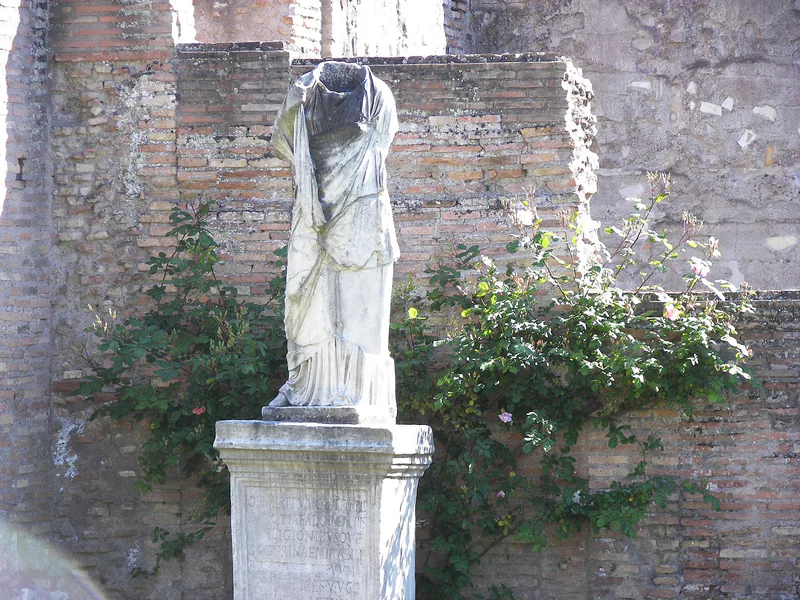
The six Vestal Virgins, chosen as girls and serving for thirty years, kept the eternal fire of Vesta burning in her round temple in the Forum. They enjoyed great privileges, but a Vestal found guilty of breaking her vow of chastity was buried alive, a punishment recorded in historical sources and described here as such. Ways of reading omens are treated more widely in What Is Divination?.
Festivals and the Roman Calendar§
The Roman calendar, recorded in inscribed fasti, marked days as suitable or unsuitable for public business and listed dozens of festivals. The Lupercalia (15 February) involved young men running around the Palatine striking onlookers with strips of goatskin; the Parilia (21 April) purified flocks and celebrated Rome's birthday; the Saturnalia, from 17 December, became a holiday of feasting, gift-giving and role reversal. Public games (ludi), including chariot races and theatrical shows, were religious occasions held in honour of the gods. The poet Ovid's Fasti (c. 8 CE), an unfinished verse commentary on the calendar, is a major if literary source.
Foreign Cults, Mysteries and Religious Control§
Rome regularly welcomed new gods, sometimes to win their favour in war. In 204 BCE, during the war with Hannibal and on the advice of the Sibylline Books, the sacred stone of the Phrygian Magna Mater (Cybele) was brought from Asia Minor to Rome. The state also restricted cults it saw as threats: in 186 BCE the Senate suppressed the Bacchanalia, the Dionysian mysteries, as a conspiracy, an episode recorded by Livy and in a surviving bronze inscription.
Under the empire the worship of Isis and Serapis from Egypt, of Mithras in small underground sanctuaries with his image slaying a bull, and of Jupiter Dolichenus and Sol Invictus spread widely, especially among soldiers and traders. Mithraism, despite its Persian name, is now generally regarded by scholars as a largely Roman creation of the first century CE; see Mithra and the Roman Mithraic Mysteries. Astrology also gained great prestige, despite periodic expulsions of astrologers from the city; see Astrology. Spells and curse tablets, which Roman law sometimes punished, are covered in Greco-Roman Magic.
The Imperial Cult and the End of Roman Religion§
After Julius Caesar's assassination the Senate declared him a god, divus Julius, in 42 BCE. Augustus accepted worship joined with the goddess Roma in the provinces while avoiding direct worship as a god in Rome itself, and most emperors were deified by the Senate after death. The imperial cult expressed loyalty and gave provincial elites a role in empire-wide religion.
Christians, who refused to sacrifice to the gods or the emperor's genius, were persecuted intermittently, most systematically under Decius (250 CE) and in the Great Persecution under Diocletian from 303. After Constantine's conversion in 312, the balance shifted. Disputes such as the removal of the Altar of Victory from the Senate House, opposed by the senator Symmachus in 384 and defended by Bishop Ambrose of Milan, mark the transition. Laws of Theodosius I in 391 and 392 banned sacrifice and pagan worship, though traditional practices lingered for generations. Philosophical paganism survived longest in schools such as those described in Neoplatonism and Theurgy.
Frequently asked questions§
Did the Romans believe in their gods?§
Most Romans assumed the gods existed and took ritual obligations seriously, but Roman religion did not require a statement of belief. Educated Romans debated the nature of the gods philosophically while continuing to perform traditional rites.
What is the difference between Roman and Greek gods?§
Romans identified many of their gods with Greek ones and borrowed Greek myths, but their cults had distinct origins and practices. Some Roman deities, such as Janus and Quirinus, had no real Greek equivalent, and Roman worship placed greater weight on precise ritual and state control.
Why did Roman religion decline?§
Christianity grew steadily and gained imperial support from Constantine onward. In 391–392 Theodosius I banned sacrifice and pagan worship; temples were closed or converted over the following decades, though old customs continued in rural areas and in private.
Sources and further reading§
- Religions of Rome — Mary Beard, John North and Simon Price, 1998
- An Introduction to Roman Religion — John Scheid, 2003
- Religion of the Romans — Jörg Rüpke, 2007
- The Cults of the Roman Empire — Robert Turcan, 1996
- Fasti — Ovid, c. 8 CE
- On the Nature of the Gods — Cicero, 45 BCE
- The Roman Cult of Mithras: The God and His Mysteries — Manfred Clauss, 2000