Liber XVI · Indigenous & Ancient Religions · Chapter IX: Roman Religion
The Vestal Virgins of Ancient Rome: Priestesses of the Fire
The Vestal Virgins of ancient Rome: how they were chosen, their duties at the sacred fire of Vesta, their privileges, punishments and the end of the order.

The Vestal Virgins were the six priestesses of Vesta, goddess of the hearth, who kept the eternal fire burning in her temple in the Roman Forum and performed rites on which Romans believed the safety of the state depended. Chosen as young girls and bound to thirty years of chastity and service, they enjoyed honours no other Roman women possessed, but a Vestal convicted of unchastity was buried alive. The order lasted for more than a thousand years, from the legendary age of the kings until the Christian emperors withdrew its support at the end of the fourth century CE.
Vesta and the Eternal Fire of Rome§
Vesta was the Roman form of the hearth goddess known to the Greeks as Hestia. Unlike most Roman deities she was not normally represented by a cult statue in her temple; her presence was the flame itself. Every Roman household had its hearth and its domestic gods, and the fire of Vesta in the Forum was understood as the hearth of the whole community. As long as it burned, Rome endured.
Her temple was a small round building at the eastern end of the Forum, near the Regia, the old seat of the kings and later of the pontiffs. Its circular shape was said to recall the huts of early Latium. It was technically an aedes, a sacred building, rather than an inaugurated templum. Within was the penus Vestae, a storeroom into which only the Vestals could go, said to hold objects on which Rome's destiny rested, among them the Palladium, an image of Pallas Athena believed to have been brought by Aeneas from Troy. Next to the temple stood the Atrium Vestae, the large house in which the Vestals lived.
The ancient historians Livy and Plutarch attribute the foundation of the order to Numa Pompilius, Rome's second king and the legendary organiser of its religion. Rome's own founding legend gave the office a still older pedigree: Rhea Silvia, the mother of Romulus and Remus, was said to have been a Vestal of Alba Longa, made pregnant by the god Mars.
Selection, Service and the Thirty-Year Term§
When a place fell vacant, the pontifex maximus, head of the college of pontiffs, chose a new Vestal from among girls aged six to ten. According to the antiquarian Aulus Gellius, she had to have both parents living, be free of physical defects and speech impediments, and come from a family of free birth and good standing. In the formal act of selection, called captio ("taking"), the pontiff took her by the hand and addressed her as Amata. From that moment she left her father's legal authority and passed into the service of the goddess.
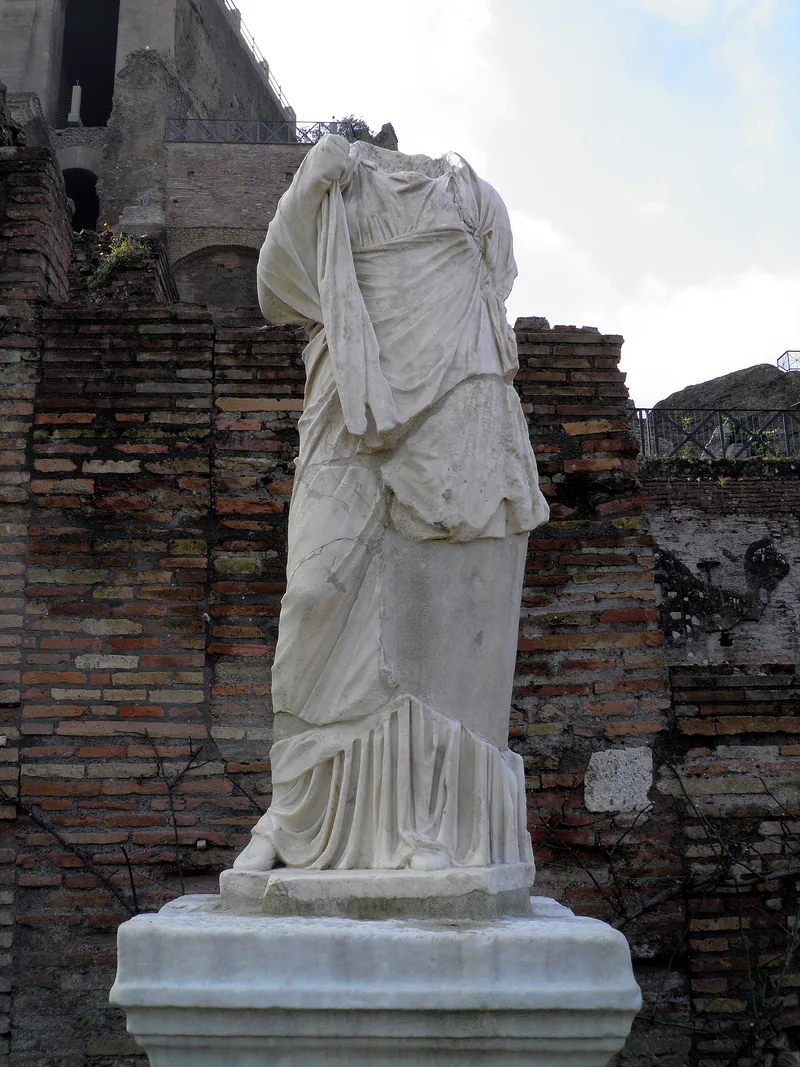
Service lasted thirty years. Ancient writers describe the first decade as a time of learning the rites, the second as performing them and the third as teaching the novices. Afterwards a Vestal was free to leave and marry, but sources say that few did and that those who left were thought to have been unhappy. Many remained for life. The senior priestess was the Virgo Vestalis Maxima, whose influence could be considerable, and inscribed statue bases from the Atrium Vestae honour several Chief Vestals of the third and fourth centuries CE.
Vestals wore distinctive dress: a white woollen headband (infula) with ribbons, a veil called the suffibulum during sacrifice, and a hairstyle of six braids (seni crines) that Roman brides also wore on their wedding day. That combination of virgin and bride is one of the features that has interested historians of gender.
Duties: Fire, Water and Sacred Food§
The Vestals' most famous duty was to keep the fire burning day and night. If it went out, this was regarded as a dreadful omen, and the priestess responsible could be scourged by the pontifex maximus. The fire was solemnly renewed every year on 1 March, the old Roman new year.
They also fetched water for the cult from a sacred spring rather than from the aqueducts, carrying it in a vessel designed so that it could not be set down. Above all they prepared materials used in the public sacrifices of Rome. The most important was mola salsa, a mixture of roasted spelt and salt, made from ears of grain the Vestals gathered in May. It was sprinkled on the heads of sacrificial animals, and the Latin verb immolare, "to sacrifice", comes from it. They also made the suffimen, a purifying substance compounded from the ashes of unborn calves burned at the festival of the Fordicidia and the blood of the October Horse, used at the shepherds' festival of the Parilia on 21 April.
The Vestals took part in many festivals, but their own was the Vestalia, from 7 to 15 June. During it the penus was opened, and married women walked barefoot to the temple with offerings; at the end the temple was swept and the sweepings carried away and disposed of in a prescribed manner. Bakers and millers also honoured Vesta at this time, and donkeys were garlanded.
Privileges and Status of the Vestals§
The Vestals held a legal and social position unlike that of any other Roman women. They were free of a father's or husband's authority and could manage their own property and make wills. A lictor, the attendant who walked before magistrates, accompanied them in public. They had reserved seats at games and in the theatre, could give evidence without taking an oath, and were buried within the city walls, an honour normally forbidden. If a Vestal happened to meet a condemned criminal on his way to execution, he was spared, provided the meeting was accidental.
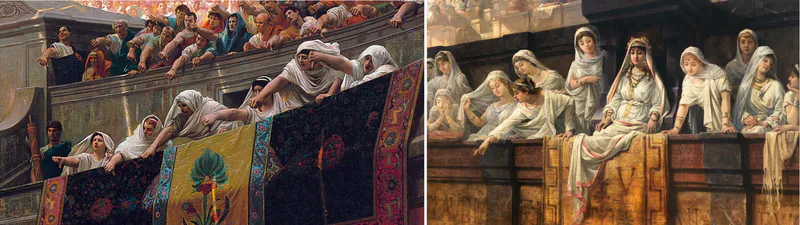
Their inviolability made them trusted keepers of documents. Wills and treaties were deposited with them; both Julius Caesar and Augustus lodged their wills in the house of the Vestals. They also interceded in politics: Suetonius records that the Vestals pleaded with Sulla to spare the young Caesar.
Ancient and modern writers have struggled to classify the Vestals. In a much-cited 1980 article Mary Beard argued that their status combined features of virgins, matrons and even men, and that this ambiguity was the source of their sacred power. Later work, including her own, has refined the argument, but the sense that the Vestals stood outside ordinary categories remains central to interpretations of the order. The wider framework of public priesthoods is explained in Roman religion.
Unchastity, Live Burial and Roman Anxiety§
A Vestal's chastity was bound up with the safety of Rome. A charge of incestum, sexual impurity, was tried by the pontiffs. A Vestal condemned for it could not be executed by the shedding of blood. Instead she was carried through the Forum on a covered litter, as if in a funeral, to the Campus Sceleratus ("the wicked field") near the Colline Gate, and placed in an underground chamber furnished with a little food, water, oil and a lamp, which was then sealed. The man involved was beaten to death.
Such trials often coincided with crises. After the catastrophic defeat at Cannae in 216 BCE, two Vestals, Opimia and Floronia, were convicted; in 114–113 BCE three Vestals were tried after a prodigy, in a case that became politically charged. Under the emperor Domitian the Chief Vestal Cornelia was buried alive around 91 CE, an event that the younger Pliny described with evident disapproval of the emperor. Historians see these cases less as evidence of widespread misconduct than as a way in which Romans explained and expiated disaster: a broken relationship with the gods was located in the body of a priestess.
Stories also celebrated vindication. The Vestal Tuccia, accused of unchastity, was said to have proved her innocence by carrying water from the Tiber in a sieve without spilling it. Renaissance and Baroque painters made her an emblem of chastity, and she appears in portraits of Queen Elizabeth I holding a sieve.
The End of the Vestal Order§
The order survived the conversion of Constantine and the growth of Christianity for most of the fourth century. In 382 CE the emperor Gratian withdrew public funds from the traditional priesthoods and had the Altar of Victory removed from the Senate house. The senator Symmachus appealed in 384 for the restoration of the altar and the Vestals' income, and Bishop Ambrose of Milan successfully opposed him; the exchange is one of the classic documents of the end of Roman public religion.
Laws of Theodosius I in 391–392 forbade sacrifices and closed temples, in the same years in which the Serapeum of Alexandria was destroyed. The fire of Vesta seems to have been extinguished soon afterwards, probably around 394. The historian Zosimus tells of an aged former Vestal who cursed Serena, the niece of Theodosius, for taking a necklace from a statue of the Great Mother, a story that shows how the memory of the order became part of pagan accounts of Rome's decline. The ruins of the temple and of the Atrium Vestae, with its pool and its statues of Chief Vestals, can still be seen in the Forum.
Frequently asked questions§
How many Vestal Virgins were there?§
During most of Roman history there were six. Ancient writers say there had originally been two or four, and the number was increased in the regal period. They served under the authority of the pontifex maximus.
What happened to a Vestal Virgin who broke her vow?§
A Vestal convicted of unchastity was buried alive in an underground chamber near the Colline Gate, since her blood could not be shed. Her partner was beaten to death. Such trials often followed military defeats or ominous prodigies.
Could Vestal Virgins marry?§
After thirty years of service a Vestal was free to leave the order and marry. Ancient sources say that few did, and many Vestals remained in the order until their deaths.
Sources and further reading§
- Fasti — Ovid, c. 8 CE
- Religions of Rome — Mary Beard, John North and Simon Price, 1998
- From Good Goddess to Vestal Virgins: Sex and Category in Roman Religion — Ariadne Staples, 1998
- Rome's Vestal Virgins: A Study of Rome's Vestal Priestesses in the Late Republic and Early Empire — Robin Lorsch Wildfang, 2006
- Vestal Virgins, Sibyls, and Matrons: Women in Roman Religion — Sarolta A. Takács, 2008
- An Introduction to Roman Religion — John Scheid, 2003