Liber XVI · Indigenous & Ancient Religions · Chapter X: Shamanism
Korean Shamanism: The Mudang, the Gut and Musok Today
Korean shamanism (musok) explained: the mudang and mansin, spirit illness, the gut ritual, gods such as Princess Bari, centuries of suppression and revival.

Korean shamanism, known in Korean as musok ("shamanic custom") or mugyo, is a living religious tradition in which ritual specialists called mudang, most of them women, mediate between people and the spirits of gods and the dead. Its central rite is the gut, a day-long or night-long ceremony of music, dance, costume changes, offerings and oracular speech, performed to secure good fortune, heal, or send the dead peacefully on their way. Despite centuries of disdain from Confucian officials, colonial authorities, modernising governments and some churches, it remains widely practised in South Korea.
What Musok Means: Mudang, Mansin and Paksu§
The word mudang is the most general term for a Korean shaman, though some practitioners find it disparaging and prefer mansin, "ten thousand spirits", a term common in Seoul and among shamans originally from the north. Male shamans, a minority, are called paksu or paksu mudang. Clients, historically most of them women managing the welfare of their households, consult a mudang for divination (jeom), for small rites at home, and for the full gut at moments of crisis or transition.
Ethnographers have long distinguished two broad types. The kangsinmu, "spirit-descended shamans" of central and northern Korea, receive the gods into their own bodies and speak for them. The sesŭmmu, "hereditary shamans" of the southern provinces, traditionally came from families of ritual specialists who married among themselves; they perform with great musical and poetic skill but usually do not claim possession. On Jeju Island the simbang form a further tradition with its own extensive cycle of myths and chants. These distinctions have blurred since the Korean War, when many northern shamans settled in the south and urban practice mixed regional styles.
Musok has never been a unified church. There is no scripture, though ritual chants (muga) preserve long myths; authority passes from a senior shaman, the "spirit mother" (sin-eomeoni), to her "spirit daughters", who form lineages of teachers and pupils.
Spirit Illness and the Calling of the Mudang§
In the classic accounts gathered by Korean and foreign ethnographers, a future spirit-descended shaman does not decide to become one. She, or occasionally he, suffers sinbyeong: persistent illness that doctors cannot explain, disturbing dreams and visions, loss of appetite, and often family misfortune. Within the tradition this is understood as the gods pressing their claim. Resistance, according to many life stories, only makes matters worse.
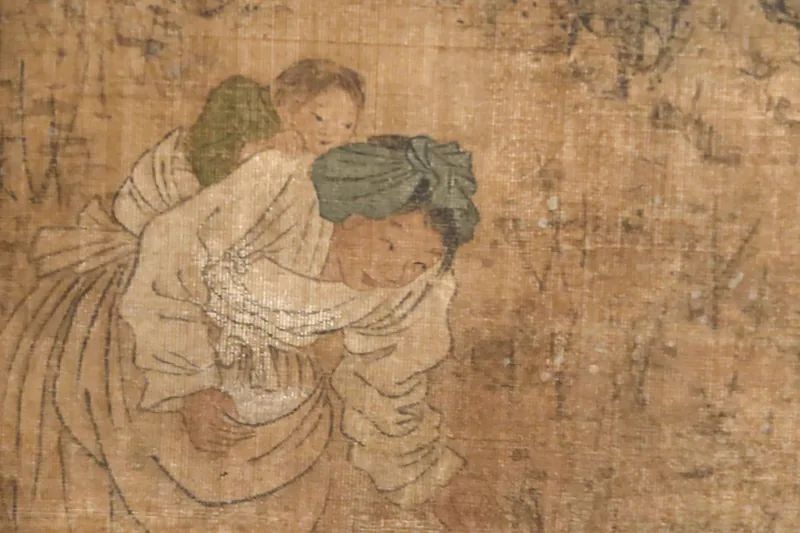
The crisis is resolved by an initiation rite, the naerim-gut, "descent ritual", organised by an experienced shaman, in which the candidate's personal guardian gods are identified and received. Years of apprenticeship follow, in which the new shaman learns songs, dances, the order of the rites and the craft of divination. Laurel Kendall's The Life and Hard Times of a Korean Shaman (1988) follows one such initiation and shows how much the outcome depended on community recognition, not only on inner experience. Korean practitioners describe the calling as a burden as often as a gift, and they do not regard their rites as techniques that outsiders can learn from books.
The pattern of an initiatory illness is one of the features that led scholars to classify Korean practice under the wider category of shamanism, even though Korean shamans speak of the gods coming down to them more than of journeys of the soul to other worlds.
The Gut: Ritual, Music and the Voice of the Spirits§
A gut is the great ritual of Korean shamanism. Its many forms are named by purpose and region: the chaesu-gut for household luck and prosperity, the jinogwi-gut of Seoul for the recently dead, the ssitgim-gut of Jindo for cleansing the soul of the deceased, the dang-gut and byeolsin-gut for village guardian shrines and fishing communities.
A typical Seoul-area gut proceeds through a sequence of segments called geori, each devoted to a particular group of spirits. Tables are laid with rice cakes, fruit, meat, liquor and paper money. Musicians play the hourglass drum (janggu), cymbals and the double-reed piri. The mudang changes into the costume of each god in turn, a general's robe and hat for the warrior spirits, an official's dress for the Daegam, a white robe for Buddhist figures, and dances until the god "arrives". She then speaks in the god's voice, a speech called gongsu, scolding, joking, demanding offerings and promising protection. The dead too may speak, and clients sometimes weep as a parent or child is heard again. Some rites in the northern tradition include striking feats such as standing barefoot on blades, displayed as proof of the spirit's presence.
The gut is therefore drama, worship, family therapy and feast at once. Scholars such as Daniel Kister have analysed it as ritual theatre in which conflicts within the household, between living and dead, and between humans and gods, are acted out and reconciled.
Gods of Korean Shamanism: Mountain Spirits, Generals and Princess Bari§
The pantheon is large, regional and open to newcomers. Among its commonest figures are:
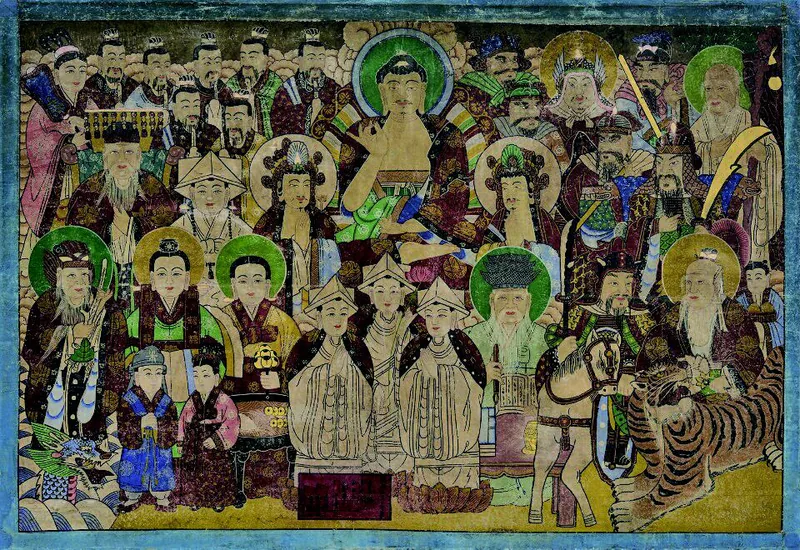
- Sansin, the mountain god, often shown as an old man with a tiger, also honoured in shrines on the grounds of Buddhist temples.
- Chilseong, the Seven Stars of the Big Dipper, who govern lifespan and the welfare of children.
- Jeseok and other Buddhist-derived figures, reflecting centuries of contact with Korean Buddhism.
- The Daegam, greedy and comical official spirits who bring wealth if properly fed.
- Generals (janggun), including deified historical figures such as the Goryeo general Choe Yeong.
- Ancestors and the restless dead, whose grievances must be heard and settled; the attention to ancestors overlaps with the Confucian rites discussed in Chinese ancestor veneration.
The best-known myth is that of Princess Bari (Bari Gongju), sung during rites for the dead. Abandoned at birth as the seventh daughter of a king who wanted a son, she later learns that her parents are dying and travels to the Otherworld to fetch the water of life. She serves a guardian there, bears him sons, and returns in time to revive her parents. Refusing worldly reward, she becomes the guide of souls to the afterlife and is regarded by many as the patron of shamans. Scholars have read the story as an expression of daughters' devotion and of women's undervalued work in a patrilineal society.
Suppression Under Confucian, Colonial and Modern Regimes§
Shamanic specialists appear early in Korean records. The twelfth-century Samguk sagi notes that the title of the Silla king Namhae, chachaung, was a local word for a shaman, and many scholars link the foundation myth of Dangun with ideas of sacred, priestly kingship, though such interpretations remain debated.
Under the Joseon dynasty (1392–1910), Neo-Confucian officials regarded shamanic rites as vulgar and wasteful, especially because they gave women a ritual role outside the patriline. Shamans were taxed, listed among the lowest social classes, and at times barred from the capital, although the court and royal women continued to employ them. During Japanese colonial rule (1910–1945) shamanism was studied by Japanese scholars such as Murayama Chijun and Akiba Takashi, but treated by officials as superstition. After independence, Protestant missions and modernising governments continued the campaign: the "New Village Movement" (Saemaul Undong) of the 1970s encouraged the removal of village shrines and spirit poles as backward. In North Korea shamanism was suppressed as superstition and survives there, so far as is known, only privately.
Heritage, Revival and Korean Shamanism Today§
A counter-current began in the 1960s and 1970s, when folklorists and nationalist intellectuals came to see shamanic music, dance and myth as a storehouse of authentic Korean culture. Under the Cultural Properties Protection Law of 1962, several gut were designated Important Intangible Cultural Properties, with named performers as official holders. The Gangneung Danoje festival, which includes shamanic rites, was proclaimed by UNESCO in 2005, and the Chilmeoridang Yeongdeung-gut of Jeju, a rite for the wind goddess of fishing and diving communities, was inscribed in 2009. The celebrated mansin Kim Keum-hwa (1931–2019), born in Hwanghae Province, became a national figure who performed in Korea and abroad.
Shamanism in South Korea today is both heritage and practice. Large public performances coexist with private consultations in apartments, shrines on mountainsides, online fortune-telling and clients from every social class. Kendall's later work describes how mudang adapted to economic crisis and urban life, while Christian opposition remains strong in some quarters. Comparisons are often drawn with other female and possession-based traditions, such as the shrine maidens in Shinto or Afro-Atlantic spirit possession, but Korean practitioners describe their own tradition in its own terms.
Frequently asked questions§
What is a mudang?§
A mudang is a Korean shaman, usually a woman, who performs rituals and divination by communicating with gods, ancestors and spirits. Many mudang believe they were chosen by the spirits through a period of illness and were then initiated and trained by a senior shaman.
What happens in a Korean gut ritual?§
A gut is a long ceremony with offerings, music on drums and cymbals, and dances in which the shaman wears the costumes of successive gods. Through her, the gods and the dead speak to the family, giving advice, demands and blessings, and the rite ends by sending the spirits away.
Is shamanism still practised in Korea?§
Yes. Many South Koreans consult shamans for divination and rituals, and several shamanic rites are protected as national intangible heritage. Practice has adapted to cities, though it faces criticism from some religious groups.
Who is Princess Bari?§
Princess Bari is the heroine of a shamanic myth sung at rites for the dead. An abandoned daughter who journeys to the Otherworld to save her dying parents, she becomes the guide of souls and is honoured as a patron of shamans.
Sources and further reading§
- Shamans, Housewives, and Other Restless Spirits: Women in Korean Ritual Life — Laurel Kendall, 1985
- The Life and Hard Times of a Korean Shaman — Laurel Kendall, 1988
- Shamans, Nostalgias, and the IMF: South Korean Popular Religion in Motion — Laurel Kendall, 2009
- Six Korean Women: The Socialization of Shamans — Youngsook Kim Harvey, 1979
- Songs of the Shaman: The Ritual Chants of the Korean Mudang — Boudewijn Walraven, 1994
- Korean Shamanist Ritual: Symbols and Dramas of Transformation — Daniel A. Kister, 1997
- Korean Shamanism: The Cultural Paradox — Hyun-key Kim Hogarth, 1999