Liber XXXI · Taoism & Chinese Religion · Chapter I: Ancestors & Popular Religion
Chinese Ancestor Veneration and Popular Religion Explained
Chinese ancestor veneration and popular religion explained: oracle bones, altars and lineage halls, gods, ghosts and ancestors, Qingming, the Ghost Festival.

Chinese ancestor veneration is the practice of honouring deceased family members with offerings, incense, prayers and tomb care, in the belief that the dead continue to depend on and watch over their descendants. It sits at the centre of Chinese popular religion, the shared world of household altars, local temples, gods, ghosts, festivals and divination that draws freely on Taoism, Buddhism and Confucianism and has been practised by most Chinese people throughout history without membership of any single church.
Ancestors in Early China: Oracle Bones and the Zhou Ancestral Temple§
The earliest Chinese writing records communication with the dead. Inscriptions on turtle plastrons and cattle shoulder blades from the late Shang capital at Anyang, dating to roughly 1250–1050 BCE, record questions that the king's diviners put to royal ancestors and to the high god Di: whether a harvest would succeed, whether an ancestor was causing the king's toothache, which sacrifices would please them. The answers were read from cracks produced by heat, an early form of the divination traditions surveyed in What Is Divination?.
Under the Zhou dynasty, ancestral temples were the ritual centre of aristocratic life. Bronze vessels used in sacrifices bore inscriptions praying for blessings from ancestors, and the classics later associated with Confucius, especially the Book of Rites, codified the ranks of temples, the order of tablets and the grades of mourning. Confucian teaching made filial piety, including care for parents after death, the foundation of morality.
The Ancestral Altar and Lineage Hall§
In a traditional Chinese home, the main room holds an altar with wooden ancestral tablets inscribed with the names and dates of deceased forebears, often beside images of gods such as Guanyin or the Earth God. Families light incense daily or on the first and fifteenth days of the lunar month, offer tea, fruit and food on anniversaries and festivals, and report important events such as births, marriages and examinations to the ancestors.
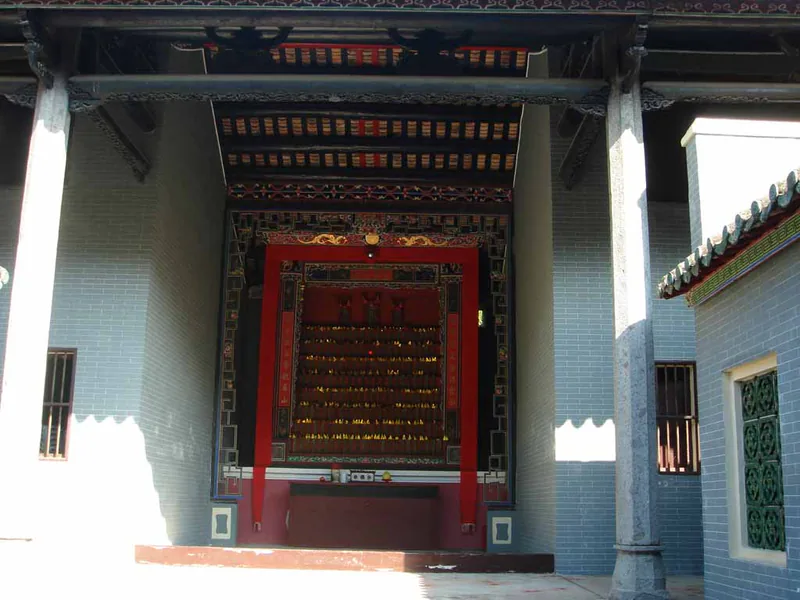
In southern China, Hong Kong and Taiwan, large patrilineal lineages built ancestral halls, in which tablets of many generations are arranged in rows. These halls served as centres of lineage administration, education and property, and their rites were often modelled on Zhu Xi's twelfth-century Family Rituals. The relationship is reciprocal: descendants provide sacrifice and remembrance, and contented ancestors bring prosperity, sons and protection. Neglected or offended ancestors may cause illness or misfortune.
Death, Mourning and the Care of the Dead§
Funerals have long been the most elaborate rites in Chinese family life. They combine Confucian norms of mourning, in which the closeness of kinship determined the clothing and duration of mourning, with Buddhist and Taoist rituals to guide the dead through the underworld courts. Popular belief imagines ten courts ruled by the Ten Kings, where the soul is judged before rebirth, a scheme studied by Stephen Teiser and others.
Families provide for the dead by burning joss paper, or spirit money, together with paper models of houses, clothing and, in modern times, cars and mobile phones, which are believed to reach the deceased in the other world. The site and orientation of graves were traditionally chosen by geomancers, since the welfare of the dead was thought to affect the fortunes of the living; see feng shui. Many Chinese also distinguish multiple souls, often the hun, which ascends, and the po, which stays with the body, though beliefs about this vary widely.
Gods, Ghosts and Ancestors: The Shape of the Spirit World§
In an influential 1974 essay, the anthropologist Arthur P. Wolf argued that Taiwanese villagers imagined three classes of spirit that mirrored their social world. Gods (shen) are like imperial officials: powerful, bureaucratic, approached with formal offerings and petitions. Ancestors (zuxian) are one's own kin, cared for within the household. Ghosts (gui) are the dead who have no descendants to care for them, or who died violently, and who wander hungry and potentially dangerous, like strangers, beggars or bandits.
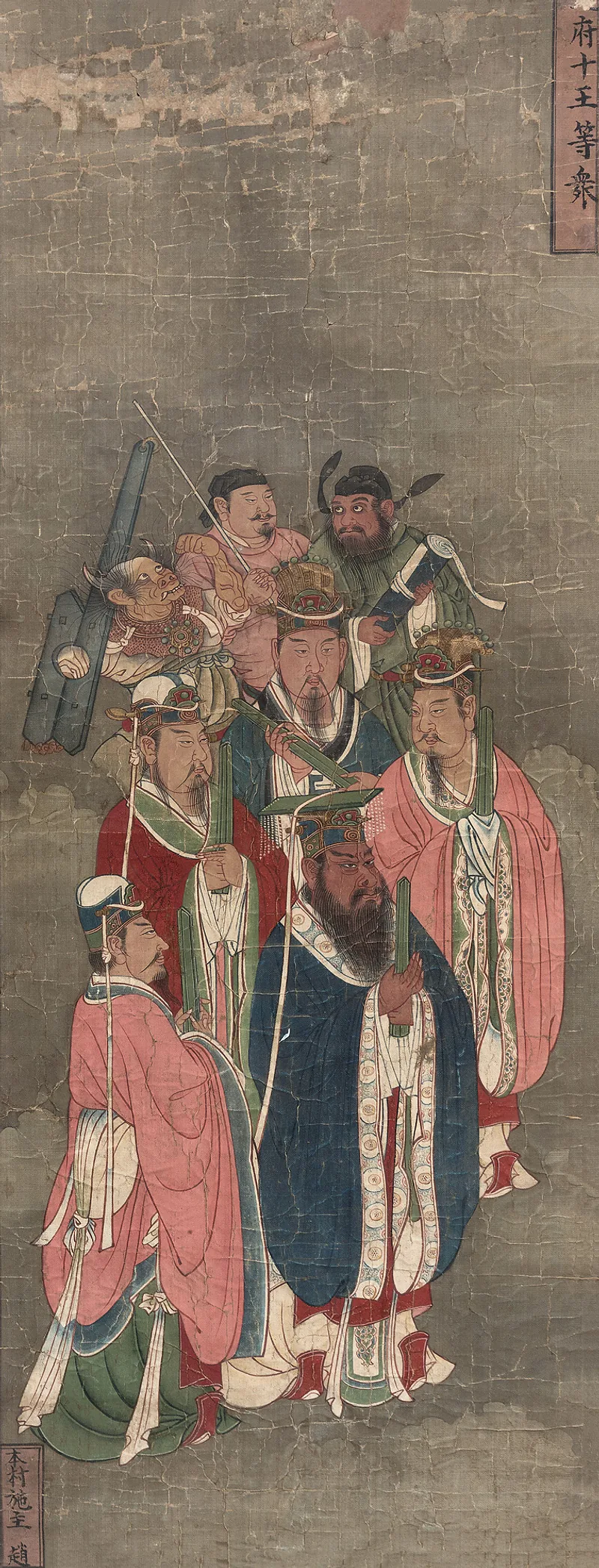
One person's ancestor is another's ghost, and offerings to ghosts are made outside the house rather than at the family altar. This framework, though simplified, helps explain much of Chinese ritual: the bureaucratic language of petitions to gods, the intimacy of ancestor rites, and the communal feeding of ghosts. Readers can compare beliefs elsewhere in ghosts and hauntings and reincarnation and the afterlife.
The sociologist C. K. Yang described Chinese religion as largely "diffused": rather than forming a separate institution, it was embedded in family, community, guild and state. Most people did not belong to "Taoism" or "Buddhism" exclusively but used temples and specialists of each as needed, an attitude summed up in the slogan "the three teachings are one".
The Ritual Year: Qingming, the Ghost Festival and the New Year§
Chinese festivals follow the lunar calendar, except for Qingming, which falls on a solar term.
- Lunar New Year begins with household rites: the Kitchen God, who watches the family through the year, is sent up to heaven a week before New Year to report, traditionally with sweet offerings to make his words kind; on New Year's Eve the family reunites and honours the ancestors.
- Qingming ("Clear Brightness"), around 4–5 April, is the main tomb-sweeping festival, when families clean graves, make offerings and burn spirit money. It became a public holiday in mainland China in 2008.
- The Ghost Festival on the fifteenth day of the seventh lunar month, when the gates of the underworld are said to open, combines the Buddhist Yulanpen (Ullambana) rites, rooted in the story of the monk Mulian rescuing his mother, with the Taoist festival of the Earth Official. Communities stage offerings, opera and the floating of lanterns for the wandering dead.
- The winter solstice and the anniversaries of individual deaths are also important occasions for ancestor rites.
Temples, Divination and Spirit Mediums§
Village and city temples, dedicated to deities such as the Earth God, the City God, the sea goddess Mazu or Lord Guan (see Chinese gods and immortals), are run by local committees rather than clergy. Their festivals feature processions, opera, incense pilgrimages to a "mother" temple, and rituals by hired Taoist priests or Buddhist monks.
Worshippers consult the gods directly. They throw pairs of crescent-shaped divination blocks to obtain a yes or no, or shake a container of numbered fortune sticks until one falls out, then read the corresponding poem. Spirit mediums (in Hokkien tâng-ki) go into trance to let a god speak and heal, sometimes demonstrating invulnerability through self-mortification, and spirit-writing with a forked stylus produced revelations and whole scriptures, including texts of inner alchemy.
Popular Religion in Modern China and the Diaspora§
From the late Qing dynasty reformers attacked temple religion as superstition, and many temples were converted into schools. After 1949 the People's Republic classified most popular practices as "feudal superstition", and the Cultural Revolution destroyed shrines and ancestral tablets throughout the country. Since the 1980s, however, temples, lineage halls and festivals have revived across much of China, often tolerated as "folk culture"; Adam Yuet Chau's study of a temple in northern Shaanxi documents how this revival works in practice. In Taiwan, Hong Kong, Singapore, Malaysia and overseas Chinese communities, popular religion continued without interruption and remains highly visible. Ancestor veneration, in particular, survives even among Chinese who describe themselves as having no religion.
Frequently asked questions§
Is Chinese ancestor veneration the same as worship?§
Practitioners and scholars differ on the word. Offerings, incense and bowing resemble worship, but most families understand the rites as expressions of filial respect and continuing relationship, not as treating ancestors as gods. The question was central to the Catholic "Chinese Rites Controversy" of the seventeenth and eighteenth centuries.
Why do Chinese people burn paper money for the dead?§
Joss paper, or spirit money, is burned in the belief that it is transmitted to the other world, where the dead need money and goods just as the living do. The practice also expresses the family's care and fulfils obligations to ancestors and to wandering ghosts.
What is the Hungry Ghost Festival?§
It falls on the fifteenth day of the seventh lunar month, when ghosts are thought to roam the world of the living. Families and temples make offerings to them, especially to the dead who have no descendants, combining Buddhist and Taoist rituals of feeding and salvation.
Sources and further reading§
- Religion in Chinese Society — C. K. Yang, 1961
- Religion and Ritual in Chinese Society — Arthur P. Wolf (ed.), 1974
- Gods, Ghosts, and Ancestors: The Folk Religion of a Taiwanese Village — David K. Jordan, 1972
- The Cult of the Dead in a Chinese Village — Emily M. Ahern, 1973
- Religions of China: The World as a Living System — Daniel L. Overmyer, 1986
- The Ghost Festival in Medieval China — Stephen F. Teiser, 1988
- Confucianism and Family Rituals in Imperial China — Patricia Buckley Ebrey, 1991
- Popular Religion in China: The Imperial Metaphor — Stephan Feuchtwang, 2001
- Miraculous Response: Doing Popular Religion in Contemporary China — Adam Yuet Chau, 2006