Liber XXXI · Taoism & Chinese Religion · Chapter I: Ancestors & Popular Religion
The Hungry Ghost Festival: Zhongyuan, Yulanpen and Ghost Month
The Hungry Ghost Festival explained: Mulian and the Yulanpen sutra, the Taoist Zhongyuan, pudu feasts, water lanterns and the taboos of Ghost Month.

The Hungry Ghost Festival is the Chinese festival of the dead held on the fifteenth day of the seventh lunar month, at the height of "Ghost Month", when the gates of the underworld are believed to open and wandering spirits roam the world of the living. Known to Buddhists as Yulanpen (Ullambana) and to Taoists as Zhongyuan, the "Middle Prime", it combines offerings to ancestors with feasts and rites for the hungry ghosts who have no descendants to care for them.
What Is the Hungry Ghost Festival?§
In Chinese popular religion the dead fall into two broad groups. Ancestors are remembered and fed by their descendants on household altars and in lineage halls. Ghosts (gui) are the dead who have no one to care for them: those who died without children, far from home, by violence or by drowning, or whose graves have been forgotten. Unfed and resentful, they wander as "hungry ghosts", and they can bring illness and misfortune.
The seventh month is their season. In many regions the gates of the underworld are said to open on the first day of the month and close on the last, and the fifteenth day is the climax, when families honour their own ancestors and communities provide for the anonymous dead. The festival thus expresses a moral concern that runs through Chinese religion: no one, living or dead, should be left without food and care.
Mulian Rescues His Mother: The Buddhist Yulanpen§
The Buddhist form of the festival rests on a short scripture, the Yulanpen Sutra, traditionally said to have been translated in the third or fourth century but regarded by most scholars as composed in China. It tells how Mulian (the Buddha's disciple Maudgalyāyana), having attained supernatural powers, looked for his dead mother and found her reborn as a hungry ghost, emaciated and starving. When he offered her a bowl of rice, the food turned to burning coals before it reached her mouth.
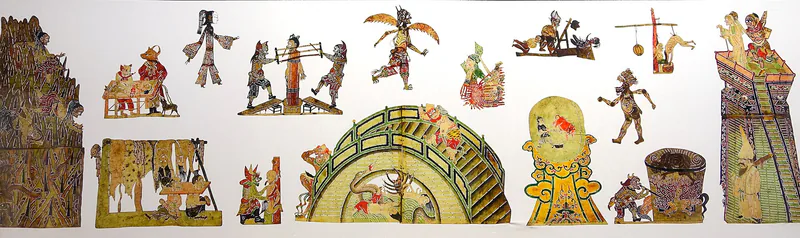
The Buddha explained that her sins were too heavy for one person to overcome, and instructed him to make offerings to the assembled monks on the fifteenth day of the seventh month, the day the monastic summer retreat ended and their accumulated merit was greatest. Through the merit of this offering his mother was released, and the Buddha declared that all filial children could do the same for their parents and ancestors of seven generations.
Stephen Teiser's study The Ghost Festival in Medieval China shows how the festival joined Buddhist monasticism with the Chinese ethic of filial piety. Emperor Wu of the Liang dynasty is recorded as holding a Yulanpen assembly in 538, and under the Tang it became a major public festival. The Mulian story was retold in popular "transformation texts" found at Dunhuang, in which Mulian travels through the hells, and later in long operas, Mulian Rescues His Mother, performed to pacify the dead. The meaning of the word yulanpen is debated; a traditional explanation links it with a Sanskrit word for "hanging upside down", describing the ghosts' torment.
The Taoist Zhongyuan and the Officer of Earth§
Taoism knows the same day as Zhongyuan, the "Middle Prime". Taoist tradition honours the Three Officials of Heaven, Earth and Water, whose festivals fall on the fifteenth days of the first, seventh and tenth months: the Upper Prime, when the Officer of Heaven bestows blessings; the Middle Prime, when the Officer of Earth pardons sins; and the Lower Prime, when the Officer of Water dispels misfortune. The Three Officials go back to the confessions of the early Celestial Masters, described in the article on religious Taoism.
On Zhongyuan the Officer of Earth reviews the records of the living and the dead, and Taoist priests perform rites of repentance and of deliverance for souls in the underworld. Teiser and other historians have shown that Buddhist and Taoist calendars developed side by side in medieval China, borrowing from each other, so that in practice most people have celebrated a single festival with both Buddhist and Taoist elements. In the bureaucratic imagery of Chinese religion, presided over by the Jade Emperor, the release of the dead is an act of official amnesty.
Ghosts in Chinese Religion: Who Are the Hungry Dead?§
Anthropologists have described the Chinese spirit world in social terms. In Arthur Wolf's well-known formulation, based on fieldwork in Taiwan, gods are treated like officials, ancestors like kin, and ghosts like strangers, beggars and bandits: outsiders who must be placated but are kept at a distance. Offerings to ghosts are therefore set out at the door, by the roadside or in temple courtyards, never on the family altar, and they are often plainer than offerings to gods or ancestors.
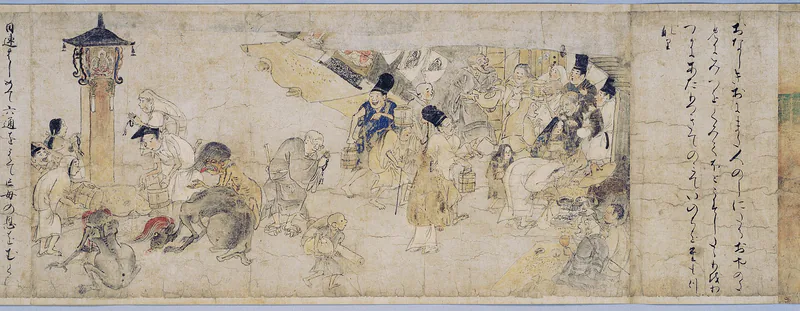
People avoid the word gui during the seventh month, especially in Taiwan, where ghosts are politely called "good brothers" (haoxiongdi). Robert Weller's study of the festival in northern Taiwan shows that the same ritual could carry different meanings: for priests it was a rite of universal salvation, for ordinary worshippers a way of keeping dangerous spirits content, and for communities an occasion to display wealth and solidarity. The festival also reflects historical experience, including migration, war and epidemics, which produced many dead far from home.
Rituals of Ghost Month: Offerings, Pudu and Water Lanterns§
The central communal rite is the pudu ("universal deliverance"), a feast for all the wandering dead. Neighbourhoods, temples, markets and businesses set out long tables of rice, meat, fruit, cakes, drinks and cigarettes, with basins of water and towels so that the ghosts can wash, and burn large quantities of spirit money and paper clothing for their use. Buddhist monks perform the Flaming Mouth (yankou) rite, a ceremony of esoteric Buddhist origin in which mantras and hand gestures open the narrow throats of the hungry ghosts so that they can receive food and hear the teaching. Taoist priests perform comparable rites of feeding and deliverance.
A towering paper effigy of the Great Being (Dashi ye), a fierce ghost king often identified as a manifestation of the bodhisattva Guanyin, is commonly set up to keep order among the spirits at the feast and is burned when the rites are over. Tall lantern poles are raised to summon the dead from afar, and on rivers and harbours people float water lanterns to guide the souls of the drowned. Many families also visit graves or temples to make offerings for their own ancestors. Paper offerings of this kind are discussed in the article on ancestor veneration.
Regional Traditions: Taiwan, Hong Kong and Southeast Asia§
The festival is celebrated most visibly in southern China, Taiwan, Hong Kong and the Chinese communities of Southeast Asia. In Taiwan the Keelung Ghost Festival goes back to the mid-nineteenth century, when, according to local tradition, rival groups of settlers from Zhangzhou and Quanzhou agreed after deadly clashes to share responsibility for the rites; the duty now rotates among surname associations, and the festival culminates in a parade and the release of water lanterns into the sea. In Toucheng and Hengchun the month closes with the qianggu, "grappling with the ghosts", in which teams climb tall greased frames to seize offerings once the ghosts have eaten.
In Hong Kong the Teochew (Chiu Chow) community's Yu Lan Festival, with its opera stages, rice distributions and paper effigies, was added to China's national list of intangible cultural heritage in 2011. In Singapore, Malaysia and Indonesia temples and associations stage getai, lively song-and-dance shows in which the front row of seats is traditionally left empty for invisible guests. The same Buddhist roots produced Obon in Japan, Vu Lan in Vietnam and Baekjung in Korea, each with its own customs; see Mahayana Buddhism.
Taboos, Getai and the Festival Today§
Ghost Month carries many popular taboos, observed with varying seriousness. People may avoid swimming, for fear that drowned ghosts seek replacements; avoid going out late at night, whistling or calling out names after dark; refrain from hanging washing outside overnight; and postpone weddings, house moves and major purchases. Estate agents and car dealers in Singapore and Hong Kong have long noted quieter business in the seventh month.
In mainland China the festival was suppressed for decades as superstition, but it has revived in many places since the 1980s, sometimes promoted as cultural heritage. Governments and temples have encouraged more restrained burning of paper offerings for environmental reasons. Whatever their beliefs, many participants describe the festival as a moral occasion: a time to remember the dead, to give food to strangers, and to acknowledge that the living depend on those who came before.
Frequently asked questions§
When is the Hungry Ghost Festival?§
It falls on the fifteenth day of the seventh month of the Chinese lunar calendar, usually in August or early September. The whole seventh month is known as Ghost Month, and some communities celebrate on the fourteenth day instead.
What is the difference between Zhongyuan and Yulanpen?§
They are two names for the same day. Yulanpen (Ullambana) is the Buddhist festival based on the story of Mulian saving his mother, while Zhongyuan is the Taoist festival of the Officer of Earth who pardons sins; in practice most people combine elements of both.
Why are empty seats left at getai shows?§
The front row at getai performances during Ghost Month is traditionally reserved for the spirits who are the guests of honour. Living spectators sit behind them out of courtesy and caution.
Sources and further reading§
- The Ghost Festival in Medieval China — Stephen F. Teiser, 1988
- Unities and Diversities in Chinese Religion — Robert P. Weller, 1987
- Ritual Opera, Operatic Ritual: "Mu-lien Rescues His Mother" in Chinese Popular Culture — David Johnson (ed.), 1989
- Religion and Ritual in Chinese Society — Arthur P. Wolf (ed.), 1974
- Gods, Ghosts, and Ancestors: The Folk Religion of a Taiwanese Village — David K. Jordan, 1972
- The Chinese Transformation of Buddhism — Kenneth K. S. Ch'en, 1973
- Religion in Chinese Society — C. K. Yang, 1961