Liber XXXI · Taoism & Chinese Religion · Chapter VIII: Religious Taoism
Religious Taoism: Celestial Masters, Scriptures and the Daozang
Religious Taoism explained: Zhang Daoling and the Celestial Masters, Shangqing and Lingbao scriptures, Taoist gods and priests, jiao rites and the Daozang.

Religious Taoism (daojiao, "the Taoist teaching") is the organised Taoist religion that began with the Celestial Masters movement of Zhang Daoling in second-century China and developed priests, revealed scriptures, a celestial bureaucracy of gods, and elaborate rituals of offering and exorcism. Its scriptures were gathered into the Daozang, or Taoist Canon, whose surviving edition was printed in 1445, and it continues today in the Zhengyi priesthood and the monastic Quanzhen order.
The Covenant of 142: Zhang Daoling and the Five Pecks of Rice§
Taoist tradition holds that in 142 CE, on Crane Call Mountain (Heming shan) in Sichuan, Zhang Daoling received a visitation from the Most High Lord Lao, the deified Laozi. The god appointed him Celestial Master (tianshi) and granted him a new covenant, the "Covenant of Orthodox Unity with the Powers", to replace the corrupt worship of the age, in which the dead and demonic spirits demanded blood sacrifices. Historians treat the account as a founding legend, but contemporary sources confirm that a well-organised movement existed in the region by the late second century.
Outsiders called it the Way of the Five Pecks of Rice after the contribution required of members. Under Zhang's grandson Zhang Lu, it ran a theocratic state in the Hanzhong valley for more than two decades, with free roadside hostels for travellers and a system of public penance, until Zhang Lu submitted to the warlord Cao Cao in 215. His followers were resettled in the north, which helped spread the religion across China. The movement is distinct from the contemporary Way of Great Peace (Taiping dao), whose Yellow Turban uprising of 184 shook the Han dynasty.
Libationers, Registers and the Healing of Sin§
Celestial Master communities were organised into twenty-four parishes led by libationers (jijiu), male and female, who kept records of households and conducted rites. Members received registers (lu), lists of spirit generals and officers who protected them, in stages from childhood to adulthood; the register remains the basis of Taoist ordination.
Illness was understood as a consequence of sin. The sick person meditated in a "quiet chamber" (jingshi) and confessed; a libationer then wrote out the confession in triplicate as petitions to the Three Officials of Heaven, Earth and Water, and one copy was placed on a mountain, one buried and one sunk in water. The communities held collective feasts called "kitchens", forbade offerings of meat to the gods, and expected priests to serve without fees, a principle known as the "pure covenant". Their reading of the Tao Te Ching as a guide to moral precepts survives in the Xiang'er commentary.
Highest Clarity and Numinous Treasure: The Revealed Scriptures§
After the fall of the north to non-Chinese dynasties in the early fourth century, Celestial Master families moved south, where they met an older tradition of southern occultism and alchemy represented by Ge Hong (283–343) and his Baopuzi.
Shangqing (Highest Clarity)§
Between about 364 and 370 a medium named Yang Xi received visits from perfected beings, among them the deceased woman Taoist Lady Wei Huacun, at the home of the aristocratic Xu family near Mount Mao (Maoshan). The revelations, written in an elegant hand and poetic style, described the heavens of Highest Clarity, the gods residing within the body, and methods of visualisation, ingesting the essences of sun and moon, and ascent to the stars. The polymath Tao Hongjing (456–536) collected the original manuscripts and edited them as the Declarations of the Perfected (Zhen'gao), and Maoshan became the centre of an influential lineage. See Isabelle Robinet's studies of Shangqing meditation for details.
Lingbao (Numinous Treasure)§
In the 390s Ge Chaofu, a descendant of Ge Hong's family, began circulating the Lingbao scriptures. Influenced by Mahayana Buddhism, they speak of cosmic cycles, rebirth and the universal salvation of all beings, and they set out grand public liturgies. The Scripture of Limitless Salvation (Duren jing) became one of the most recited Taoist texts. The ritualist Lu Xiujing (406–477) systematised Lingbao liturgy and in 471 presented a catalogue that classified Taoist scripture into Three Caverns: Shangqing, Lingbao and the Sanhuang (Three Sovereigns) texts.
The Taoist Pantheon and the Bureaucracy of Heaven§
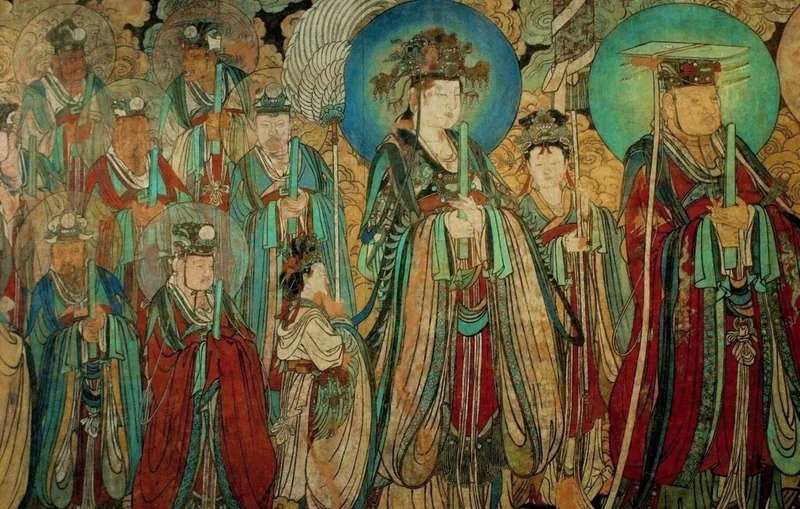
Religious Taoism imagines the unseen world as an administration, mirroring the Chinese imperial state. At its summit stand the Three Pure Ones (Sanqing): the Celestial Worthy of Primordial Beginning, the Celestial Worthy of the Numinous Treasure, and the Celestial Worthy of the Way and Its Virtue, who is Laozi. They are emanations of the Tao rather than creators in the Abrahamic sense. Below them are the Jade Emperor, promoted by the Song court in the eleventh century and the supreme god of popular religion, the star gods of the Northern Dipper, the Three Officials, the city gods and countless officers and generals; see Chinese gods and immortals.
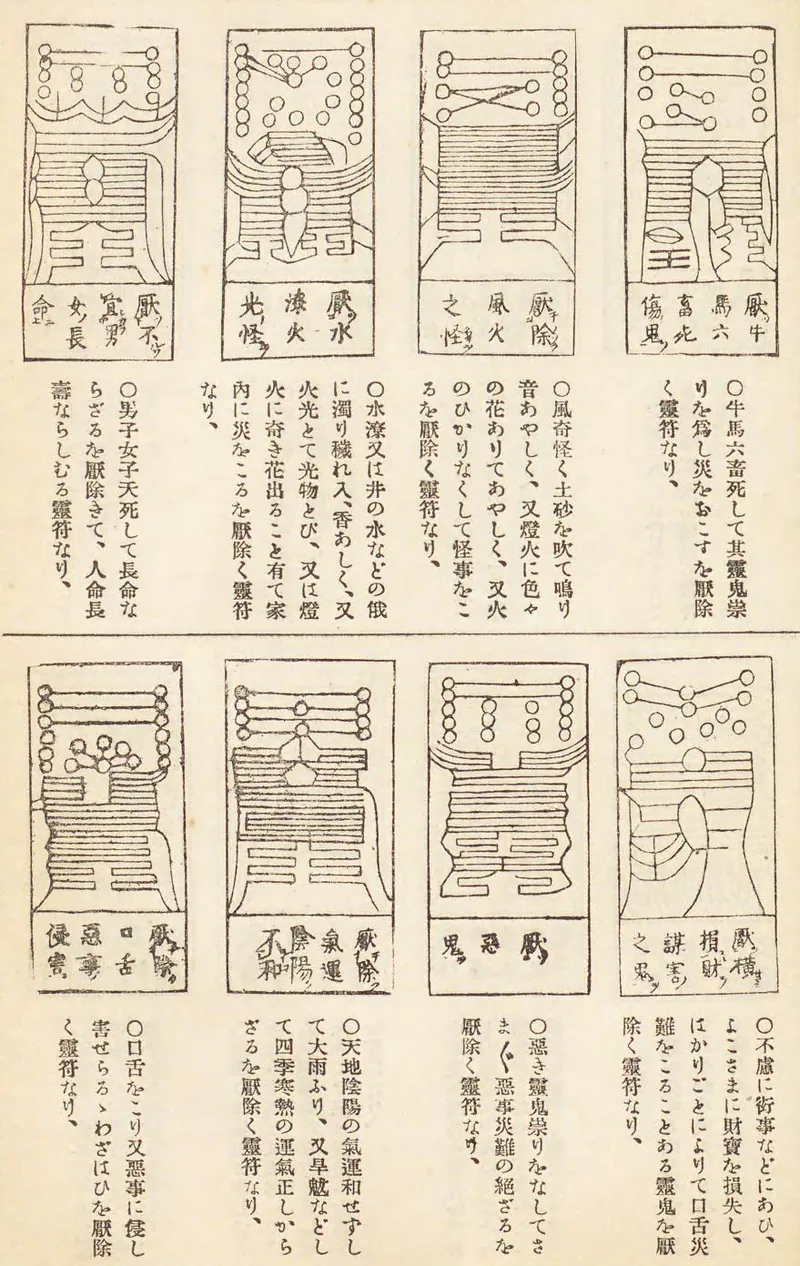
A Taoist priest (daoshi) acts as an official of this heavenly government. Ordained with registers that list the spirit troops at his or her command, the priest writes memorials and petitions in formal bureaucratic language, seals them, and transmits them by burning. Talismans (fu), written in a stylised celestial script, function as divine orders: they summon protective spirits, expel demons and heal. Such talismans have close parallels in other cultures' amulets and talismans.
Ritual: Jiao Offerings, Zhai Retreats and Exorcism§
Taoist liturgy developed from the medieval zhai (retreat or fast) and jiao (offering) into the great communal ceremonies still performed today, especially in Taiwan, Hong Kong, Fujian and among overseas Chinese.
- The jiao, a rite of cosmic renewal, is held for a temple's inauguration or at intervals of several years. Over one to several days the priests purify a sacred area, invite the gods, present memorials, recite scriptures, and offer food, incense and paper to all beings, including hungry ghosts.
- Funerary rites (gongde, "merit") guide the dead through the underworld, break open the hells, and transmit merit to the deceased, often alongside Buddhist rites for the same family.
- Exorcisms expel demons of disease and misfortune; the priest may walk the "Pace of Yu", a step-dance tracing the stars of the Big Dipper, and wield a sword and water.
Kristofer Schipper, a Dutch scholar who was ordained as a Taoist priest in Tainan, and John Lagerwey both documented these rites in detail and argued that the liturgy preserves forms going back to the medieval period.
The Daozang: Compiling the Taoist Canon§
Imperial courts sponsored Taoist canons repeatedly from the fifth century onwards, but wars and persecutions destroyed most of them; the Yuan court ordered many Taoist books burned in 1281 after debates with Buddhists. The canon that survives is the Zhengtong Daozang, printed in 1445 under the Ming, with a supplement in 1607 under the Wanli emperor. It was reprinted in Shanghai in 1923–1926, which made it widely available to scholars for the first time.
The canon is arranged in the Three Caverns (Dongzhen, Dongxuan and Dongshen, associated with Shangqing, Lingbao and the Three Sovereigns) and Four Supplements (Taixuan, Taiping, Taiqing and Zhengyi), each subdivided into twelve categories such as scriptures, talismans, diagrams, precepts, rituals and methods. It holds roughly 1,500 works, including the Tao Te Ching and the Zhuangzi, texts on alchemy, medicine, divination and hagiography. An international project led by Schipper and Franciscus Verellen produced the first complete descriptive guide, The Taoist Canon (2004).
Zhengyi and Quanzhen: Religious Taoism Today§
From the Song and Yuan dynasties two branches dominate. Zhengyi ("Orthodox Unity") Taoism continues the Celestial Master lineage, whose hereditary heads lived for centuries at Longhushan in Jiangxi and were recognised by the Yuan court as leaders of the southern priesthood. Its priests normally marry, live at home and serve communities as ritual specialists; the line of Celestial Masters moved to Taiwan in 1949. Quanzhen ("Complete Perfection"), founded in the twelfth century, is a monastic order of celibate monks and nuns centred on the White Cloud Monastery in Beijing, with an emphasis on meditation and inner alchemy.
In mainland China both are represented by the Chinese Taoist Association. Religious Taoism also continues to supply the ritual framework for much of Chinese popular religion, even where the worshippers would not call themselves Taoists.
Frequently asked questions§
What is the difference between religious and philosophical Taoism?§
"Philosophical Taoism" usually refers to the classics of Laozi and Zhuangzi, while "religious Taoism" refers to the organised religion of priests, gods and rituals that began in the second century CE. Scholars now stress that the two are intertwined: the religion reveres the classics and Laozi himself as a deity.
Who were the Celestial Masters?§
The Celestial Masters were the leaders of the first organised Taoist movement, founded by Zhang Daoling around 142 CE. The title passed down his family line, and the Zhengyi priesthood still regards the hereditary Celestial Master as its head.
What is the Daozang?§
The Daozang is the Taoist Canon, a vast collection of scriptures, ritual manuals, commentaries and treatises. The surviving edition was printed in 1445, with a supplement in 1607, and contains around 1,500 works.
Do Taoist priests marry?§
It depends on the branch. Zhengyi priests usually marry and pass on their office within families, while Quanzhen monks and nuns are celibate and live in monasteries.
Sources and further reading§
- The Taoist Body — Kristofer Schipper, 1993
- Early Daoist Scriptures — Stephen R. Bokenkamp, 1997
- Celestial Masters: History and Ritual in Early Daoist Communities — Terry F. Kleeman, 2016
- Taoist Meditation: The Mao-shan Tradition of Great Purity — Isabelle Robinet, 1993
- Taoist Ritual in Chinese Society and History — John Lagerwey, 1987
- The Taoist Canon: A Historical Companion to the Daozang — Kristofer Schipper and Franciscus Verellen (eds.), 2004
- Daoism Handbook — Livia Kohn (ed.), 2000
- Taoism: Growth of a Religion — Isabelle Robinet, 1997