Liber XXXI · Taoism & Chinese Religion · Chapter II: Chinese Gods & Immortals
Chinese Gods and the Eight Immortals: A Guide to the Pantheon
Chinese gods and the Eight Immortals explained: the Jade Emperor, Earth and City Gods, Guan Yu, Mazu, Guanyin, Lü Dongbin and the gods of Journey to the West.

The Chinese pantheon is a vast, open-ended community of gods, immortals and Buddhist figures, imagined as a heavenly bureaucracy headed by the Jade Emperor, with gods of place such as the Earth God and the City God, deified heroes such as Lord Guan and the sea goddess Mazu, the bodhisattva Guanyin, and immortals such as the Eight Immortals led by Lü Dongbin. New gods were added throughout history, often humans who were honoured after death and promoted by imperial titles or popular devotion.
The Heavenly Court: The Jade Emperor and the Three Pure Ones§
At the head of the popular pantheon sits the Jade Emperor (Yuhuang Dadi), ruler of heaven and overseer of all lesser gods. His cult grew in the Tang and was strongly promoted by the Song emperor Zhenzong in the early eleventh century, who bestowed grand titles on him. In popular imagination he presides over a court of ministers, generals and clerks; at the New Year the Kitchen God ascends to report to him on each household.
In religious Taoism, the highest deities are the Three Pure Ones, personifications of the Tao in its primordial, scriptural and teaching aspects, the last identified with the deified Laozi. Below them, Taoist ritual addresses the Jade Emperor, the Three Officials of Heaven, Earth and Water, and the star gods of the Northern Dipper, who govern life spans. The Taoist priest relates to these gods much as a provincial official related to the imperial court, through memorials and petitions.
Gods of Place: The Earth God, the City God and the Kitchen God§
The most frequently encountered gods are the lowest-ranking officials of the spirit world.
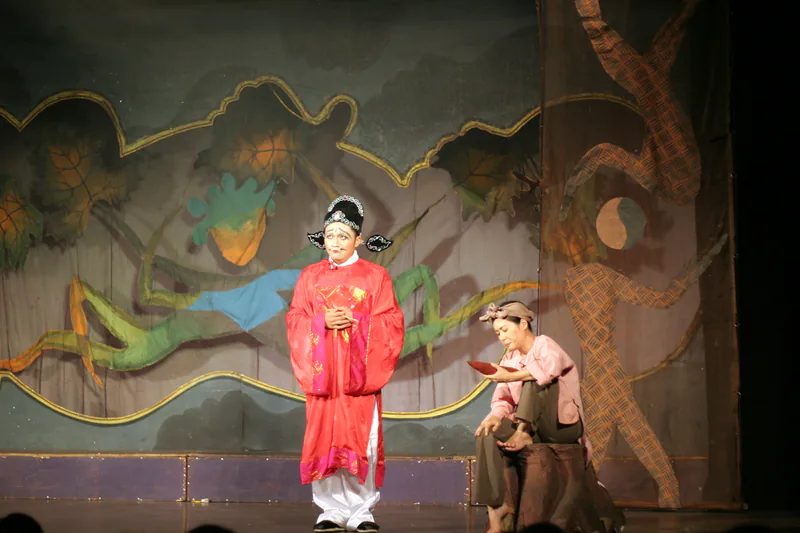
- The Earth God (Tudi Gong), an elderly figure with a white beard, protects a village, street or field. His small shrines are found everywhere, and he is often paired with a consort, Earth Grandmother.
- The City God (Chenghuang), originally a protector of a walled city's moat and walls, became the spiritual counterpart of the local magistrate, judging the dead and supervising ghosts in his jurisdiction. The first Ming emperor reorganised the cult in 1369, assigning ranks to city gods parallel to those of human officials. Famous historical figures were often appointed city gods after death.
- The Kitchen God (Zaojun) watches each household from a paper image above the stove and reports on the family's conduct each year.
Above these, regional and functional gods abound: Wenchang, god of literature and examinations, originally a thunder deity from Sichuan; the God of Wealth (Caishen); and the demon-queller Zhong Kui, whose fierce image was hung at doors, according to legend after he appeared to the Tang emperor Xuanzong in a dream.
Deified Heroes: Lord Guan, Mazu and Others§
Guan Yu (died 220 CE) was a general of the Three Kingdoms period, celebrated in the fourteenth-century novel Romance of the Three Kingdoms for his loyalty to Liu Bei. After his violent death he was first feared as a powerful spirit, then honoured; Barend ter Haar has traced how his cult grew from the Song onward. The Ming court proclaimed him Emperor Guan (Guandi) in 1614. He is worshipped as a god of war, loyalty and righteousness, as a patron of merchants and police, and in Buddhist monasteries as a protector of the Dharma. His red face and long beard make him instantly recognisable.
Mazu, the goddess of the sea, is said to have been a young woman named Lin Moniang from Meizhou island in Fujian, traditionally dated 960–987, who saved fishermen through visions and miracles. Her cult spread with maritime trade along the coast, to Taiwan and throughout Southeast Asia, and she received successive imperial titles, including Empress of Heaven (Tianhou) under the Qing. Her annual pilgrimage processions in Taiwan draw hundreds of thousands of participants.
Many other local heroes, healers and filial children became gods in a similar way. Valerie Hansen's study of the Southern Song shows how new deities gained followers when their miraculous responses (ling) became known, and how the state tried to control them by granting or withholding titles.
Buddhist Figures in Chinese Worship: Guanyin and Others§
Guanyin, "Perceiver of the World's Sounds", is the Chinese form of the bodhisattva Avalokiteśvara, who in Indian Buddhism is generally represented as male. In China the figure was increasingly depicted as female from around the tenth to twelfth centuries, and the legend of Princess Miaoshan, who sacrificed her eyes and arms to heal her father, made Guanyin a model of compassion. Chün-fang Yü's study of this "Chinese transformation" is the standard work. Guanyin is invoked for safety, healing and children, and appears on Taoist and family altars as well as Buddhist ones.
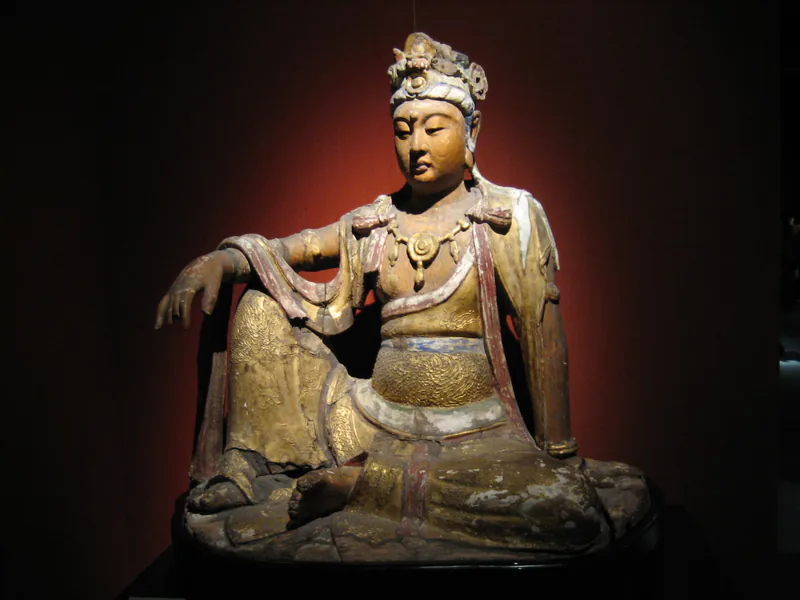
Other Buddhist figures widely revered in popular religion include Dizang (Kṣitigarbha), who vows to save beings in the hells, and Maitreya in the form of the laughing, pot-bellied monk Budai. These deities show how thoroughly Buddhism became part of Chinese religion; compare Zen and Chan Buddhism.
The Eight Immortals§
The Eight Immortals (Baxian) are the most famous group of Taoist transcendents. Individual members have older legends, but the group took fixed form in Yuan and Ming drama and in the sixteenth-century novel Journey to the East (Dongyou ji). Each carries a characteristic emblem:
| Immortal | Usual emblem |
|---|---|
| Zhongli Quan | Fan |
| Lü Dongbin | Sword |
| Zhang Guolao | Fish drum; rides a donkey backwards |
| Li Tieguai (Iron-Crutch Li) | Iron crutch and gourd |
| Han Xiangzi | Flute |
| Cao Guojiu | Castanets |
| Lan Caihe | Flower basket |
| He Xiangu | Lotus |
Lü Dongbin, said to have lived in the Tang dynasty, is the most important. He was revered as a patriarch of inner alchemy and of the Quanzhen order; his temple, the Palace of Eternal Joy (Yongle gong) in Shanxi, preserves fourteenth-century murals of his life, studied by Paul Katz. Lü was also a frequent communicator in spirit-writing séances, and many later texts, including The Secret of the Golden Flower, are attributed to him. The story of the Eight Immortals crossing the sea, each using his or her own magical emblem, is a favourite subject of painting and ceramics, and the group appears on birthday decorations as a wish for long life.
Gods in Literature: Journey to the West and the Investiture of the Gods§
Two Ming novels did much to fix the popular image of the gods. Journey to the West (published 1592, usually attributed to Wu Cheng'en) tells of the monk Xuanzang's pilgrimage to India escorted by the Monkey King, Sun Wukong, who has earlier caused havoc in the Jade Emperor's heaven. The Investiture of the Gods (Fengshen yanyi), from the late sixteenth century, narrates the fall of the Shang dynasty as a war among gods and immortals that ends with the appointment of hundreds of deities to their posts. Figures such as the boy god Nezha and the three-eyed Erlang Shen owe much of their fame to these works, and in turn became objects of worship and spirit-medium cults.
Star Gods and the Gods of Fortune§
Chinese religion also personifies the heavens. The three star gods Fu, Lu and Shou, Fortune, Rank and Longevity, are depicted together as a wish for happiness, success and long life; Shou, with his high forehead and peach, is associated with the Southern Pole Star. The goddess Doumu, Mother of the Dipper, presides over the stars that govern destiny, linking the pantheon with Chinese astrology. The Queen Mother of the West, ancient patron of immortality, hosts the banquet of the peaches of immortality. For a wider comparative view of deities in world religions, see gods and goddesses.
Frequently asked questions§
Who is the most important Chinese god?§
In popular religion, the Jade Emperor is the supreme ruler of heaven, while in Taoist theology the Three Pure Ones rank higher. In practice the most widely worshipped figures are often Guanyin, Guan Yu, Mazu and local Earth Gods, depending on region.
Who are the Eight Immortals?§
They are Zhongli Quan, Lü Dongbin, Zhang Guolao, Li Tieguai, Han Xiangzi, Cao Guojiu, Lan Caihe and He Xiangu. Their group legend took shape in Yuan and Ming plays and novels, and they symbolise long life, good fortune and the Taoist ideal of transcendence.
Were Chinese gods once human?§
Many were. Guan Yu was a historical general, Mazu is said to have been a woman from Fujian, and many City Gods were officials honoured after death. Other deities personify natural forces, stars or Buddhist ideals.
Sources and further reading§
- Myths and Legends of China — E. T. C. Werner, 1922
- Chinese Mythology: An Introduction — Anne Birrell, 1993
- Changing Gods in Medieval China, 1127–1276 — Valerie Hansen, 1990
- Unruly Gods: Divinity and Society in China — Meir Shahar and Robert P. Weller (eds.), 1996
- Images of the Immortal: The Cult of Lü Dongbin at the Palace of Eternal Joy — Paul R. Katz, 1999
- Kuan-yin: The Chinese Transformation of Avalokiteśvara — Chün-fang Yü, 2001
- Guan Yu: The Religious Afterlife of a Failed Hero — Barend ter Haar, 2017
- The Journey to the West — trans. Anthony C. Yu, 1977