Liber XXXI · Taoism & Chinese Religion · Chapter V: Immortality & Inner Alchemy
Taoist Immortality: The Xian, Longevity Arts and the Elixir
Taoist immortality explained: the xian or transcendent, Penglai and the fangshi, Ge Hong's grades of immortals, nourishing life and the turn to inner alchemy.

In Taoism, immortality means becoming a xian (仙), a "transcendent" or "immortal": a person who, through ethical living, longevity practices, elixirs or inner alchemy, escapes ordinary death and ascends to the realms of the gods or roams freely among sacred mountains. The quest began among the court magicians of the Qin and Han dynasties and was gradually transformed, especially from the Song dynasty onward, into the inward, meditative path of inner alchemy, in which the "elixir" is formed within the practitioner's own body and spirit.
What Is a Xian? Immortals and Transcendents§
The Chinese term xian has no exact English equivalent. Older translations use "immortal", but Robert Ford Campany and other scholars prefer "transcendent", because a xian is defined less by never dying than by passing beyond the limits of ordinary human existence. One form of the character combines "person" and "mountain", and transcendents are typically pictured living in the mountains, feeding on air and dew, light enough to fly or ride a crane, and sometimes covered in feathers; early sources call them "feathered people".
The roots of the idea lie in the Warring States period. The Zhuangzi describes "spirit persons" on the remote Gushe mountain who do not eat grain, breathe the wind and drink the dew, ride the clouds and cannot be harmed. The Chuci ("Songs of Chu") poem "Far Roaming" depicts a spirit journey through the heavens. By the Han dynasty these images had combined with the belief that a human life could be prolonged indefinitely by the right methods.
Early Quests: Penglai, the Queen Mother and the Fangshi§
The pursuit of immortality first appears in the historical record as a court enterprise. The First Emperor of Qin (r. 221–210 BCE as emperor) was persuaded that immortals lived on the island of Penglai and other isles in the eastern sea, and in 219 BCE he sent the fangshi Xu Fu with a party of young men and women to find them; they never returned. Emperor Wu of Han (r. 141–87 BCE) patronised a succession of fangshi, among them Li Shaojun, who claimed that cinnabar could be transformed into gold and that eating from vessels made of it would prolong life and allow the emperor to meet the immortals of Penglai.
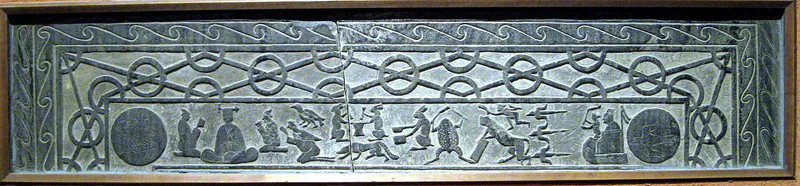
The Queen Mother of the West (Xiwangmu), a goddess ruling over the Kunlun mountains, became the patron of immortality. Han tomb reliefs and bronze mirrors depict her enthroned among attendants, and in 3 BCE a popular religious movement spread across northern China in her name. Her peaches of immortality, ripening once in thousands of years, later became a famous motif of Chinese literature.
The fangshi also practised medicine, divination, astrology and exorcism, and they bridge the gap between court magic and the later Taoist religion. Their methods, and the ambitious external alchemy that grew from them, were later absorbed and reinterpreted by Taoist lineages.
Grades of Transcendence in Ge Hong's Baopuzi§
The fullest early theory of transcendence is the Inner Chapters of the Baopuzi ("The Master Who Embraces Simplicity") by Ge Hong (283–343), completed around 317–320. Ge Hong argued against sceptics that immortality was real and attainable through learning, though only for those with the right destiny, a qualified teacher and great perseverance. He distinguished three grades:
- Heavenly transcendents, who ascend bodily to heaven, sometimes "in broad daylight".
- Earthly transcendents, who roam the famous mountains and live indefinitely on earth.
- Those released from the corpse (shijie), who appear to die but leave behind only an empty shell, a sword or a staff, having secretly departed.
Ge Hong ranked the methods: breathing, gymnastics, herbs and sexual cultivation could lengthen life, but only a properly compounded mineral elixir, above all the "golden elixir" made from cinnabar and gold, could confer transcendence. He also insisted that good deeds were essential; a would-be immortal needed a long record of merit, and misdeeds subtracted days from one's allotted span. His collection of biographies, Traditions of Divine Transcendents (Shenxian zhuan), translated and studied by Campany, illustrates these ideals through lives of famous masters.
Nourishing Life: Diet, Breath, Movement and the Body's Gods§
Alongside the elixir, a wide repertoire of techniques was grouped under the heading of "nourishing life" (yangsheng). Medical manuscripts buried at Mawangdui in 168 BCE already include a painted chart of gymnastic postures (the Daoyin tu), instructions on breathing and on "eliminating grain and eating qi", and texts on sexual cultivation, showing that these practices were established well before organised Taoism.
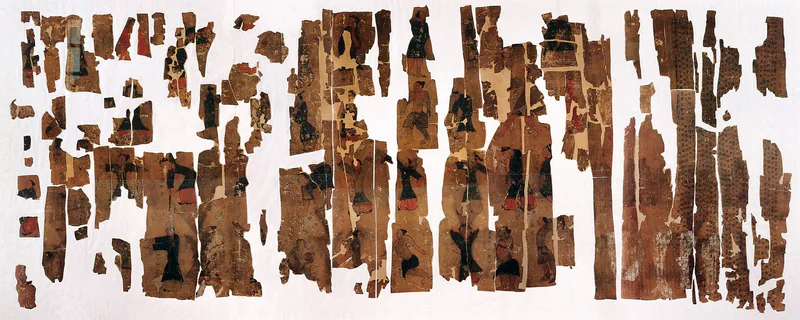
Grain avoidance and breath§
Bigu, "avoiding grains", was a dietary discipline based on the belief that cereals nourish the "three worms" or "three corpses", parasitic spirits within the body that hasten death and report a person's sins to heaven. Practitioners replaced grain with special foods, herbs or, in theory, with the absorption of qi alone. Breath control and daoyin exercises, ancestors of modern qigong, aimed to circulate and refine the vital breath.
Visualisation and the gods within§
The Shangqing tradition of the fourth century taught that the body houses thousands of deities, and that by visualising them, "guarding the One", and absorbing the radiance of sun, moon and stars, the adept could strengthen the body's divine inhabitants and prepare for ascent. Ethical precepts, purity and solitude in the mountains framed these practices. Historians describe them without endorsing medical claims; several historical techniques, including prolonged fasting, carried real risks.
From Elixir to Inner Alchemy§
The mineral elixirs of external alchemy were dangerous: compounds of mercury, lead and arsenic poisoned many adepts, and several Tang emperors are believed to have died from elixirs (see Chinese alchemy). From the Tang and decisively in the Song dynasty, the dominant approach became neidan, inner alchemy, which kept the language of furnace, cauldron, lead and mercury but applied it to the refinement of essence, qi and spirit within the body.
In inner alchemy the goal shifts. The "immortal embryo" formed by meditation is a spiritual body that survives death and returns to the Tao, rather than the physical body living forever. Masters of the Quanzhen school, such as Wang Chongyang and his disciples, taught that the true transcendent is one whose mind has returned to its original clarity. The methods and texts of this tradition are described in detail in Taoist internal alchemy.
Immortals in Hagiography and Sacred Geography§
Stories of transcendents form a large literature, from the Arrayed Traditions of Transcendents (Liexian zhuan), traditionally attributed to Liu Xiang (79–8 BCE) though probably compiled later, to Ming-dynasty illustrated collections. Popular figures include Pengzu, said to have lived about 800 years, and the Eight Immortals, whose group legend took shape in the Yuan and Ming dynasties.
Taoism also mapped immortality onto the landscape. A system of ten great and thirty-six lesser "grotto-heavens" (dongtian) and seventy-two "blessed lands" located paradises inside sacred mountains, accessible to adepts through caves. Mountains such as Maoshan, Mount Tai, Huashan and Wudangshan became centres of pilgrimage and practice.
Immortality in Modern Taoism§
Today, Quanzhen monks and nuns and lay practitioners continue to practise inner alchemy, while the broader ideal of yangsheng survives in traditional Chinese medicine, dietary customs and public exercise in parks. Many teachers interpret the quest for immortality spiritually, as liberation of the mind or union with the Tao, though some lineages still speak of physical transformation. Visitors to Taoist temples will find the immortals honoured on altars, in paintings and in festivals, where they act as patrons of health, long life and good fortune.
Frequently asked questions§
Did Taoists believe in physical immortality?§
Many early sources, including Ge Hong, describe the transformation and even bodily ascent of the transcendent. Over time, and especially in inner alchemy, the goal was more often understood as the formation of a spiritual body or a return to the Tao. Taoism has always contained both literal and symbolic readings.
What is the elixir of immortality?§
In external alchemy it was a compound of minerals such as cinnabar and gold, prepared in a furnace and ingested, and it was often toxic. In inner alchemy the "elixir" is formed within the body by refining essence, qi and spirit through meditation and breath.
What is the difference between a xian and a god?§
Gods (shen) include powers of nature, stars and deified heroes, while a xian is a human being who has attained transcendence through practice. In popular religion the categories overlap, and famous immortals such as Lü Dongbin are worshipped like gods.
Sources and further reading§
- Alchemy, Medicine, Religion in the China of A.D. 320: The Nei P'ien of Ko Hung — James R. Ware, 1966
- To Live as Long as Heaven and Earth: A Translation and Study of Ge Hong's Traditions of Divine Transcendents — Robert Ford Campany, 2002
- Making Transcendents: Ascetics and Social Memory in Early Medieval China — Robert Ford Campany, 2009
- Ways to Paradise: The Chinese Quest for Immortality — Michael Loewe, 1979
- Great Clarity: Daoism and Alchemy in Early Medieval China — Fabrizio Pregadio, 2006
- Taoist Meditation: The Mao-shan Tradition of Great Purity — Isabelle Robinet, 1993
- The Encyclopedia of Taoism — Fabrizio Pregadio (ed.), 2008