Liber XXXV · Witchcraft & Wicca · Chapter II: Gods & Goddesses
Gods and Goddesses of Modern Paganism and Witchcraft
A guide to the gods and goddesses of modern Paganism and Wicca: the Goddess and Horned God, Norse, Celtic and Greek deities, and how historians assess them.

Modern Pagans and witches honour a wide range of gods and goddesses, from the Goddess and Horned God of Wicca to the Norse deities of Heathenry, the Celtic gods of Druidry and the Olympians of Hellenic polytheism. They understand these beings in different ways: as real and distinct persons, as faces of a single divine Goddess and God, as archetypes of the psyche, or as powers of nature. Historians add a further question, how far modern images of these deities reflect ancient evidence and how far they are new creations.
How Modern Pagans Understand Deity§
Contemporary Paganism has no single creed, and its understanding of the divine is correspondingly varied. Scholars and practitioners commonly describe several positions:
- Hard polytheism: the gods are many distinct beings, each with their own will and history. This view is common in Heathenry and Hellenic and Roman reconstructionism.
- Duotheism: all goddesses are aspects of one Goddess and all gods aspects of one God, a view associated with Wicca and often expressed in a phrase adapted from the occult novelist Dion Fortune.
- Pantheism and animism: the divine is immanent in nature, and the world is full of persons, human and other-than-human, a view explored by Graham Harvey in Contemporary Paganism (1997).
- Archetypal or psychological: deities are powerful patterns of the human psyche, a reading influenced by C. G. Jung.
- Goddess monotheism: some feminist spiritualities honour a single Great Goddess.
Many Pagans hold more than one of these views at once or regard them as different perspectives on an experience that matters more than doctrine.
The Goddess and the Horned God of Wicca§
Wicca, as published by Gerald Gardner and developed by Doreen Valiente in the 1950s, honours a Goddess and a God. The Goddess is associated with the moon, the earth and the cycles of life; in many traditions she is invoked as Maiden, Mother and Crone, an image popularised by the poet Robert Graves in The White Goddess (1948). Valiente's Charge of the Goddess, a liturgical text spoken in her voice, became one of the best-loved pieces of Pagan writing.
The Horned God is lord of animals, the hunt, the forest and the underworld, and his life follows the turning of the Wheel of the Year as he is born, weds the Goddess, dies and is reborn. He draws on images such as the antlered figure on the Gundestrup cauldron, often identified with the Gaulish Cernunnos, and on the Greek Pan. Margaret Murray's The God of the Witches (1931) argued that a horned god had been worshipped secretly through the Middle Ages and demonised as the Devil; historians have not accepted that claim, but it shaped Wiccan theology.
Wiccan ritual includes "drawing down the moon", in which the priestess invokes the Goddess into herself, and the corresponding invocation of the God into the priest. Covens may name the deities with specific traditional names known only to initiates or use names from ancient pantheons such as Diana and Cernunnos, Isis and Osiris, or Aradia, the witch-messiah of Charles Godfrey Leland's Aradia (1899).
Reconstructionist Polytheism: Norse, Celtic, Hellenic and Others§
Alongside Wicca, many movements seek to revive the religion of a specific ancient culture, using historical, literary and archaeological evidence.
Norse and Germanic deities§
Heathenry honours the gods of the Eddas. Odin (Óðinn) is the one-eyed seeker of wisdom, god of poetry, war, ecstasy and the dead, who won the runes by hanging on the world-tree. Thor (Þórr), wielder of the hammer Mjölnir, protects gods and humans and was the most popular god of the Viking Age. Freyja is the goddess of love, fertility, gold and seiðr magic, who receives half the slain; Frigg, Odin's wife, is a goddess of the household and of foreknowledge. Loki, the shape-shifting trickster who brings both gifts and catastrophe, is a matter of debate among Heathens, some of whom will not honour him at all. Other deities include Freyr, Njörðr, Tyr, Heimdall, Idunn and Skadi.
Celtic deities§
Celtic polytheists and many Druids honour deities known from Irish and Welsh literature and from Romano-Celtic inscriptions: Brigid, goddess of poetry, healing and smithcraft, closely linked with the later Saint Brigid of Kildare; Lugh, the many-skilled god whose festival is Lughnasadh; the Morrígan, a goddess of battle, prophecy and sovereignty; the Dagda, the "good god" of plenty; and Welsh figures such as Cerridwen and Rhiannon. Because the medieval texts were written by Christian authors, the degree to which they preserve ancient belief is debated.
Hellenic, Roman, Baltic and Egyptian§
Hellenic polytheists honour the Olympians and other Greek gods; in 2017 Greece formally recognised the ethnic Hellenic religion as a "known religion". In Lithuania, Romuva revives Baltic deities such as Perkūnas, and Kemetic groups honour the gods of ancient Egypt. The Fellowship of Isis, founded in Ireland in 1976, honours goddesses from many cultures.
Goddesses Widely Honoured: Hecate, Diana, Isis and Brigid§
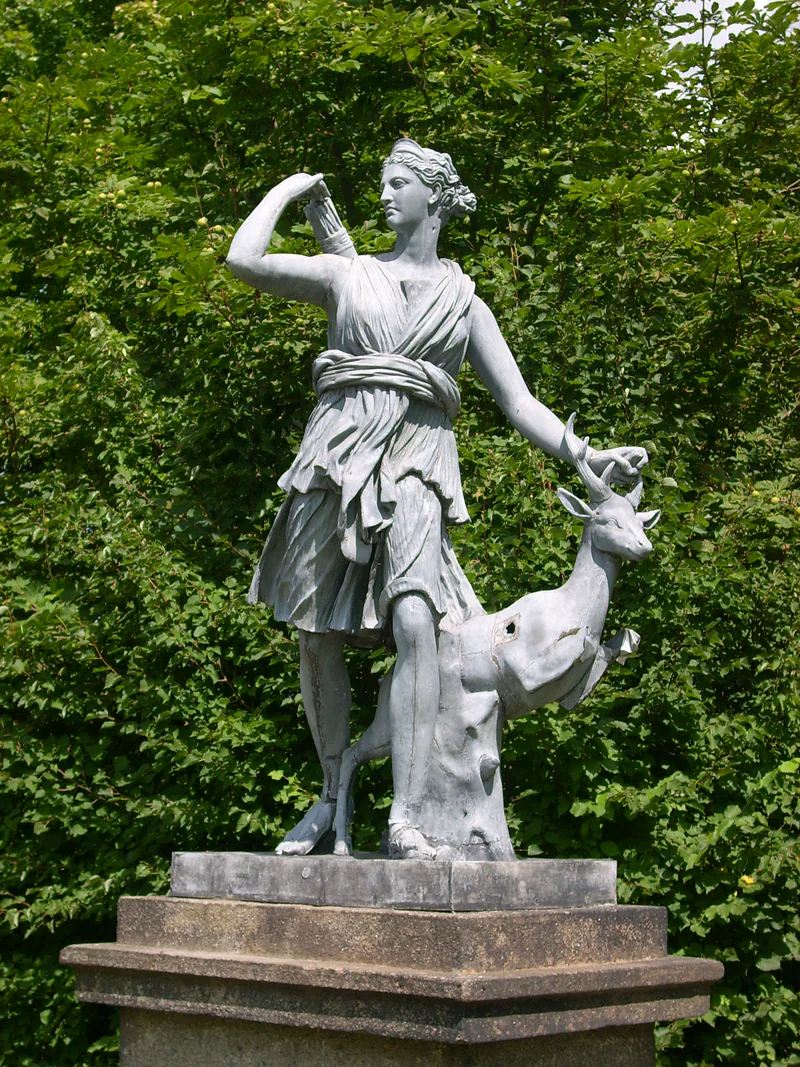
Certain goddesses are especially prominent across modern witchcraft. Hecate, the Greek goddess of crossroads, torches and magic, is honoured as a patroness of witches, a role she held already in ancient literature, where Medea is her priestess. Diana, the Roman huntress and moon goddess, entered witch lore through the medieval Canon Episcopi, which condemned women believing they rode at night with her, and through Leland's Aradia. Isis, whose cult spread across the Roman Empire, has been honoured by esoteric movements since the nineteenth century. Brigid links Pagan and Christian devotion, and her feast at Imbolc on 1–2 February is widely kept.

Ancient Evidence Versus Modern Interpretation§
Historians of religion have closely examined claims made about Pagan deities. Ronald Hutton's The Triumph of the Moon (1999) traced the Goddess and Horned God of Wicca to nineteenth- and twentieth-century Romantic literature and scholarship rather than to an unbroken ancient tradition. The idea that prehistoric Europe worshipped a single Great Goddess, advanced by the archaeologist Marija Gimbutas in The Language of the Goddess (1989), has been strongly criticised by other archaeologists, and Cynthia Eller's The Myth of Matriarchal Prehistory (2000) assessed it from a feminist perspective. Hutton's Queens of the Wild (2022) argued that medieval figures sometimes interpreted as surviving pagan goddesses, such as fairy queens, are better explained as later creations.
Many Pagans accept these findings and see their religion as a creative revival rather than a survival. As the scholar of religion Graham Harvey and others note, a tradition need not be ancient to be authentic to those who practise it. Reconstructionists, by contrast, place high value on fidelity to sources, and debates over historical accuracy are a lively part of Pagan culture.
Devotion and Practice: Offerings, Invocation and Relationship§
However they understand the gods, most Pagans relate to them through practice rather than doctrine. Common forms of devotion include household shrines with images and candles; offerings of food, drink, flowers, poetry or labour; prayers and hymns, some adapted from ancient texts such as the Orphic and Homeric Hymns; seasonal festivals honouring deities linked to the time of year; and meditation, trance or invocation in which practitioners seek direct encounter.
Many Pagans speak of a personal relationship with one or more patron deities, sometimes felt to have "called" them. Ethics of reciprocity, summed up in the Heathen formula "a gift for a gift", run through many traditions. For the wider context, see What Is Witchcraft? and Druidry.
Frequently asked questions§
Do Wiccans believe in one god or many?§
Many Wiccans are duotheists, honouring a Goddess and a God who encompass all deities. Others are polytheists who honour many distinct gods, and some regard the deities as archetypes or symbols. Wicca has no binding creed on the question.
Who is the Triple Goddess?§
The Triple Goddess is a modern Pagan image of the Goddess as Maiden, Mother and Crone, linked to the phases of the moon. It was popularised by Robert Graves in 1948. Ancient religions did have triple goddesses, such as Hecate, but not this specific universal scheme.
Which Norse gods do Heathens worship?§
Heathens commonly honour Odin, Thor, Freyja, Frigg, Freyr, Tyr and many other deities of Norse and wider Germanic tradition, together with ancestors and land spirits. Practice varies between groups.
Is the Horned God the Devil?§
No. In Wicca the Horned God is a deity of nature, animals and the cycle of life and death. Medieval Christian imagery gave the Devil horns, and Margaret Murray argued that a pagan horned god had been demonised, but modern witches do not identify their god with Satan.
Sources and further reading§
- The Triumph of the Moon: A History of Modern Pagan Witchcraft — Ronald Hutton, 1999
- Queens of the Wild: Pagan Goddesses in Christian Europe — Ronald Hutton, 2022
- The White Goddess — Robert Graves, 1948
- The God of the Witches — Margaret Murray, 1931
- Drawing Down the Moon — Margot Adler, 1979
- Contemporary Paganism: Listening People, Speaking Earth — Graham Harvey, 1997
- The Myth of Matriarchal Prehistory — Cynthia Eller, 2000
- The Prose Edda — Snorri Sturluson, c. 1220