Liber XV · History & Scholarship · Chapter IV: Periods & Movements
Periods and Movements in the History of Western Esotericism
The main periods and movements of Western esotericism, from late antique Hermeticism and the Renaissance to Rosicrucians, occultism and the New Age.

The history of Western esotericism is usually divided into a series of periods: the late antique foundations of Hermeticism, Gnosticism and Neoplatonism; the medieval transmission of astrology, alchemy and magic; the Renaissance revival of "ancient wisdom"; the Rosicrucian, Paracelsian and theosophical currents of the seventeenth century; the Masonic and illuminist eighteenth century; the occultism and Theosophy of the nineteenth; and the new religious movements and New Age of the twentieth. Each period reworked inherited ideas in response to its own religious and scientific context.
Late antiquity: the foundations§
The first centuries of the Common Era, in the cosmopolitan world of the Roman Empire, produced most of the texts later esotericists treated as foundational. In Roman Egypt, Greek-speaking authors wrote the Hermetica attributed to Hermes Trismegistus; see What Is Hermeticism?. Gnostic teachers developed myths of a hidden God and a flawed creator; see What Is Gnosticism?. Plotinus founded Neoplatonism, and his successors, guided by the Chaldean Oracles, embraced theurgy; see Neoplatonism and theurgy.
The same period saw the first alchemical writings, the Greek magical papyri and Jewish Merkavah mysticism. These traditions coexisted with emerging Christianity, which absorbed much Platonism while condemning Gnosticism and pagan ritual.
The Middle Ages: transmission and the occult sciences§
In the medieval period much of this inheritance survived in Byzantium and passed into Arabic, where philosophers, astrologers and alchemists developed it further. Arabic works such as the Picatrix, the Jabirian corpus and the Emerald Tablet reached Latin Europe through twelfth- and thirteenth-century translations, creating the medieval "occult sciences" of astrology, alchemy and image magic; see astral magic and the history of Western alchemy.

Medieval Jewish Kabbalah emerged in Provence and Spain in the twelfth and thirteenth centuries, culminating in the Zohar. In the Christian West, clerics copied Solomonic grimoires and ritual magic texts, while dualist movements such as the Cathars drew on older traditions. Some scholars treat these as part of esotericism proper; others regard them as its prehistory. The Catalan philosopher Ramon Llull (c. 1232–1316) devised a combinatory "Art" for demonstrating religious truths, later read as an esoteric system, and the Byzantine scholar Michael Psellos (eleventh century) studied the Chaldean Oracles and Hermetic texts. Medieval learned culture debated which of the occult sciences were licit: astrology was taught in universities, alchemy was argued over by scholastics, and ritual magic was condemned as demonic.
The Renaissance: ancient wisdom revived§
The Renaissance is often regarded as the starting point of Western esotericism in the strict sense. In Florence, Marsilio Ficino translated the Corpus Hermeticum (1463) and Plato and promoted a prisca theologia, an "ancient theology" running from Hermes and Zoroaster to Plato and confirming Christianity. Giovanni Pico della Mirandola added Kabbalah to this synthesis, founding Christian Kabbalah, which Johannes Reuchlin developed.
These ideas fed into the learned magic of Ficino, Agrippa and Dee, the art of memory and the cosmology of Giordano Bruno. In 1614 Isaac Casaubon's redating of the Hermetica to the Christian era undermined the "ancient theology", but esoteric currents continued. Frances Yates's work made this period central to the modern study of esotericism.
The seventeenth century: Rosicrucians, Paracelsians and theosophers§
Three anonymous Rosicrucian publications, the Fama Fraternitatis (1614), the Confessio Fraternitatis (1615) and The Chymical Wedding of Christian Rosenkreutz (1616), announced a secret brotherhood of reformers and provoked hundreds of responses across Europe. They combined Lutheran reform, alchemy, Paracelsian medicine and apocalyptic expectation. Paracelsianism itself, the alchemical medicine and nature philosophy of Paracelsus's followers, became a major intellectual movement.
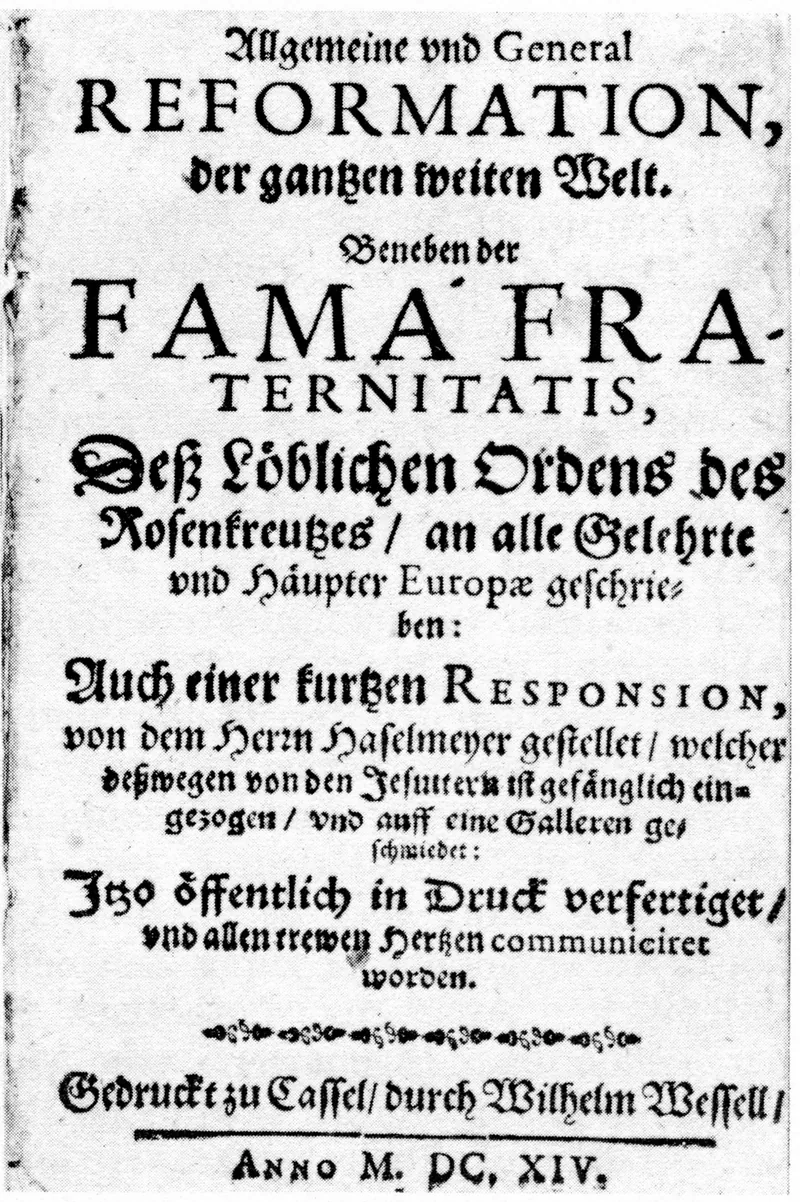
At the same time, Jacob Boehme created Christian theosophy, a visionary account of God, nature and the soul that inspired followers in Germany, England and the Netherlands. In England, Robert Fludd, Thomas Vaughan and the Cambridge Platonists engaged with these ideas, and alchemy remained a respectable pursuit for figures such as Robert Boyle and Isaac Newton.
The eighteenth century: Freemasonry, illuminism and mesmerism§
The Enlightenment marginalised much esoteric thought in learned culture, but esotericism flourished in new social forms. Freemasonry, organised in the Grand Lodge of London in 1717, spread rapidly, and continental lodges developed "higher degrees" with Templar, Rosicrucian, Hermetic and alchemical themes. Orders such as the Gold- und Rosenkreuz combined Masonic ritual with alchemical study.
Emanuel Swedenborg's visions of the spiritual world and his doctrine of correspondences found readers across Europe. In France, Martinès de Pasqually and Louis-Claude de Saint-Martin developed theurgic and mystical "illuminism". Franz Anton Mesmer's "animal magnetism", introduced in Paris in the 1770s and 1780s, launched a movement whose trance states and healing practices later fed into spiritualism and occultism. The century also produced celebrated adventurers such as Cagliostro and the Comte de Saint-Germain.
The nineteenth century: spiritualism, occultism and Theosophy§
The nineteenth century saw a large esoteric revival. Modern spiritualism began in 1848 with the rappings reported by the Fox sisters in Hydesville, New York, and spread through séances across America and Europe. Eliphas Lévi, writing in Paris in the 1850s, created modern "occultism" and the idea of high magic. The Theosophical Society, founded in New York in 1875 by Helena Blavatsky, Henry Steel Olcott and William Quan Judge, presented an ambitious synthesis of Western esotericism and Asian religions and moved its headquarters to India.
In Britain the Hermetic Order of the Golden Dawn (1888) systematised ritual magic, while France saw a lively occult revival around Papus, Stanislas de Guaita and Joséphin Péladan. The New Thought movement in America applied mesmeric and idealist ideas to healing and prosperity. Scholars describe this occultism as an attempt to reconcile esoteric traditions with modern science, evolution and a disenchanted world.
The twentieth century and beyond§
The twentieth century produced a profusion of esoteric movements. Aleister Crowley founded Thelema; Rudolf Steiner's Anthroposophy and Gurdjieff's Fourth Way offered new paths of spiritual development; René Guénon's Traditionalism rejected modernity in the name of a primordial tradition; and C. G. Jung's psychology reinterpreted alchemy and Gnosticism. From the 1950s, Gerald Gardner's Wicca and other forms of modern Paganism emerged in England; see Wicca and Gerald Gardner.
From the 1970s the New Age movement spread a popular, eclectic spirituality of channelling, healing, astrology and personal transformation, which Wouter Hanegraaff traced to esoteric roots. Chaos magick and other postmodern forms of occultism appeared in the late 1970s, and since the 1990s the internet has transformed how esoteric knowledge is shared. Scholars now also study the global spread of these currents and their interaction with non-Western traditions, a theme taken up in What Is Western Esotericism?.
Frequently asked questions§
When did Western esotericism begin?§
Its source texts date to late antiquity, especially the first to fifth centuries CE, but many scholars argue that esotericism as a self-conscious tradition began in the Renaissance, when Ficino and Pico created the idea of an ancient wisdom running from Hermes to Plato.
What was the occult revival?§
It was the surge of esoteric activity in the nineteenth and early twentieth centuries, including spiritualism, the occultism of Eliphas Lévi, the Theosophical Society and magical orders such as the Golden Dawn. It responded to modern science and secularisation by presenting esoteric knowledge as a higher science.
How is the New Age related to esotericism?§
Historians such as Wouter Hanegraaff have shown that the New Age movement of the 1970s and later draws heavily on earlier esoteric currents, including Theosophy, New Thought, spiritualism and Jungian psychology, combined with Asian religions and counterculture.
Sources and further reading§
- The Western Esoteric Traditions: A Historical Introduction — Nicholas Goodrick-Clarke, 2008
- Western Esotericism: A Brief History of Secret Knowledge — Kocku von Stuckrad, 2005
- New Age Religion and Western Culture — Wouter J. Hanegraaff, 1996
- The Rosicrucian Enlightenment — Frances A. Yates, 1972
- Access to Western Esotericism — Antoine Faivre, 1994
- The Occult World — Christopher Partridge, 2015