Liber XV · History & Scholarship · Chapter IV: Periods & Movements
Esotericism in the Enlightenment: Lodges, Seers and Magnetists
Esotericism in the Enlightenment: Christian theosophy, high-degree Freemasonry, Swedenborg, Martinism, mesmerism and Cagliostro in the Age of Reason.

Esotericism in the Enlightenment flourished in the very century that proclaimed the triumph of reason. Between about 1700 and 1800, Christian theosophers read Jacob Boehme, Freemasons invented high degrees full of Templar, Rosicrucian and alchemical symbolism, Emanuel Swedenborg described the spiritual world, the Martinists of Lyon practised theurgy, and Franz Anton Mesmer filled Parisian salons with magnetic cures. Historians now see these movements not as relics of the past but as part of the Enlightenment's own search for hidden laws of nature and spirit.
Esotericism and the Age of Reason§
The traditional picture set the Enlightenment against everything occult: Voltaire mocked miracles, the Encyclopédie explained nature mechanically, and witchcraft prosecutions ended. In Britain the Witchcraft Act of 1735 replaced the crime of witchcraft with that of pretending to magical powers. Yet the same century saw an extraordinary growth of esoteric societies and doctrines. Antoine Faivre called much of this world "illuminism", and the German historian Monika Neugebauer-Wölk, in the volume Aufklärung und Esoterik (1999), argued that Enlightenment and esotericism were often two sides of the same culture.
The connection lay partly in method. Esotericists shared the Enlightenment's appetite for system, experiment, secret knowledge of nature and universal brotherhood. They also offered something the official Enlightenment did not: an experience of the sacred outside confessional churches and a cosmos still alive with meaning. After the Renaissance synthesis had been undermined by Casaubon's redating of the Hermetica, eighteenth-century esotericism rebuilt itself on new foundations, above all Boehme's theosophy, Masonic ritual and the new science of electricity and magnetism.
Christian theosophy after Boehme§
The writings of the German shoemaker Jacob Boehme (1575–1624) became the scripture of a European network of "theosophers". Johann Georg Gichtel published a complete edition in Amsterdam in 1682 and led a small celibate community. In London, Jane Leade (1624–1704) recorded visions of the divine Sophia and inspired the Philadelphian Society of the 1690s. In Württemberg the Lutheran prelate Friedrich Christoph Oetinger (1702–1782) combined Boehme, Kabbalah, alchemy and Pietist devotion, and in England William Law turned to Boehme in his later works; the English edition associated with his name appeared after his death.
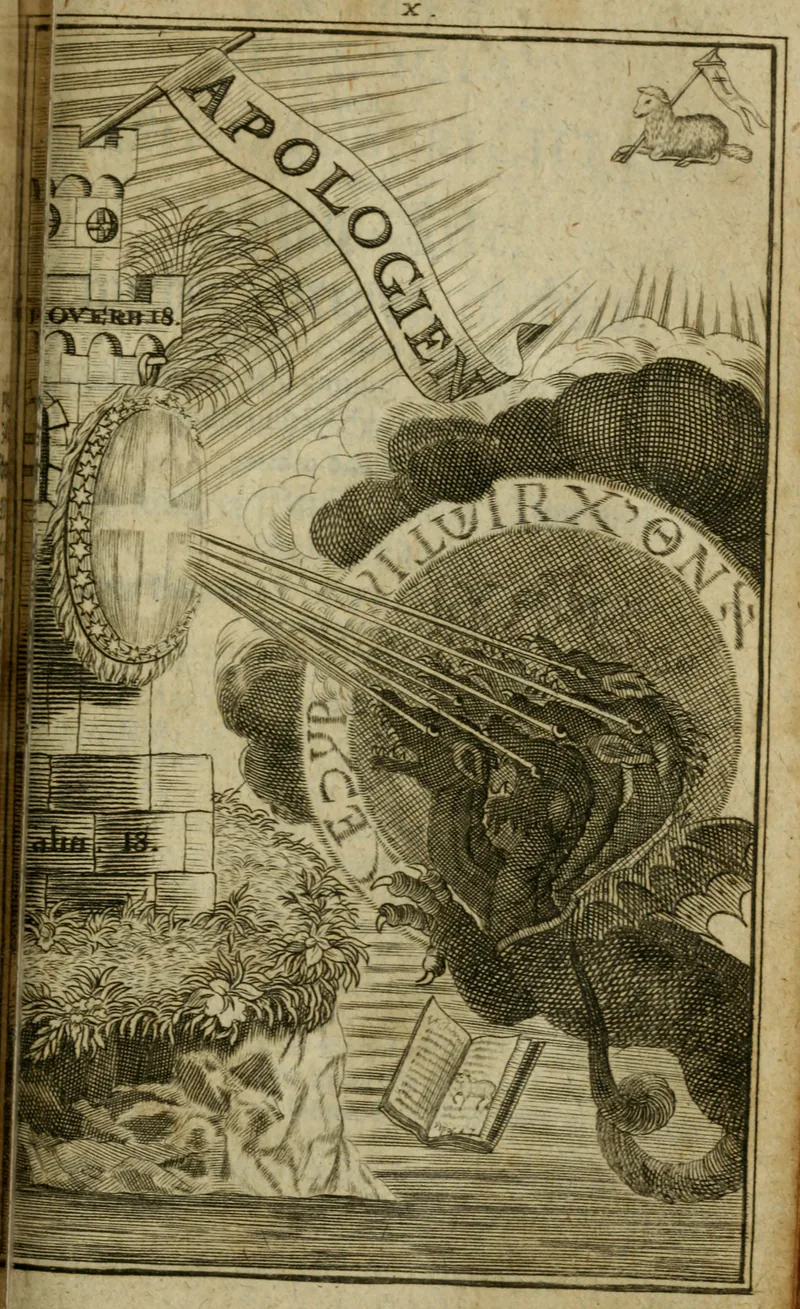
Theosophy in this older sense meant knowledge of God through the inner reading of nature and Scripture, not the modern Theosophical Society. It treated the divine as a living process, Wisdom as a feminine figure, and nature as a book of signatures. Faivre regarded it as one of the purest expressions of esoteric thought, and it fed directly into German Romanticism and Naturphilosophie.
Freemasonry and the high degrees§
The founding of the Premier Grand Lodge of London in 1717 and the publication of Anderson's Constitutions in 1723 created a new kind of association, open to men of different denominations and organised around initiation, symbolism and secrecy. Freemasonry spread across Europe within a generation. Its three craft degrees were moral rather than esoteric, but from the 1730s and 1740s, especially in France and Germany, members created higher degrees that claimed descent from crusading knights, the Templars or the Rosicrucians.
These "high degrees" became the main institutional vehicle of eighteenth-century esotericism. The Rite of Strict Observance, organised in Germany in the 1750s by Karl Gotthelf von Hund, claimed to continue the Knights Templar under unknown superiors; its legend collapsed at the Convent of Wilhelmsbad in 1782. The Gold- und Rosenkreuzer, the Golden and Rosy Cross, offered graded instruction in alchemy and theosophy and briefly gained influence at the Prussian court of Frederick William II. In France, Martinès de Pasqually founded the Élus Coëns, a Masonic order that practised a theurgical ritual for the reintegration of fallen humanity. His disciple Jean-Baptiste Willermoz shaped the Rectified Scottish Rite at Lyon in 1778, and his other disciple Louis-Claude de Saint-Martin, the "Unknown Philosopher", became the namesake of later Martinism. Not every secret society was esoteric: the Bavarian Illuminati, founded in 1776, were radical rationalists, although conspiracy literature later merged them with the occult lodges.
Swedenborg, Saint-Martin and the illuminists§
The most influential visionary of the century was the Swedish scientist Emanuel Swedenborg (1688–1772). After a religious crisis in the 1740s he devoted himself to describing heaven, hell and the spirit world, and to an allegorical exegesis of Scripture based on a doctrine of correspondences between natural and spiritual realities. His Arcana coelestia (1749–1756) and Heaven and Hell (1758) were read across Europe; Immanuel Kant felt obliged to answer him in Dreams of a Spirit-Seer (1766), and a New Church based on his teachings was organised in London in the 1780s.

Saint-Martin, whose Of Errors and Truth appeared in 1775, moved from his master's ritual theurgy toward an interior "way of the heart" and in his last years translated Boehme into French. Around such figures gathered an illuminist milieu of aristocrats, officers, physicians and clergy who sought direct communication with the spiritual world, sometimes through somnambulist mediums, angelic messages or alchemical work. Auguste Viatte later argued that these circles were among the hidden sources of French Romanticism.
Mesmerism, magnetism and the occult sciences§
The new physics of electricity and magnetism suggested that invisible forces might connect bodies and souls. The Viennese physician Franz Anton Mesmer arrived in Paris in 1778 and treated patients with his "animal magnetism", a supposed universal fluid. In 1784 royal commissions including Benjamin Franklin and Antoine Lavoisier concluded that its effects came from imagination, but the movement continued. The same year the Marquis de Puységur discovered "magnetic somnambulism", a trance in which subjects seemed to diagnose illness or see at a distance. Robert Darnton's Mesmerism and the End of the Enlightenment in France (1968) showed how mesmerism became entangled with radical politics on the eve of the Revolution.
Other occult sciences also took modern form. Antoine Court de Gébelin claimed in 1781 that the tarot preserved ancient Egyptian wisdom, launching the esoteric history of tarot, and the Parisian Etteilla soon published a divinatory method. Cheap printed grimoires such as the Grand Grimoire circulated in French popular literature, as Owen Davies has shown in Grimoires (2009).
Adventurers, critics and the making of "superstition"§
The century also had its celebrated adventurers. The Comte de Saint-Germain, who died in 1784 under the protection of Prince Charles of Hesse-Kassel, became a legend of the deathless adept. Giuseppe Balsamo, known as Count Cagliostro, founded an "Egyptian" Masonic rite in the 1780s, was implicated in the Diamond Necklace affair, and was arrested by the Roman Inquisition in 1789; he died imprisoned at San Leo in 1795. In England the chemist James Price claimed to transmute mercury into gold in 1782 and took his own life the following year when asked to repeat the experiment before witnesses from the Royal Society.
Enlightenment scholarship meanwhile created the categories that later excluded such figures. Wouter Hanegraaff has emphasised the role of Protestant historians of philosophy such as Jacob Brucker, whose Historia critica philosophiae (1742–1744) treated Hermetic, Kabbalistic and theosophical thinkers as corrupt "pagan" pseudo-philosophy. This classification helped turn esotericism into the "rejected knowledge" of modern culture. When the Romantics rediscovered Boehme, Swedenborg and magnetism after 1800, and when Francis Barrett published The Magus in 1801, they drew on an eighteenth-century inheritance that the Age of Reason had both nurtured and disowned.
Frequently asked questions§
Was the Enlightenment opposed to esotericism?§
Only in part. Many leading Enlightenment voices mocked magic and mysticism, but esoteric lodges, theosophical circles and magnetic societies grew in the same cities and often among the same educated readers. Historians now speak of an entangled relationship rather than a simple opposition.
What was illuminism?§
Illuminism is a term used by historians such as Antoine Faivre for the eighteenth-century milieu of Christian theosophers, Swedenborgians, Martinists and mystically minded Freemasons who sought direct illumination from the spiritual world.
Were the Bavarian Illuminati an esoteric order?§
No. Founded by Adam Weishaupt in 1776, they were an Enlightenment society that used Masonic forms to promote rationalism and reform. Their later reputation as occult conspirators comes from anti-revolutionary propaganda of the 1790s.
Why did mesmerism matter to later occultism?§
Mesmerism offered a scientific-sounding theory of invisible forces and trance states. Its somnambulists anticipated nineteenth-century mediums, and its fluid theory influenced spiritualism, occultism and the early history of hypnosis.
Sources and further reading§
- Access to Western Esotericism — Antoine Faivre, 1994
- Mesmerism and the End of the Enlightenment in France — Robert Darnton, 1968
- The Radical Enlightenment: Pantheists, Freemasons and Republicans — Margaret C. Jacob, 1981
- Aufklärung und Esoterik — Monika Neugebauer-Wölk (ed.), 1999
- Emanuel Swedenborg: Visionary Savant in the Age of Reason — Ernst Benz, 2002
- The Last Alchemist: Count Cagliostro, Master of Magic in the Age of Reason — Iain McCalman, 2003
- Grimoires: A History of Magic Books — Owen Davies, 2009
- Esotericism and the Academy: Rejected Knowledge in Western Culture — Wouter J. Hanegraaff, 2012