Liber XV · History & Scholarship · Chapter IV: Periods & Movements
Traditionalism: René Guénon and the Perennialist School
Traditionalism, the movement founded by René Guénon: the primordial tradition, critique of modernity, Schuon's perennialism, Evola's politics and its legacy.

Traditionalism is a twentieth-century esoteric movement founded by the French writer René Guénon (1886–1951), which holds that all authentic religions derive from a single primordial Tradition, that modern Western civilisation represents a catastrophic departure from it, and that the remedy lies in initiation into a living traditional path. Through Frithjof Schuon, Ananda Coomaraswamy and Julius Evola it developed both a religious "perennialist" school and a radical political current, and it has influenced scholars, converts, artists and ideologues across the world.
What Traditionalism is§
The historian Mark Sedgwick, whose Against the Modern World (2004) is the standard history, describes Traditionalism as built on three ideas. The first is perennialism: the conviction that a single transcendent truth underlies the great religions, which are different expressions of one primordial Tradition. The second is the necessity of initiation: metaphysical knowledge cannot be gained by reading alone but requires regular attachment to an orthodox religion and, within it, to an authentic esoteric lineage. The third is inversion: the modern world, with its individualism, materialism and faith in progress, is not the summit of history but its lowest point.
Traditionalists capitalise the word Tradition to distinguish it from customs in the everyday sense. They reject the label "esotericism" in the modern academic sense and disdain "occultism", Theosophy and spiritualism, yet historians place their movement firmly within the history of Western esotericism. Its idea of a primordial wisdom transmitted across ages is a modern form of the Renaissance prisca theologia, and its founder emerged from the French occult revival.
René Guénon: from Paris occultism to Cairo§
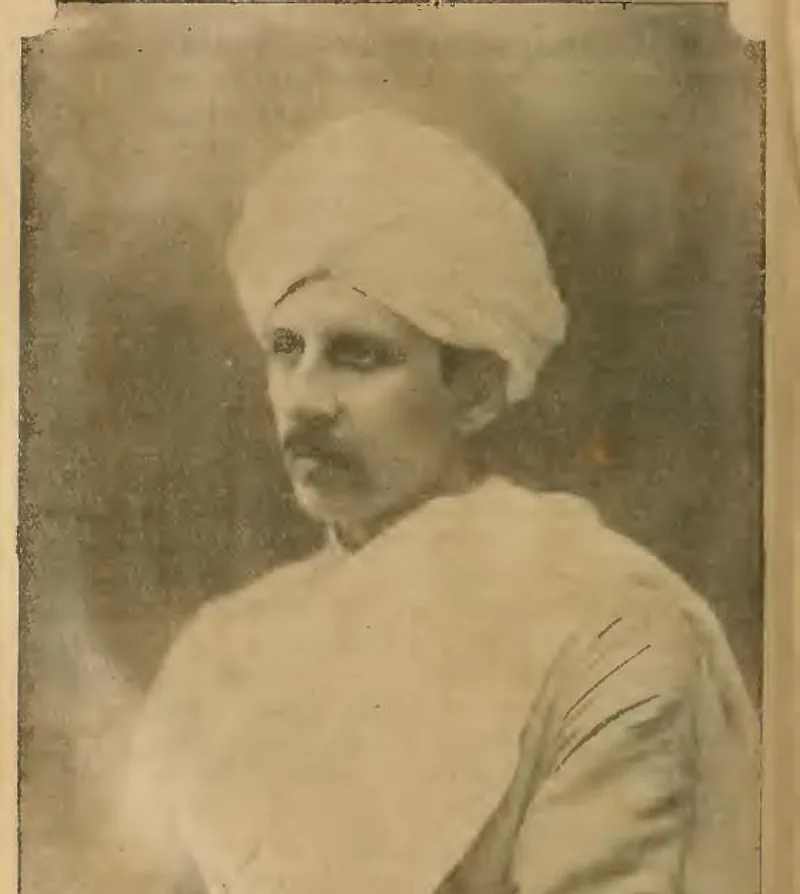
René Guénon was born at Blois in 1886 and came to Paris to study mathematics and philosophy. Around 1906 he entered the circle of Papus and his School of Hermetic Studies, joined the Martinist Order and several Masonic and quasi-Masonic bodies, and in 1908 founded a short-lived "Renewed Order of the Temple" on the basis of messages received in séances. He was consecrated a bishop of the small Gnostic Church under the name Palingenius and edited its journal La Gnose from 1909 to 1912. By about 1912 he had broken with this world and, according to most accounts, received initiation into a Sufi order through the Swedish painter Ivan Aguéli.
In the 1920s Guénon published the books that defined Traditionalism. Introduction to the Study of the Hindu Doctrines (1921), reportedly submitted unsuccessfully as a doctoral thesis, presented the Vedanta as pure metaphysics. Theosophy: History of a Pseudo-Religion (1921) and The Spiritist Error (1923) were sharp attacks on the Theosophical Society and spiritualism, which he regarded as counterfeits of tradition. East and West (1924), The King of the World (1927) and The Crisis of the Modern World (1927) set out his diagnosis of the West.
In 1930 Guénon travelled to Cairo and stayed for the rest of his life. He lived as a practising Muslim under the name Abd al-Wahid Yahya, married an Egyptian wife and raised a family. From Cairo he directed, through correspondence and articles in the journal Études traditionnelles, a growing network of European disciples. His late masterpiece, The Reign of Quantity and the Signs of the Times (1945), described modernity as the terminal phase of a cosmic cycle. He died in Cairo in January 1951.
The main ideas of Traditionalism§
Guénon's doctrine starts from metaphysics, by which he meant knowledge of the supra-individual principle, the Infinite, expressed in Hindu Advaita Vedanta, Taoism, Islamic Sufism and the esoteric dimension of every orthodox religion. Each religion has an exoteric side of law and dogma for all believers and an esoteric side reserved for those qualified for initiation. Esotericism, in this vocabulary, is not a separate tradition but the inner core of every tradition.
History, for Guénon, is a descent rather than an ascent. Borrowing the Hindu doctrine of cosmic ages, he held that humanity now lives in the Kali Yuga, the dark age, marked by the rule of quantity over quality and by the loss of sacred science. Modern philosophy since Descartes, Protestantism, democracy and materialist science were stages of this decline. Worse still were the "counter-initiation" and pseudo-spiritualities, among which he counted Theosophy and much modern occultism, that imitated tradition while subverting it. Only a restoration of genuine initiation by an intellectual elite could prepare for the end of the cycle.
Frithjof Schuon and the perennialist school§
The religious wing of Traditionalism was shaped above all by the Swiss-German writer Frithjof Schuon (1907–1998). In 1932 he travelled to Algeria and received initiation from the Sufi shaykh Ahmad al-Alawi of Mostaganem; he later led his own Sufi order, eventually known as the Maryamiyya, first in Lausanne and from 1980 in Bloomington, Indiana. His The Transcendent Unity of Religions (1948) argued that the religions differ in their exoteric forms but converge at the level of esoteric truth.
Around Schuon and Guénon gathered a remarkable group of writers, often called the perennialist or Sophia Perennis school. The Ceylonese-born art historian Ananda Coomaraswamy (1877–1947), curator at the Museum of Fine Arts in Boston, interpreted traditional art as sacred science. Titus Burckhardt wrote on alchemy, sacred art and Sufism; Martin Lings wrote a biography of the Prophet Muhammad and studies of the Sufi master Ahmad al-Alawi; Marco Pallis wrote on Tibetan Buddhism. The Iranian philosopher Seyyed Hossein Nasr and the American scholar of religion Huston Smith carried perennialist ideas into universities and popular books. Aldous Huxley's The Perennial Philosophy (1945) was not a Traditionalist work, but it spread a related vocabulary to a wide public.
Julius Evola and political Traditionalism§
A different reading of Guénon came from the Italian painter and philosopher Julius Evola (1898–1974). In the late 1920s he led the UR group, which published monographs on magic and initiation, and in 1931 he wrote The Hermetic Tradition, an interpretation of alchemy as spiritual discipline. His Revolt Against the Modern World (1934) accepted Guénon's history of decline but exalted the warrior and the sacred king over the contemplative priest. Evola sought influence in Fascist Italy and Nazi Germany and wrote on race in a spiritualised but openly racist register, while remaining an outsider to both regimes.
After 1945 Evola became an inspiration for parts of the Italian and European far right. Sedgwick and later historians have traced Traditionalist ideas in the thought of the Russian ideologue Aleksandr Dugin and in other radical political movements. This political legacy is a major reason why the movement attracts scholarly attention; it also shows how a doctrine of decline and hierarchy, presented as timeless wisdom, can serve very modern political projects.
Traditionalism and the study of religion§
Traditionalism had a wider intellectual influence than its small numbers suggest. Sedgwick argues that the historian of religions Mircea Eliade, who corresponded with Evola and read Guénon, absorbed elements of Traditionalist thinking, and that the "religionist" approach of the Eranos circle, including Henry Corbin, shared its search for a timeless sacred. Perennialist books on Sufism, Hindu metaphysics and sacred art reached many Western readers before academic studies did, and some Western converts to Islam came to it through Guénon.
Academic historians of esotericism, from Antoine Faivre to Wouter Hanegraaff, have generally treated Traditionalism as an object of study rather than a method, and have criticised the perennialist assumption that a single primordial truth can be found behind historical religions. For them, Traditionalism is itself a modern Western current, born in the Belle Époque occult milieu and shaped by the crises of the twentieth century, as described in our survey of periods and movements.
Frequently asked questions§
Is Traditionalism the same as the perennial philosophy?§
Not exactly. "Perennial philosophy" is an older term, used by the Renaissance scholar Agostino Steuco in 1540 and popularised by Aldous Huxley, for the idea of a shared wisdom behind religions. Traditionalism is a specific modern movement founded by Guénon that adds a doctrine of initiation and a radical critique of modernity.
Did René Guénon become a Muslim?§
Yes. Guénon received Sufi initiation around 1912, moved to Cairo in 1930 and lived there as a practising Muslim under the name Abd al-Wahid Yahya until his death in 1951. He held that each seeker should follow one orthodox tradition rather than mix several.
Why is Traditionalism controversial?§
Its religious wing is admired for its writings on comparative mysticism and sacred art, but it is criticised for an unhistorical view of religion. Its political wing, associated with Julius Evola, has inspired far-right movements, which has made the label contentious.
Sources and further reading§
- Against the Modern World: Traditionalism and the Secret Intellectual History of the Twentieth Century — Mark Sedgwick, 2004
- Introduction to the Study of the Hindu Doctrines — René Guénon, 1921
- The Crisis of the Modern World — René Guénon, 1927
- The Reign of Quantity and the Signs of the Times — René Guénon, 1945
- The Transcendent Unity of Religions — Frithjof Schuon, 1948
- Revolt Against the Modern World — Julius Evola, 1934
- The Perennial Philosophy — Aldous Huxley, 1945
- Traditionalism: The Radical Project for Restoring Sacred Order — Mark Sedgwick, 2023